
Find your Samba beat together
On udansa you will find dance enthusiasts in your area who have the Brazilian rhythm in their blood just like you. Make connections and take your passion to the next level.



By Mary De LucaUpdated
On udansa you will find dance enthusiasts in your area who have the Brazilian rhythm in their blood just like you. Make connections and take your passion to the next level.
The pulsating sound of a Brazilian bateria immediately captivates everyone. Yet, behind the seemingly wild energy lies a highly precise interplay of different instruments that mesh together like gears.
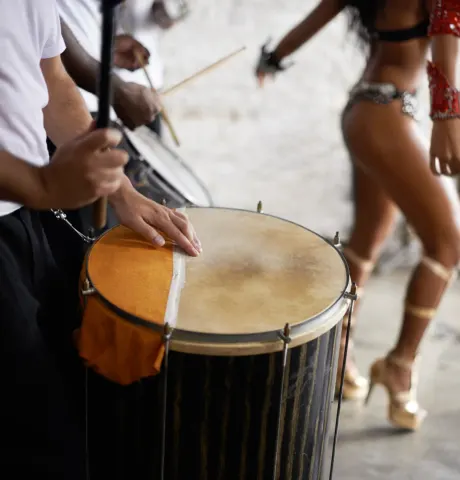
A bateria is the large percussion ensemble that provides the driving rhythm in Brazilian Samba schools. It consists of up to several hundred musicians playing various drums and percussion instruments.
At the center of every Brazilian samba school is the bateria, a massive percussion ensemble that impresses with its sheer volume and rhythmic precision. The structure of this orchestra is strictly hierarchically organized and follows a clear division, where each instrument fulfills a specific acoustic function. The deep foundations are laid by the surdos, while the bright, cutting sounds of tamborims and chocalhos decorate the rhythmic surface. Only through the seamless interplay of these different frequencies does the driving, dense sound emerge that has made the carnival famous worldwide.
The coordination of this apparatus is handled by the mestre de bateria, the conductor of the ensemble. They use whistles and hand signals to control cues, regulate the tempo, or initiate breaks. These breaks are rhythmic interruptions where the musicians fire off complex, syncopated phrases in sync before the entire ensemble returns to the powerful basic groove. To understand the music, it is crucial to perceive the bateria not as a disorganized drum group, but as a highly organized rhythm orchestra.
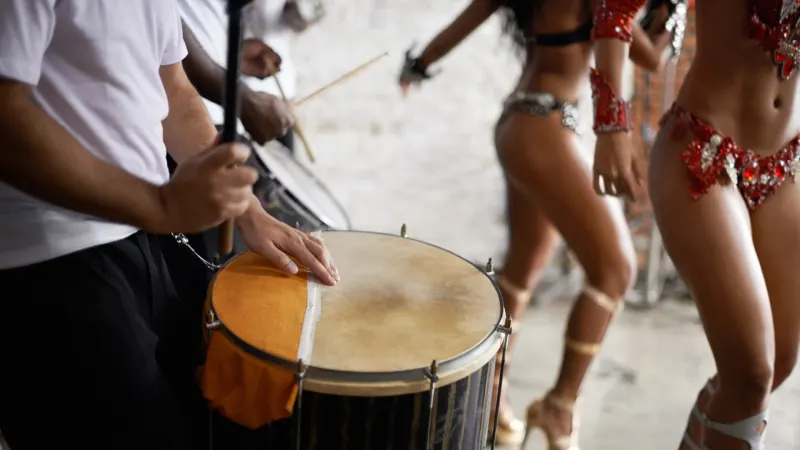
To understand the structure of Samba music, it is worth taking a closer look at the individual Samba instruments and their roles in the ensemble. The surdo, a large, low-pitched cylindrical drum, forms the heartbeat. It is usually played in three different sizes: the lowest surdo emphasizes the second beat of the bar, the middle one the first beat, while the smallest surdo, the so-called third surdo, cuts in between with syncopated patterns and provides the typical bouncy forward momentum.
Layered over this are the mid-range frequencies, which are significantly shaped by the caixa de guerra. This snare drum provides the rhythmic continuum with its dense, swirling snares, upon which the other instruments move. The repique de mão or repinique, a high-pitched drum played with a wooden stick and the bare hand, serves as a call instrument. The mestre uses its piercing sound to send signals to the entire group and to announce transitions.
The smaller Samba percussion instruments provide the unmistakable brilliance in the upper frequency range. The tamborim, a tiny, extremely tightly tensioned frame drum, is played with an elastic whip made of plastic rods. Its razor-sharp accents set the rhythmic highlights of the bateria. It is supported by the chocalho, a shaker with metal jingles that weaves a dense, silvery sound carpet, as well as by the agogô, a two-tone metal bell that contributes melodic accents. Together, these Samba rhythm instruments form a dense soundscape.
Perfect interaction
Common mistakes
Only when the deep surdos make the room palpably vibrate and the tamborims pierce through like needles, does the bateria unfold its true, magical power.
The unique character of the Samba rhythm is based on a subtle rhythmic shift, the so-called swing or groove. Unlike European march rhythms, which often fall very precisely on the beats, Samba thrives on a minimal delay of the second main beat. This tiny inaccuracy in the microsecond range is created collectively and intuitively by the musicians of the bateria. It gives the music its typical lightness and prevents the heavy sound of the large Samba drums from appearing static or stiff.
This phenomenon can be observed particularly well in the interplay between the deep surdos and the driving chocalhos. While the foundation provides the grounding, the metallic shaking of the rattles feels like it is pulling the tempo forward. Anyone who wants to dive deeper into the fascinating structure of this music will find valuable reference points in the Samba ultimate guide for beginners to better understand the various musical facets of the Brazilian national dance.
The rhythmic basis of the bateria
The surdos and caixas form the rhythmic foundation. They provide the steady pulse and the deep grounding upon which the entire ensemble builds securely.
The rhythmic ornamentation of the bateria
The surdo is the largest and deepest drum in the bateria. It establishes the rhythmic foundation and marks the characteristic heartbeat of Samba, which all other musicians follow.
A tamborim is a very small, high-pitched frame drum played with a flexible plastic beater. It produces extremely sharp, syncopated accents that structure the rhythm of the bateria.
The agogô is a two-tone metal bell played with a wooden stick. It adds a melodic component to the otherwise purely percussion ensemble and provides bright, clearly audible accents.
Find the right course and experience the fascination of the Brazilian rhythm yourself.
BallroomMeißen · Germany
Tanzkreis | PROFESSIONALTuesday · 20:15 · Oct 27, 2026 - Jan 5, 2027
“Ein Haus für Vieles” - Saal Tanzkurse
 History of Samba: The roots of the Brazilian heartbeatThe history of Samba is a journey full of rhythm, culture, and resistance. Discover the fascinating African roots and the instruments that shaped this global success.
 Dancing Samba: From Samba no Pé to competitive danceDancing Samba is pure joy of life. Learn everything about the fiery rhythm, the first steps, and how to get started successfully in our beginner's guide.History of Samba: The roots of the Brazilian heartbeatThe history of Samba is a journey full of rhythm, culture, and resistance. Discover the fascinating African roots and the instruments that shaped this global success.
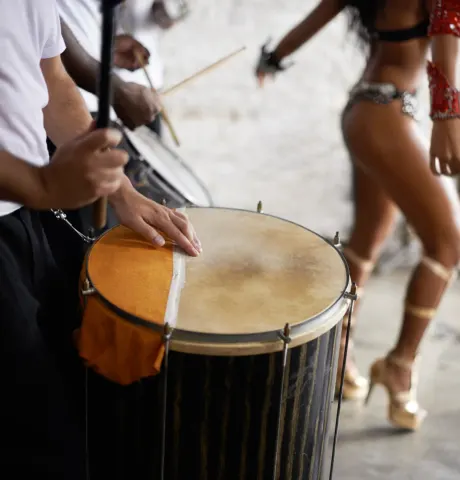 Counting Samba rhythm: How to hear the beatLearn step by step how to identify the Samba rhythm flawlessly and count the beat like a pro. No dance steps required, just for your ears.
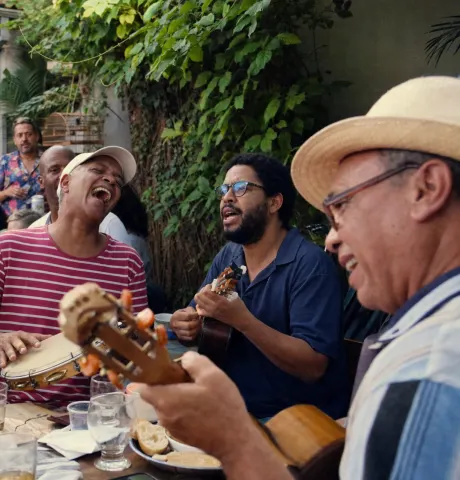 Samba music styles: From Pagode to Bossa NovaSamba is not just samba. Our guide leads you through the fascinating world of samba music styles, from wild Samba Enredo to elegant Bossa Nova.
 Which Samba style suits you? Take the testFind out which Samba subgenre best matches your musical taste with our quick test. Discover the variety from Bossa Nova to Pagode!
 Famous Samba Musicians: The Legends of RhythmDive into the world of the most famous samba musicians in history. Learn how Cartola, Clara Nunes, and other legends made the rhythm of Brazil immortal.
 Best Samba Albums of All Time: Milestones in Music HistoryDive into the golden era of Brazilian music. We introduce you to the most legendary Samba albums, milestones that changed music history forever.
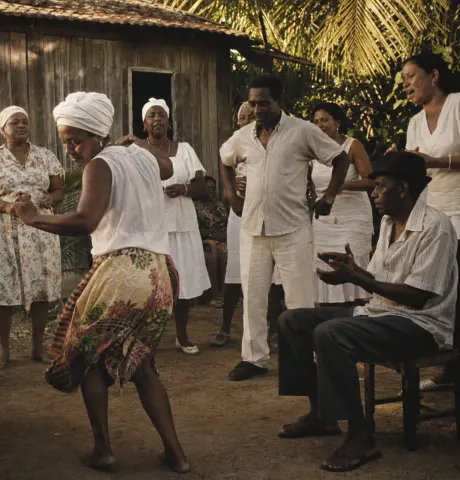 The history of Samba schools in Rio de JaneiroDive into the fascinating origins of the Samba schools in Rio de Janeiro. Learn how social protest and Afro-Brazilian rhythms evolved into a global cultural treasure.