

Find your rhythm together
On udansa you will find like-minded people and the best dance studios in your area to put your workout into practice. Sign up and strengthen your body together with others!

By Bernhard De LucaUpdated

On udansa you will find like-minded people and the best dance studios in your area to put your workout into practice. Sign up and strengthen your body together with others!
If you only think about stamina when dancing, you are missing the enormous power hidden in the fast rhythms. Zumba challenges your muscles in a completely new, three-dimensional way.
Deep muscles refer to the deeper muscle layers, particularly in the back and pelvic area, which are primarily responsible for stabilizing the skeleton and maintaining an upright posture. They cannot be consciously tensed, but react reflexively to instability.
Zumba is often perceived as pure cardio training, but this dance workout holds enormous potential for strengthening the entire body. Those who move regularly to Latin American rhythms quickly realize that the dynamic changes in direction and fluid transitions challenge the entire musculoskeletal system. Targeted Zumba strength training uses your own body weight and the centrifugal force of fast turns to keep your muscles under constant tension. Unlike classic equipment training at the gym, this does not train isolated muscles, but rather engages entire muscle chains in unison.
The deeper muscle layers especially benefit from the constant balancing acts. If you are wondering how best to build your Zumba for beginners routine, you should focus on core tension from the very beginning. By consciously maintaining your balance during fast steps like the Salsa basic step or the Reggaeton bounce, the deep muscles of the spine are permanently activated. This not only ensures an athletic posture, but also protects you from back pain in everyday life.
A look at the typical movement patterns shows why this workout is an excellent tool for toning muscles with Zumba. The secret lies in the combination of wide, sweeping steps and sudden stops. The classic focus on Zumba glutes, legs, and abs is no coincidence: squats, lunges, and hip rotations are firmly integrated into the choreographies. With every Cumbia step or Merengue hip sway, the gluteal muscles and thighs have to do heavy lifting to stabilize the body.
The abdominal muscles work as the emotional and physical center of every movement. Every isolation of the upper body, as found in Reggaeton or Bachata, requires extremely active core muscles. This dynamic core stability is often underdeveloped in everyday life. Those who train regularly strengthen the oblique and straight abdominal muscles without ever having to do a single sit-up on a mat. The constant rotation of the waist shapes a strong, resilient center.
Like this
Don't do this
The dynamic rotations in Zumba challenge the deep core muscles in a way that we can hardly achieve with classic strength equipment in the gym.
To maximize the effect for Zumba muscle building, it all comes down to intensity and conscious tension. While moving along loosely gets your cardiovascular system going, it only challenges the muscle fibers superficially. Only when you perform the movements with maximum range of motion do you provide the necessary growth stimuli. Go deep into squats and consciously pull your knees up high during jumps or fast steps.
If you have already gained experience and are looking for a new challenge, you can try special course formats like Zumba Toning, which use light weight shakers. But even in a classic class, you can control the intensity by consciously using gravity. A strong push off the floor with every step change activates the calf and shin muscles. If you want to dive deeper into the world of rhythmic movement, it is also worth taking a look at the comprehensive guide to Zumba, which shows you how versatile this workout can enrich your life.
Strength for big movements
The large muscle chains in the thighs, glutes, and upper back provide the necessary dynamics and power for big jumps and wide steps.
Protection and balance from the core
The tiny muscles along the spine and in the pelvic floor stabilize the body during quick turns and sudden stops.
Yes, Zumba is excellent for toning the body. The combination of dynamic steps, jumps, and hip movements continuously engages the muscles in your abs, legs, and glutes, ensuring a firm tissue structure.
In classic Zumba, you mainly work with your own body weight. For more intensive muscle building, formats like Zumba Toning are suitable, where light weights or dumbbells are integrated into the choreography.
To achieve noticeable effects on your deep muscles and core, training two to three times a week is ideal. This way, your body receives sufficient stimuli for adaptation while also having enough time for recovery.
Find the right studio and start your powerful workout.
ZumbaLimbach-Oberfrohna
ZUMBA® Fitness Clubrunning since Aug 18
Limbach-Oberfrohna
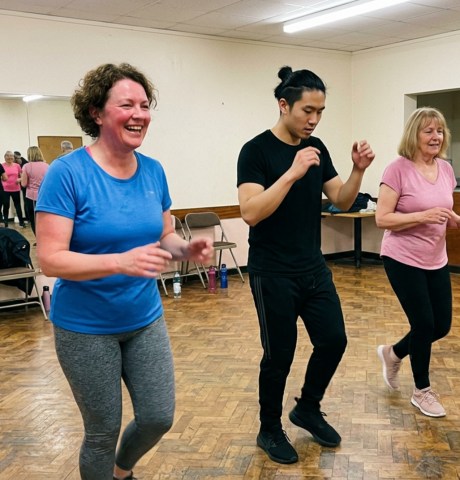 Zumba for beginners: The easy way to start your dance workoutGetting started is easy: With our beginner's guide to Zumba, you will learn about the most important formats and find out what to expect in your first class.
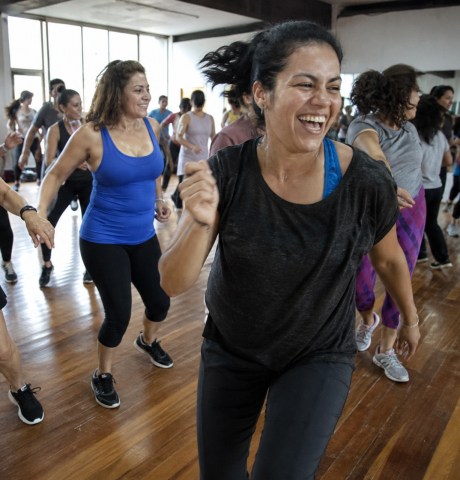 Zumba: The high-energy dance workout for every dayZumba combines Latin American rhythms with an effective full-body workout. Learn how to get started without any prior experience and which class format suits you best.
 Zumba Fitness: The effective workout for body and mindZumba Fitness is the perfect workout for anyone who loves to move and wants to improve their health at the same time. Find out how to get perfectly equipped here.
 Recovery after Zumba: How to help your muscles heal fasterGet back on the dance floor faster: With these targeted steps, your muscles will recover optimally after a Zumba workout, and you will effectively prevent muscle soreness.
 Zumba Fitness mistakes: How to train pain-freeIf you give it your all in Zumba, you risk aching joints due to minor posture mistakes. Learn how to correct the five most common movement errors immediately.
 Zumba during pregnancy: Training safely with a baby bumpZumba during pregnancy keeps you fit and boosts your mood. With the right low-impact adjustments, the workout remains perfectly safe for you and your baby.
 Zumba coordination training: More balance in everyday lifeA strong sense of balance and quick reactions are the best foundation for a safe everyday life. Learn how to train your coordination effectively and playfully with udansa and Zumba.
 Zumba Fitness Trends 2026: Wearables and New StylesFind out how smart wearables and the latest functional styles are revolutionizing Zumba training in 2026. The ultimate trend report for your workout.
 Zumba wear: The perfect outfit for your workoutThe right style for maximum energy: Learn how the perfect Zumba wear gives you maximum freedom of movement and keeps you comfortably cool.