

Zumba is even more fun together
On udansa you will find like-minded people in your city who share your passion for energetic workouts. Create your profile and find your perfect training partner for the next session!


On udansa you will find like-minded people in your city who share your passion for energetic workouts. Create your profile and find your perfect training partner for the next session!
The beat drives you, but at home the music often sounds flat or the neighbors knock on the wall. With the right adjustments, you can bring the club atmosphere directly into your living room.
Anyone who has ever been to a real Zumba class knows the feeling: the bass vibrates in your body, the melody carries you away, and the energy in the room is almost tangible. At home in front of the screen, this effect often fizzles out. The music sounds tinny, the steps feel stiff, and your motivation drops. This is rarely due to your skills, but rather the sound. To reproduce the real class feeling within your own four walls, you need to optimize your Zumba sound at home. It is not about spending huge amounts of money on expensive sound systems, but about setting up your existing technology cleverly and preparing the room acoustically.
The biggest challenge when training in your own four walls is the balance between maximum workout fun and good neighborly relations. In the dance studio, the bass can boom, but in an apartment, that quickly leads to frustration. Once you have put on your Zumba clothing and are ready to start, a targeted look at the frequencies will help you. High tones and voices carry the melody and the instructions, while the low frequencies set the rhythm. By specifically decoupling your speakers from the floor and aligning them correctly at ear level, you can drastically increase the perceived volume without the decibel levels going through the roof.
Place your speakers so that they form an isosceles triangle with your dance position. The tweeters should be at head height so that the sound reaches you without any obstacles.
Never place the bass speaker directly on laminate or parquet flooring. Use an elastic base, such as a rubber damping mat, to stop the transmission of structure-borne noise into the walls.
Open the audio settings on your phone or streaming service. Lower the frequencies below 100 Hertz slightly and boost the range between 1000 and 3000 Hertz to make voices clearer.
Start your favorite track from the Zumba music and bend your knees. If the sound surrounds you without the windows rattling, you have found the perfect volume.
Correct
Wrong
Preparation
Activation
Follow-up
Place the subwoofer on a washing machine vibration mat or a thick book. This prevents the vibrations from transferring directly to the floor and reaching your neighbors as a loud thumping sound.
The optimal Zumba music volume at home is around 60 to 65 decibels. This corresponds to a raised room volume, at which you could still hold a conversation without shouting, but which still captures you emotionally.
Yes, absolutely. You can manually adjust the frequencies using the equalizer app on your smartphone or streaming service. Lower the deepest bass and boost the mids to get a clearer sound immediately.
Experience the pure energy of Latin American rhythms live in class.
ZumbaLimbach-Oberfrohna
ZUMBA® Fitness Clubrunning since Aug 18
Limbach-Oberfrohna
 Zumba wear: The perfect outfit for your workoutThe right style for maximum energy: Learn how the perfect Zumba wear gives you maximum freedom of movement and keeps you comfortably cool.
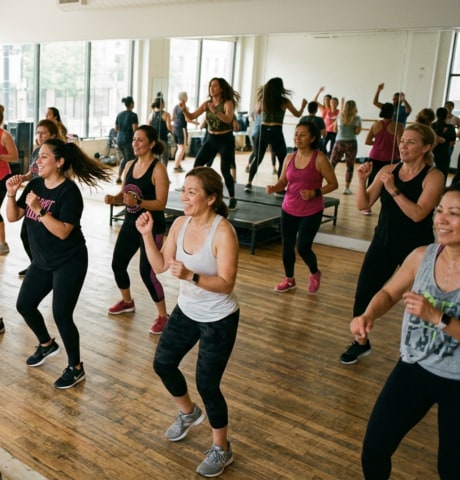 Zumba Music: The rhythms behind the workoutZumba music is much more than just a fast beat. Learn how different Latin American rhythms drive your workout and boost your fat burning.Zumba Music: The rhythms behind the workoutZumba music is much more than just a fast beat. Learn how different Latin American rhythms drive your workout and boost your fat burning.
 Zumba songs for warm-up and cool-down: The best tracksThe perfect framework for your workout: Discover the best slow Zumba songs to optimally warm up your body and help you wind down after training.
 Zumba vs. Jazzercise: Comparing the MusicLearn how the music styles of Zumba and Jazzercise differ. Our guide compares Latin polyrhythms with modern pop charts to help you find your perfect workout.
 Which Zumba rhythm suits you? The music quizFind out which music style best fits your training goals with our Zumba rhythm quiz. Take the test and get moving!
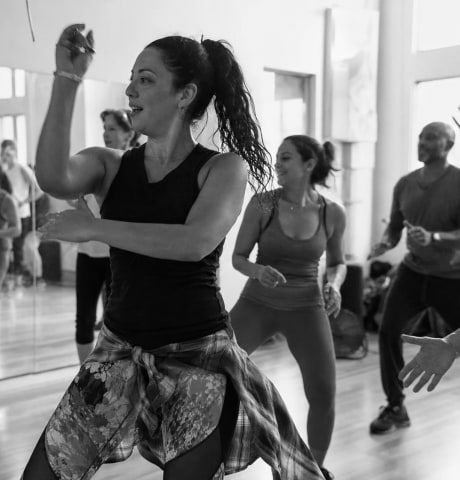 The 10 Best Zumba Songs: Classics for Your WorkoutAre you looking for the ultimate Zumba classics for your next workout? We present the ten most legendary songs that should not be missing from any class.
 Zumba Music Trends 2026: The Latest Beats for Your ClassMusic in Zumba classes is evolving rapidly. Discover the most exciting sound trends for 2026 and how they can enrich your workout.
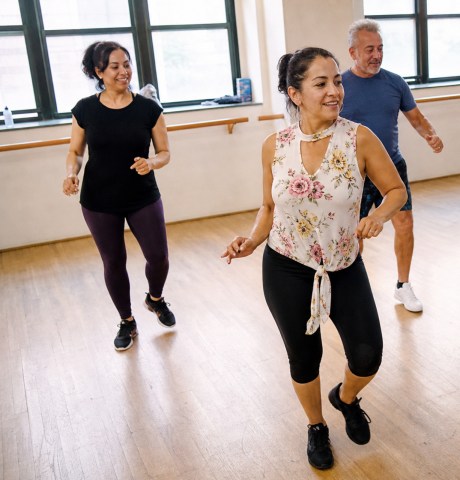 Zumba Cumbia: Understanding the Colombian rhythmDiscover the fascinating world of Cumbia in Zumba. This guide shows you how to understand the Colombian beat and master the signature steps with ease.