Experience stories together
On udansa connect, you can find people in London to talk about dance for the stage and arrange a theatre visit with.

By Mary De LucaUpdated
On udansa connect, you can find people in London to talk about dance for the stage and arrange a theatre visit with.
A well-known name on a program can obscure a long development. At Rambert, it begins with training and leads to the question of how individual trained people come together to create a shared artistic work.
A company is an artistic ensemble that develops and performs dance works together. The term refers to the group and its organized work, not the building where it rehearses or performs.
In 1919, Marie Rambert opened a dance school at Notting Hill Gate in London. A company later emerged from it. This brief historical connection tells us something essential: the starting point was a place of learning. However, it does not mean that a fully organised performing group already existed on opening day.
You can understand what comes together in principle through a simple classroom situation. Several people learn the same sequence of movements. They practise body alignment, shifts of weight and their relationship to the music. At first, what matters is whether each person can perform the movement. A stage work brings additional tasks: Who begins, who responds, who stays still, and how do individual entrances become a shared progression?
Training and company work have different goals, but one can build on the other. Classes develop skills; a company uses those skills to create works together. This explains the transition without claiming a particular teaching method or specific founding process at Rambert.
If you're new to London, this story offers you a way to understand dance venues and their history: behind a well-known name there may be an educational initiative, not just the founding of a theatre.
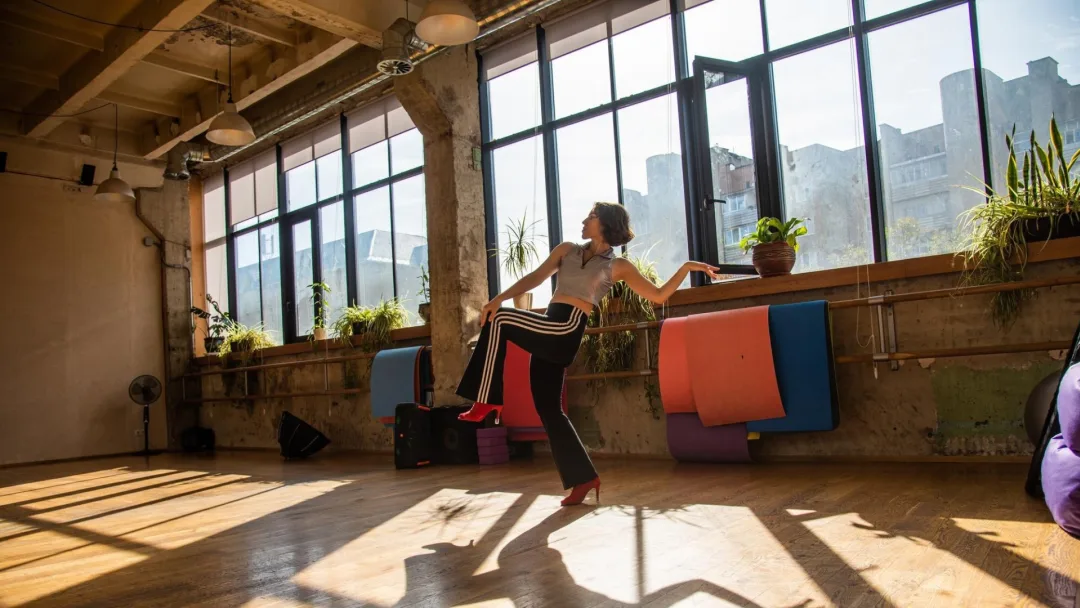
The company that emerged from Marie Rambert's school was based at the Mercury Theatre. This adds another kind of connection: a company needs spaces to work in, but remains distinct from those spaces. The recorded base connects Rambert's history with a theatre, without making the theatre and the company the same institution.
A theatre space fundamentally changes how movement is perceived. In a lesson, a teacher can come close and examine a foot position. On stage, a spatial choice must also be understandable from the audience. Distances, lines of sight, entrances and shared timing take on a different function as a result.
Imagine a group beginning the same arm movement one after another. In a practice room, this could be a coordination exercise. In front of an audience, the staggered timing could create a sequence: a movement visibly travels through the group. This is a general example of stage work, not a documented Rambert choreography.
The name Mercury Theatre therefore helps you place the story in a physical setting. By itself, it does not provide information about a current address, a current programme or which works were created there at a particular time.
So, yes
Not like this
If you’d like to try dancing yourself after reading the story, you can find dance classes in London on udansa.
A name can show continuity without every movement beneath it having remained the same over the decades.
In the commonly accepted account, Rambert is described as the oldest surviving dance company in the United Kingdom. This refers to institutional status. It concerns the continuation of a company, not the claim that its movements, works or ways of working have remained unchanged.
For your understanding of British dance history, this is an important distinction. A school can become the starting point for a long-term artistic structure. This structure can preserve its continuity while people change and new works are added. The shared name makes this development understandable; it does not replace looking at individual historical periods.
When watching, a specific description is therefore more helpful than the label “old company”. Pay attention to the relationship between movement and music: do the cues coincide, work against each other, or create a pause? Also observe whether the group forms a shared space or lets individuals stand out. These features describe a work, not automatically the entire history of its ensemble.
A single image can only show these relationships in part. The guide to common mistakes when observing dance movements explains how you can distinguish posture from movement sequence. Rambert’s origins remain the historical reference point, not an instruction for imitation.
Technique creates possibilities for movement
In class, coordination, body alignment, and musical timing are the focus. The same movement can be repeated until it becomes more controlled. From this perspective, the story begins with people developing their dance skills.
Movements Take on a Shared Context
In a company, skills come together in a shared performance. A movement gains meaning from its place among other movements, from encounters and from pauses. From this perspective, artistic work begins where the group brings decisions together.
No, the Mercury Theatre was the venue where the company that grew out of Marie Rambert's school was based. The theatre's name therefore refers to an institutional place. In this context, Rambert refers to the ensemble and its development, not simply a space.
A historical photo offers clues about posture and composition, but on its own it does not establish a complete dance style. It captures only a moment. It cannot show you a sequence of movements, transitions, tempo, music or the use of weight, even if the clothing and body position are clearly visible.
Repertoire refers to the selection of works a company has ready to perform or brings back. It is not the same as a list of steps the dancers have mastered. A work also includes its arrangement of movements, musical relationships, roles and spatial design.
No, you don't need to know ballet to understand Rambert's institutional development. It helps to distinguish between learning, collaborative creation of works and performance venues. Technical terms only become important when you want to describe specific movements or different choreographic styles in more detail.