Dance contacts6 minutes

Find German-speaking dance partners in Rome without knowing Italian

By Bernhard De LucaUpdated

In brief
  • You can use udansa to look for dance partners in Rome who want to use German as a shared language.
  • A language listing does not guarantee familiarity with dance terminology or the existence of a German-speaking group.
  • Before practicing, agree on words you both understand for directions, roles, breaks, and physical boundaries.
  • You can practice together without speaking Italian if explanations, questions, and stop signals are clear to both of you.

Find someone who speaks the same language to practice with

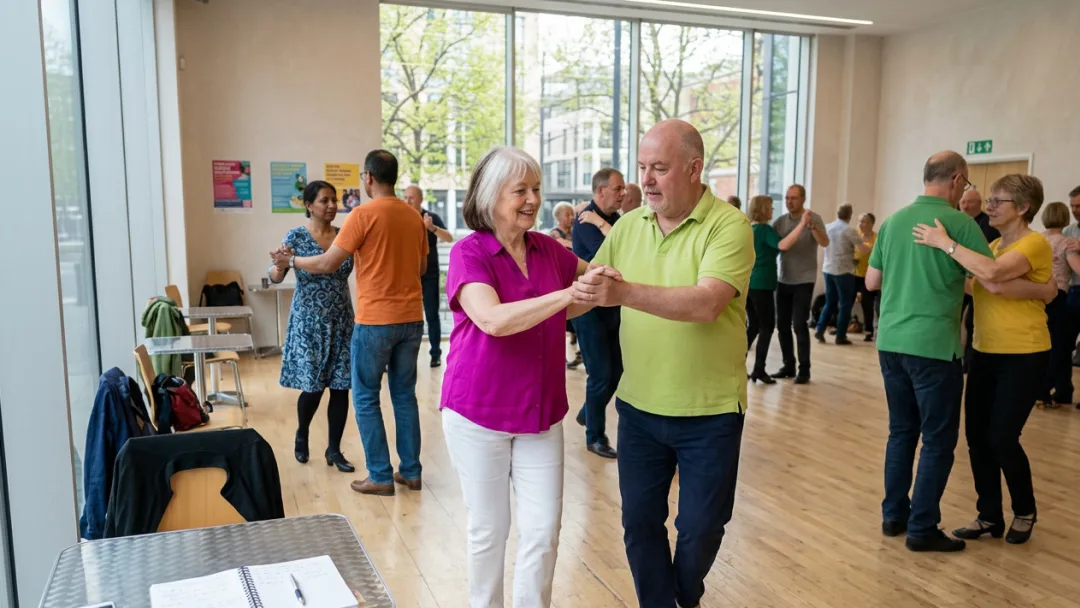
On udansa, you can search for dance connections in Rome and specify German as the language you’d like to share. You’ll only find out through personal conversation whether someone is available and understands enough German to practice.

Find someone who speaks the same language to practice with

When you can’t find the words in a foreign language, even a small correction becomes difficult. A contact you can talk to without the pressure of translating lets you focus more on the music, weight shifts, and the person you’re dancing with.

What you need for your search

  • Access to udansa to find contacts in Rome
  • A preferred dance style and dance role
  • An honest assessment of your German skills
  • Your actual proficiency in other languages
  • A specific practice goal, such as a basic step or turn

Conversation language and dance language are not the same

When searching in Rome, “speaks German” is a clue, not a complete description. Someone may be able to hold everyday conversations and still be unfamiliar with terms like “load,” “axis” or “counterbalance.” Conversely, an experienced dance contact may understand a movement after seeing it demonstrated, but need simple words to ask follow-up questions. What matters is whether you can explain a movement, recognize a misunderstanding and clearly state a boundary.

To assess this, distinguish between three situations: making arrangements, explaining things while practising and giving instructions in class. Sharing a language for meeting up does not automatically solve the other two. Even figure names used internationally do not guarantee understanding: the same name can refer to different details depending on the class. A person’s origin, name or place of residence also does not reliably indicate which languages they speak.

For how you present yourself publicly, see the guide to a dance partner profile for Rome; the page on writing to a dance contact covers how to structure a personal message. This page focuses exclusively on linguistic compatibility. A stated language preference can help with your search, but does not prove someone is available. If you can’t find a suitable contact on udansa, you can’t infer from that either the size or the existence of a German-speaking dance group in Rome.

The terms you write down stay the same between two practice sessions, even if you initially used them differently.

Seven steps to a shared practice language

  1. Define your own language needs

    Distinguish between “I’d prefer to speak German” and “I can only understand explanations in German.” Note whether you can use other languages for brief conversations. This makes it clear where a preference ends and a requirement begins.

  2. Focus your search on Rome

    Search udansa for dance connections in Rome and read any language information in the context of the person's dance preferences. Only count explicitly stated German skills; a profile line written in German may also have been translated.

  3. Assessing language skills without making assumptions

    Sort potential connections by whether their German skills are explicitly described or still unknown. Distinguish “a few words” from the ability to discuss movements. An unknown language level is initially an open question, not a reason to rule someone out.

  4. Get specific about your shared language

    State your needs in the conversation: “I need explanations and follow-up questions in German while practicing.” Let the other person describe what works well in German and what is difficult. A specific answer is more helpful than a simple “Yes, German is fine.”

  5. Verbally rehearse a movement

    Before agreeing to practice, use a simple example: “We shift our weight to the left and pause.” Your partner describes in their own words what they understand. This way, you notice unclear directions before they turn into physical impulses.

  6. Agree on stop signals and support

    Agree on clear words like “Stop”, “Pause” and “again”, complemented by an open hand as a visible stop signal. Agree to demonstrate movements slowly if anything is unclear. A pause must be possible immediately, without any additional explanation or justification.

  7. Document communication limits

    Note which explanations are possible in German and which aren’t. If you can only communicate about familiar basic steps, stick to those for now. If you don’t share a language for discussing boundaries or concerns, cancel practicing together rather than assuming you understand each other.

Dance classes in Rome for practicing together

You'll find options in Rome in the course filter, but a German-speaking dance contact doesn't guarantee instruction in German.

Avoid linguistic misunderstandings

Yes, like that

  • Explain one movement and one direction per sentence
  • Name left and right from the perspective of the person moving
  • Connect unfamiliar figure names with a movement
  • Describe corrections: “The step was too big”

Not like this

  • Packing multiple movements into one long sentence
  • Treating your own direction of gaze as self-evident
  • Using figure names as proof that you share an understanding
  • Correcting someone by saying “wrong” without naming the movement

Your language match checklist

Before the search

Needs

After the exchange

Review

After the First Practice

Review

Frequently Asked Questions

  1. No, your dance partner's country of origin doesn't matter for practicing together in German. What matters is that you understand explanations and personal boundaries. Someone can be fluent in German as an additional language. Conversely, a person's country of origin says little about whether they know your preferred dance terms or even want to practice in German.