Training Goals6 minutes

Dance Training in Vienna: From Practice to Preparing for Your Event

By Bernhard De LucaUpdated

In brief
  • Dance training in Vienna is tailored to your goal: joining in freely, performing a choreography or working through dance tasks.
  • For ball preparation, the Viennese Waltz, spatial awareness and finding shared steps again are especially important.
  • For a wedding dance, what matters is a reliable routine set to your chosen music, while entrance exams focus on the required movement repertoire.
  • Vienna's documented dance culture offers a range of points of reference, from the Quadrille to contemporary training.

A movement can feel successful in class and suddenly become shaky under different conditions. Your situation changes the task: Other people, unfamiliar clothing or an unfamiliar movement sequence each call for a different kind of confidence.

DefinitionTransfer

Transfer refers to the ability to apply what you’ve learned in dance training under changing conditions. This includes, for example, dancing a familiar step confidently to different music or with less space.

Preparing for a ball takes spatial awareness and a sense of direction

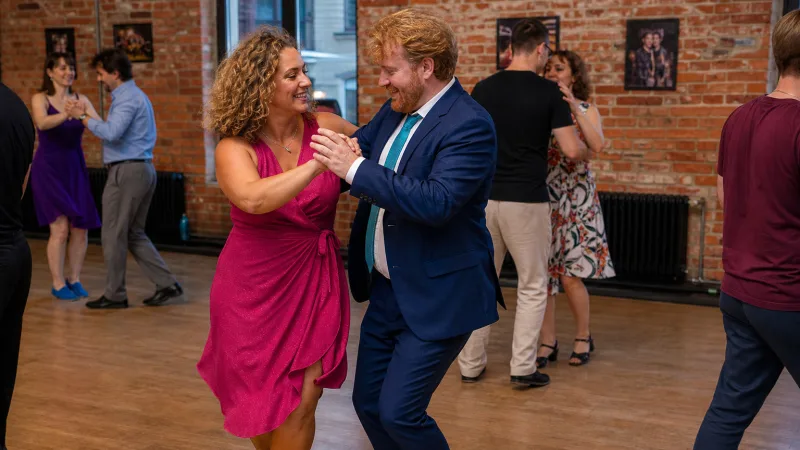
For your dance training in Vienna, the ball tradition is a concrete point of reference. The Viennese Waltz was added to Austria's list of intangible cultural heritage in 2017. The documented Vienna ball tradition also includes group dances such as the Quadrille. These involve different skills to prepare for: during the Waltz, you move through the room with your partner, while a Quadrille also requires you to orient yourself within a group sequence.

On an open practice floor, large turns are easier to execute. At a ball, however, you also need small steps, controlled changes of direction and the ability to interrupt a turn so you can continue safely. Your repertoire is only reliable when you can adapt it to the space available. Completing a full turn at every opportunity is not a useful training goal.

The Quadrille calls for a different kind of attention: you keep track of your position in the group and recognize when a new section begins. Learning in clearly separated sections helps more than trying to memorize one long sequence. You don't need to study ball etiquette in detail for this. For additional tips on your first formal dance event, see getting ready to dance at prom.
Bring the shoes you’ll wear to the event to practice too, because their soles affect turns and stops.

A wedding dance has to suit the situation you’re actually in

For a wedding dance in Vienna, the task isn’t automatically determined by ballroom tradition, but by the music you’ve chosen and how you want to present yourselves. A quiet dance with just a few transitions can work just as well as a fully choreographed routine. What matters is that the length, movements and clothing all work together.

A song version with a long introduction changes how you start. A cut in the music can make a transition you were sure of unusable. That’s why the final audio version is part of your preparation. Mark musical cues that you can use to find your bearings again: the start of the vocals, a clearly audible chorus or the final chord. When you’re feeling nervous, these kinds of anchors are often easier to recall than a long sequence of counted steps.

Also rehearse in a similar amount of space and in the shoes you plan to wear. A full skirt changes the distance between you, while a jacket can limit large arm movements. Lifts aren’t a necessary addition, and should only be practiced with professional guidance. If a movie scene inspires you, it helps to understand which dances from film and television you can learn on your own: camera effects and stage tricks aren’t a model for practice.

How to recognize training tailored to a specific occasion

Like this

  • Dance waltz turns with a smaller range of motion, too
  • Use the final version of the music for your wedding dance
  • Keep the specified details in exam tasks
  • After a mistake, continue with a move you know

Not like this

  • Practice Waltz turns only on a completely clear floor
  • Rehearse to a different version of the song each time
  • Replace an exam task with your favorite sequence
  • Start the entire dance over after every mistake

A successful rehearsal also shows how you find your way back into your dance after a moment of uncertainty.

udansa editorial team

Artistic Goals Call for Different Training Tasks

Dance training in Vienna also includes preparation for artistic tasks. The documented history of contemporary dance provides concrete points of reference: Tanzquartier Wien opened in 2001 in the MuseumsQuartier. Its documented program included training and workshops for professional dance practitioners. ImPulsTanz began in 1984 as the Internationale Tanzwochen; its documented festival concept included workshops for different experience levels and free outdoor classes under the title Public Moves. These examples show different training contexts, but they are not a promise of current offerings or exam preparation.

For a dance audition, the published requirements of the specific program are what count. That is the one piece of information you should look up before beginning focused preparation. Set combinations, open tasks, and a prepared presentation all involve different requirements. A rehearsed choreography cannot replace the ability to quickly pick up unfamiliar movements.

With a combination, it is also important to retain details: direction, sequence, rhythm, and movement quality. In improvisation, you can develop an impulse further, for example by performing the same movement smaller, closer to the floor, or more slowly. Practice the type of task required, not just the performance you chose for yourself. Workshops can offer new movement experiences; they do not automatically replace focused preparation for the specific exam.

Two forms of confidence in dancing

Set

Find your way back into your routine

For a rehearsed performance

A set sequence gives you a sense of direction: you know the opening, transitions and ending. You feel confident when you can find your way back to the music even after missing a step, without having to start the whole choreography over.

Open

Responding to a New Task

For Changing Movement Conditions

An open-ended task requires you to make decisions while dancing: You respond to the space, music, or a movement cue. Confidence comes from staying attentive and being able to consciously change a simple movement, rather than running through a prepared sequence.

Frequently Asked Questions

  1. Yes, even as a beginner, you can prepare with a limited, reliable repertoire. The key is to be able to start, stop and keep going after a moment of uncertainty. A simple connection that works with different pieces of music will help you dance along freely more than many figures you only half know.

Dance training for your occasion in Vienna

On udansa, you’ll find current courses in Vienna to help you work toward your specific dance goal.

Your dance goal needs practice

On udansa, you can find dance partners in Vienna to practice with for your occasion. Describe your goal specifically, such as open Waltz rounds or a choreographed wedding dance.

Your dance goal needs practice