Dance guide5 minutes

Salsa in Dresden: A guide to courses, socials, and dance styles

By Mary De LucaUpdated

In short
  • Salsa in Dresden is danced primarily in two styles: Salsa Cubana with circular movements and Salsa on the line with precise alignment.
  • For free social dancing, smooth dance shoes with good pivot capability and reliable body tension are the most important foundations.
  • Beginners can find suitable courses and parties through targeted offers with partner rotation, to learn leading and following independently.

Between rhythmic clave beats and smooth turns, Salsa connects people on the dance floor. If you want to dance in Dresden, you benefit from making the right choice between Cuban circles and elegant line style.

DefinitionWhat is Salsa?

Salsa refers to a family of Latin American partner dances that are danced to Afro-Cuban music in 4/4 time. Characteristic features are the rhythmic sequence of steps on three beats with a short pause, as well as the dialogic interplay of impulse and reaction.

Choosing between Salsa Cubana and Salsa on the line

Anyone wanting to start Salsa in Dresden will quickly encounter two completely different dance concepts. The two styles differ noticeably in step patterns, posture, and spatial arrangement on the dance floor. If you stumble into your first class unprepared, you might end up learning a style that does not match your personal preferences at all. While Salsa Cubana is based on circular movements and is often danced in a more earthy, playful way, the linear style (often referred to as Cross Body Lead Style or New York or LA Style) moves precisely along a straight line. Making a deliberate decision before your first trial class will save you frustration during later social dancing.

For beginners in Dresden, it is recommended to watch short dance videos of both styles in advance or to attend a non-binding trial class. Salsa Cubana delights people who appreciate spontaneous turns and the dynamics of a shared group choreography. The linear style appeals to dancers who prefer clear lines, athletic turns, and show figures. Both styles have their own music selection and dynamics. Taking a look at current offers helps you choose the classes that match your own vision.

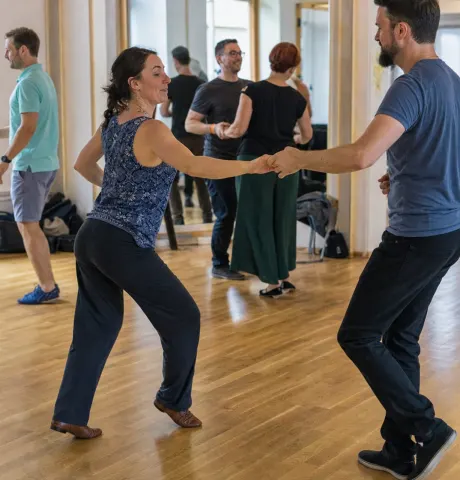
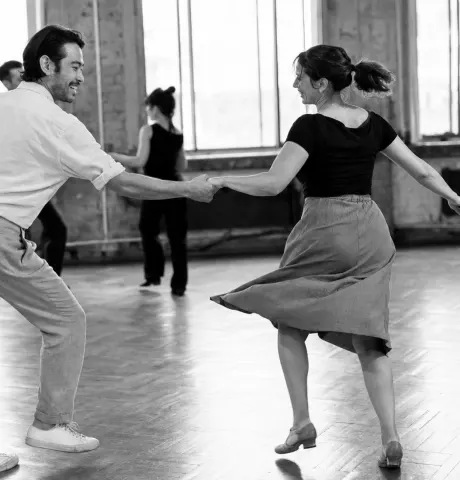
A couple dancing Kizomba, Tango, Salsa, or Bachata together
On crowded dance floors, controlled steps and mutual consideration ensure a smooth dance for everyone.

Preparing for your first social dance event

Getting started in Dresden is usually easiest through social dance evenings or specialized workshops. A typical Salsa club in Dresden is characterized by the fact that people come together without a fixed dance partner. Free dancing, away from fixed course structures, is the heart of the community. However, beginners in particular are often faced with the question of how to behave on such a dance floor without getting in the way of other couples.

On a busy floor, the principle of consideration applies: those who dance Salsa in a line stay strictly within their assigned dance corridor to avoid collisions. Because of their circular movements, Cubana couples often need a little more space on all sides, but they adapt their steps closely when it gets crowded. Anyone visiting a Salsa Party Dresden should not be afraid to approach other dancers. A friendly invitation is part of good etiquette, regardless of who is leading or following. Respectful interaction and good dance hygiene create the basis for a successful evening of dancing.

Tips for a successful start in the Salsa scene

How to get started successfully

  • Decide in advance whether the focus is on Cubana or linear style
  • Make sure to wear smooth soles to protect your knees and ankles during turns
  • Rotate partners regularly in class to learn how to truly lead and follow
  • Respect the space corridor of other couples when social dancing

Common misconceptions

  • Going into the first general social dance class without knowing the style
  • Trying to force fast multiple turns while wearing sneakers with high grip
  • Practicing only with one fixed partner and not understanding signals from others
  • Performing space-consuming acrobatic moves on a crowded dance floor

Salsa is not created in the head by memorizing patterns, but in the body by constantly listening to the rhythm and your partner.

Dance instructor for Latin dances

What matters when choosing a Salsa course

Anyone who admires the Semperoper Ballett: Dresden's top ensemble explained for the audience in a lasting way knows the importance of clean technique from the ground up. This applies equally if you want to learn Salsa in Dresden in a structured way. Classic partner dance courses in conventional dance schools often cover many standard and Latin dances superficially, but rarely dedicate themselves to the subtle lead signals of Salsa in detail. For noticeable progress, it is therefore worth choosing an offer that focuses specifically on Latin American rhythms.

When choosing your dance school, make sure that dance partners are changed regularly during class. Changing partners trains true leading and following far better than just adjusting to the quirks of a single person. Once you have refined your skills, you will also discover historical dance venues with tradition in the Saxon state capital: The listed Ballhaus Watzke in Dresden: Ballroom and dance history since 1898 impressively shows how deeply rooted dancing has been in Dresden for centuries. With a well-founded course, you lay the foundation to shine confidently on any dance floor.

Salsa styles in direct comparison

Cubana

Salsa Cubana

Circular and dynamic

The Cuban variant is characterized by round walking steps, close lead paths, and playful knot figures. It feels lively, earthy, and allows for plenty of rhythmic improvisation to Cuban Timba music.

Line

Cross Body Style

Precise and structured

The line style is danced on an imaginary straight line and emphasizes clean turns, clear stops, and elegant footwork. It is strongly oriented towards the brass sections of classic Salsa music and offers clear leading lines.

Frequently Asked Questions

  1. No, a fixed partner is not a requirement for Salsa courses and parties. In specialized courses, partners are rotated regularly, and at socials, asking people to dance freely is the standard.

Salsa courses and workshops in Dresden

Find suitable courses for your start or expand your figures in social dance.

Find your connection for Salsa

On udansa you can find dance enthusiasts for Salsa in Dresden as well as current dates for socials and courses in the city area. Enter your preferred role and arrange to meet directly for the next dance floor.

Find your connection for Salsa

Read more