Urban Dance5 minutes

Dancehall in Frankfurt: Rhythm and Isolation

By Bernhard De LucaUpdated

In short
  • In Frankfurt, when comparing courses, it’s worth looking at musicality and isolation technique.
  • Dancehall often uses changing Dancehall rhythms and a pronounced bounce, while Reggaeton usually follows the Dembow pulse.
  • Both styles train body isolations, where the chest, shoulders, or pelvis move independently on purpose.
  • A good introduction combines musical listening, controlled repetition, and movement, rather than just copying a quick choreography.

The music provides the impulse, but not every movement has to happen at the same time. Being able to distinguish between these two layers helps you better understand what you practice in class and which course is right for your starting point.

DefinitionIsolation

Isolation refers to a movement in which one area of the body is deliberately moved while the others remain as still as possible. In dance training, you might practice controlling your rib cage, shoulders, and pelvis independently.

In Frankfurt, musicality matters in class

Dancehall and Reggaeton often come up side by side in conversations about urban dance styles. Still, when choosing a class, it helps to pay attention to how the music is used: Dancehall can draw on different rhythms and accents, while Reggaeton is often oriented around the Dembow pulse. This is a broad musical guide, not a strict rule for every choreography.

A class should give you the chance to listen to the rhythm first and then translate it into movement. Pay attention to whether the teacher explains where an accent falls, how to maintain the bounce, and how a movement can change when the track changes. This helps you see whether the class teaches technique or mainly rehearses a set sequence.

If you're weighing up other styles, check out the overview of dance styles in Frankfurt. For Dancehall and Reggaeton themselves, it's best to ask directly about music examples and the focus of the class. You can find current local classes using the course filter.
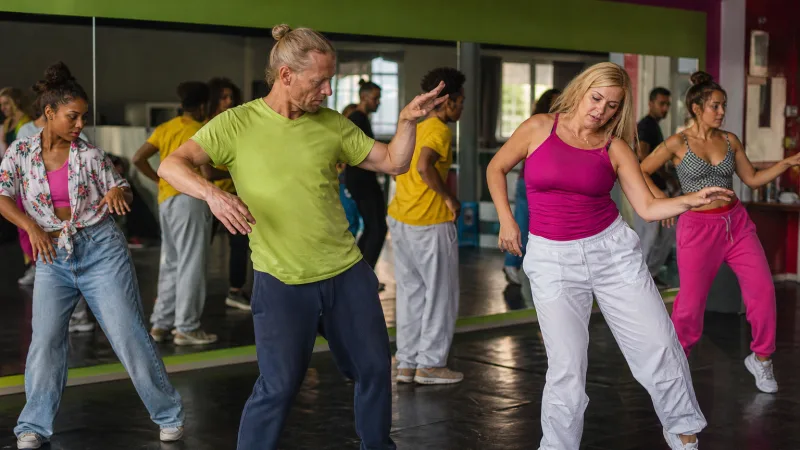
Professional dancers in a dance class in a studio
When your rib cage and pelvis don't move outward at the same time, the rhythm becomes more precise rather than bigger.

Isolation makes small movements easier to understand

Isolation is not about wiggling as much as possible, but about deliberate separation: one area of the body moves while the others remain stable or simply keep the basic pulse. At the beginning, the focus is often on the rib cage, shoulders, and pelvis. For example, you can move your rib cage back and forth without moving your pelvis, then connect the movement with a steady bounce.

The difference becomes clear when you practice: when everything moves at once, accents get blurred. A smaller, controlled movement makes it easier to see which body part is responding to which impulse. That does not mean your posture should stay rigid. Stability simply gives the moving area a clear point of reference.

So when looking for a class in Frankfurt, it is worth asking whether isolations are introduced one at a time and practiced repeatedly. The guide to finding the right dance school can help you check the focus of the classes before signing up. A trial lesson can also show whether the explanations and pace are easy for you to follow.

Distinguishing rhythm and body control

That's right

  • Keep the bounce at the basic tempo and add accents consciously
  • Move your rib cage or pelvis on its own while keeping the rest of your body stable
  • Practice slowly first, then connect the movement to the music
  • Listen for different accents in the track instead of guessing the steps

Not like this

  • Mark every accent with a big full-body swing
  • Let your chest, shoulders and pelvis swing out at the same time
  • Increase the tempo before you can perform the movement with control
  • Impose a fixed sequence of steps on the track's rhythm

If you hear the beat first and then choose the body part, even a small movement becomes easy to read.

Dance instructor for urban dance styles

Beginner courses combine technique and choreography

In a good introduction, foundational technique and practical application complement each other. First, you listen to the beat, learn a simple bounce or a single isolation, and try it out in short repetitions. Then the teacher can combine several elements into a short phrase. This helps you notice whether you’re controlling the movement yourself or just trying to follow others as quickly as possible.

Also pay attention to how corrections are given. A helpful explanation clearly identifies which part of the body should be working and what should stay stable. If you feel pain, don’t force any movements, and talk to the teacher. A small range of motion is perfectly fine at first, as long as you maintain the rhythm and control.

If you don’t have much time, you can look for a compact introduction such as a weekend course in Frankfurt. Check the course description to see whether Dancehall or Reggaeton is actually taught, since general urban dance classes can cover different content. The name alone doesn’t tell you how much technique is included.

Two Musical Approaches in Training

Dancehall

Recognizing accents and bounce

The groove can change within a track.

Dancehall training is about connecting the bounce to the rhythm and recognizing accents. A class can respond to different musical cues instead of repeating just one continuous sequence of steps.

Reggaeton

Feel the Dembow Pulse

A distinctive basic pulse organizes the movement.

Reggaeton is often approached through the Dembow pulse, which provides clear rhythmic guidance. In class, you can practice small steps and isolated movements without marking every beat with a big action.

Frequently Asked Questions

  1. No, you can learn many of the basics without any dance experience. The important thing is that the class builds movements step by step and lets you practise at your own pace to start with. Ask in advance whether the class is designed for beginners and whether it focuses on choreography or technique training.

Dance classes in Frankfurt

Compare current classes and dates in Frankfurt using the course filter, and look for rhythm work and isolation technique.

Find your rhythm for the course

On udansa, you can compare dance classes in Frankfurt and look for an option that covers Dancehall or Reggaeton and the right level for you.

Find your rhythm for the course