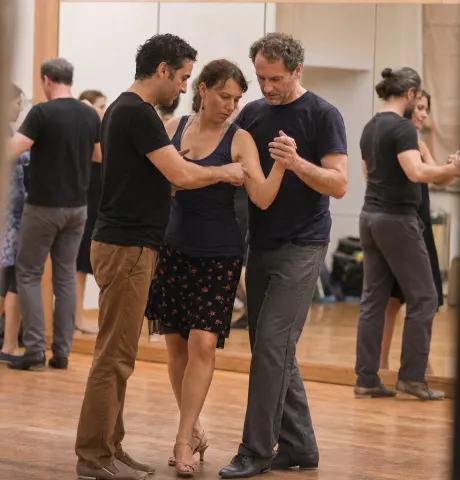
Partner Dance5 minutes

Discofox in Hamburg: Basic Step, Music and Turns

By Bernhard De LucaUpdated

In short
  • In Hamburg, Discofox works especially well when you keep the basic rhythm small and steady.
  • The basic step is often taught as a sequence of two weight changes and a tap.
  • A clear, steady beat helps you recognize Discofox music and dance the step without rushing.
  • In tight spaces, keep your steps compact; turns require eye contact and enough room for other couples.

Discofox is often the dance that gets a party moving spontaneously. Especially when the music changes, a reliable basic step is more helpful than a long sequence of figures.

DefinitionTap Step

The tap step is a brief foot contact without fully transferring weight. In Discofox, it often completes a basic step sequence and prepares for the next weight shift.

The Discofox basic step stays deliberately compact

Discofox can be danced at many celebrations because the basic movement requires little space and can adapt to different tempos. In Hamburg, this practicality is a good reason not to confuse the basics with complicated figures: the core is a steady transfer of weight in time with the beat.

A common beginner count is “one, two, tap.” You take two steps and tap with your free foot without shifting your full weight onto it. Then the sequence starts again with the other foot. Depending on the class, the count may be named differently or the tap may be explained differently; what matters more than the word is that you keep feeling the rhythm.

Start by practicing without turns and with little travel. Keep your knees and upper body relaxed, and make sure your steps do not reach too far forward. Add a simple turn only once both partners can keep the basic step confidently. This keeps the movement clear even when the floor is crowded or the music gets faster.

Small steps leave the couple room for a turn and let others on the dance floor move freely.

The Beat Matters More Than the Music Genre

Discofox is danced to many different kinds of songs. Instead of relying on a genre, listen for the steady pulse: if you can count along evenly and repeat the basic step in a relaxed way, the tempo is probably a good fit. A fast song is not automatically danceable if the beat is hard to follow.

A common misconception is that you have to respond to every musical accent with a new figure. This makes the dance hectic and makes it harder to stay in sync. It’s better to stick with the basic step until you give or notice a clear cue for a turn. Even when a song has distinct pauses, the couple doesn’t need to add an elaborate variation right away.

When listening to music, you can mark the pulse with your hand or foot and then add the step sequence. At a dance school or a social dance event, it’s worth asking what music is used in class and whether the tempo is adjusted for beginners. For more tips on choosing a course format, see the overview of dance course formats in Hamburg.

Basic step with feeling instead of force

That's right

  • Shift your weight clearly with every step
  • Place the tap lightly and without pressure
  • Lead with a calm impulse and eye contact
  • Keep track of your own space during the turn

Not like this

  • Move your feet without shifting your weight
  • Make the tap a forceful stomp
  • Pull your partner by the arm
  • Execute turns even when the path is blocked

When both partners hear the beat and keep their steps small, even a crowded dance floor feels manageable.

Partner dance instructor

On the dance floor, shared awareness matters

Discofox is often danced in changing spaces, from dance venues to festival tents. The floor, the available space, and the number of other couples can vary. That’s why it helps to think of figures as options, not as a required routine. When space is tight, the basic step is a complete way to dance.

Leading doesn’t mean pushing the other person’s body around. A clear signal gives them time to respond; following doesn’t mean being passive, but rather picking up the rhythm and balancing your own movement. Either person can make a figure smaller or stop it if the path isn’t clear. When dancing with someone new, it’s best to agree on closeness and turns in a straightforward way.

If you want to practise in Hamburg, compare current course options using the course filter and look for information about beginner levels and practice time. A social dance evening can later help you apply what you’ve learned with different partners. The Introduction to Social Dance in Hamburg explains what to expect at these evenings. For a general overview of local styles, the page on dance styles in Hamburg is also helpful.

Two roles, one shared rhythm

Leading

An Impulse, Not a Command

The direction is prepared, not forced.

In Discofox, the leading partner signals a turn with a clear, small movement. If there is no impulse, it is better to stay with the basic step than to force the figure through.

Following

Pick up the beat and respond

Movement remains an individual choice.

The follower hears the rhythm and senses the impulse without anticipating every movement. This lets them respond to a clear lead and keep a turn smaller when space is limited.

Frequently Asked Questions

  1. Discofox works well with music that has an easily recognizable, steady beat. Pop, Schlager and many danceable songs often have this clear pulse. What matters is that you can pick out the beats and are not misled by the tempo of the vocals.

Discofox courses in Hamburg

Compare current Discofox courses in Hamburg and check whether the basic step, musicality and turns suit your level.

Find the right dance class for you

Once you understand the basic step, you can compare current Discofox classes in Hamburg on udansa. Look for a class where you can practice rhythm, connection, and turns at a level suited to your experience.

Find the right dance class for you