Folk dance5 minutes

Kathreintanz in Munich: Tradition and dance steps

By Mary De LucaUpdated

In a nutshell
  • The Kathreintanz in Munich traditionally marks the end of the Bavarian folk dance season on the Saturday before Advent at the Hofbräuhaus am Platzl.
  • Classics such as Waltz, Polka, Zwiefacher, and the historical Munich Française are played and danced.
  • Prior knowledge is not strictly required, as many dances are announced and demonstrated on site.
  • Comfortable clothing or traditional attire, as well as shoes with smooth soles for turning, make it easier to join in on the dance floor.

When the days get shorter in late autumn, Munich celebrates the last big party of the traditional dance season. Why the Kathreintanz connects generations and how you can join in even without a course.

DefinitionKathreintanz

The Kathreintanz refers to a traditional folk dance evening around November 25th, which used to mark the beginning of the pre-Christmas dance break. In Munich, it is maintained as an open folk dance evening by the Department of Culture and the Hofbräuhaus.

Customs for the end of the season before Advent

The Kathreintanz in Munich marks the official finale of the folk dance year. Its origin lies in the memorial day of Saint Catherine of Alexandria on November 25th. In previous centuries, the strict Advent fasting period began after this, during which public dance festivities and loud music were strictly prohibited. The saying "Kathrein stops the dance" summarizes this turning point. In Munich, this date is still celebrated today as a grand festival, where several halls in the Hofbräuhaus at the Platzl are filled with dancing before the quieter winter season begins.

The Department of Arts and Culture of the City of Munich organizes the Kathreintanz together with the Hofbräuhaus. Traditionally, it is celebrated on the Saturday before Advent. Unlike closed traditional evenings, the festival is aimed at the entire dance-enthusiastic public. Various bands play in different halls simultaneously, so that dancers can switch between cozy rounds and more demanding rhythms. Anyone who wants to get to know the Bavarian dance floor will experience the lively togetherness of young and old here.

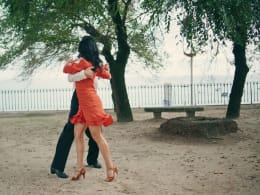
Couple dancing in traditional Bavarian clothing at Oktoberfest
On Bavarian dance floors, the alternation of turning steps and waltz rhythm creates the typical swing.

Waltz, Zwiefacher and the Munich Française

The program of a typical Kathreintanz offers a balanced mix of round dances and figure dances. Most frequently, you will hear Waltz and Polka, where couples move through the room in a large circular path. In between, the leisurely Ländler and figure dances are on the schedule, which are often danced in a fixed order or upon call. If you are interested in traditional folklore, you will experience living dance history in the room here.

A true Munich specialty is the Munich Française. In this five-part country dance, two long rows of dancers face each other while a dance master loudly announces the figures. The Zwiefache is also a challenge: because it constantly switches between the three-quarter time of the Waltz and the two-quarter time of the Dreher, it requires attentive listening to the musicians. The beauty of the Kathreintanz: because the steps are guided on-site, beginners do not necessarily have to master the sequences in advance. To familiarize yourself with the steps beforehand, a targeted preparatory offer for those interested in dance is worthwhile.

Etiquette on the folk dance floor

Recommended

  • Choose shoes with smooth leather soles for effortless turns
  • Watch from the side for a moment before joining in to grasp the rhythm
  • Maintain eye contact with your partner and keep your shared dance axis
  • Listen actively to the dance instructor's cues on the dance floor

Avoid

  • Wearing shoes with sticky rubber soles that block turns
  • Pushing into the middle of the dance lines without knowing the routine
  • Ignoring the change in rhythm during the Zwiefacher and dancing through it with a waltz step
  • Walking against the common line of dance during figure dances

In folk dance, no one dances alone, because the community in the hall safely carries even those couples who do not yet master every step perfectly.

Dance instructor for Bavarian folk dance

Getting started without prior knowledge and appropriate clothing

At the Kathreintanz, there is an uncomplicated approach: nobody needs to show proof of Bavarian folk dance exams to join in. Beginners are best off not standing in the front row, but rather observing the first few bars of a new dance from the side. As soon as the pattern is clear, you simply join in. Traditional costumes in the form of a Dirndl or Lederhosen are welcome and widespread, but they are not a mandatory requirement for participation. What is important is clean, festive clothing that offers sufficient freedom of movement.

A central aspect is footwear. On the ballroom floor, shoes with smooth leather soles are ideal, as rubber soles stop during turns and put strain on the knees. You can also come without a fixed appointment: many dancers change partners over the course of the evening, and a friendly invitation at the edge of the dance floor is considered good manners. This makes the evening particularly accessible for everyone who wants to try out Bavarian dancing in an uncomplicated way.

A comparison of two dance forms of the Kathreintanz

Circular dance

Partner dynamics

Free movement as a couple on the outer lane

In circular dances like Waltz or Dreher, the couple moves independently within the flow of the dance direction. Individual step lengths and rotation speeds can be flexibly adjusted.

Line dance

Group formation

Fixed sequences of figures on command

In the Française, two long rows dance fixed figures on the command of the dance master. Here, it is all about precise interaction with the couples standing opposite you.

Frequently Asked Questions

  1. No, prior knowledge is not a requirement for participation. Many figures are explained directly on the dance floor by lead dancers or announcers, so that even newcomers can keep up by simply watching and imitating.

Find partner dance courses in Munich

Find suitable dance courses in Munich and learn the basics for Bavarian dance evenings.

View all suitable courses

Conquer the dance floor together

Find like-minded people for traditional dance parties or the next partner dance course in your area. On udansa, you can arrange to dance together directly.

Conquer the dance floor together