World danceDance styles in Hannover

Dancing folklore in Hannover: World dance styles from Ireland to the Orient

4 minutes
In a nutshell
  • Folklore dancing in Hannover covers a spectrum from Irish Dance to oriental dance to southeastern European circle and chain dances.
  • Most folklore dances are performed in open formations without a fixed dance partner, so joining alone is easily possible.
  • The requirements for equipment and technique vary greatly between rhythmic hard shoes for tap dance, soft slippers for oriental dance, and flexible indoor shoes for circle dance.
  • Those interested can find suitable courses and dance groups via the search filters on udansa as well as local cultural associations.

Traditional folk dances combine centuries-old rhythms with a vibrant community. Those who engage with global dance styles experience a completely new sense of body awareness, far beyond standard dance school programs.

DefinitionFolk dance

Folk dance refers to traditional forms of dance from a specific culture or region, which are often passed down communally in circles, in lines, or as folk dances. It is characterized by handed-down step patterns and music typical of the region.

Traditional rhythms beyond classic partner dances

If you are looking for ways to try out folk dance in Hannover, you will encounter a remarkable variety of historical dance forms. Away from the major partner dance competitions and urban dance styles, local dance groups cultivate the movement patterns of different cultures. The styles range from the rhythmically accented steps of Irish tap dance to the fluid body waves of oriental dance and the open circle and chain dances of the Balkans and Greece.

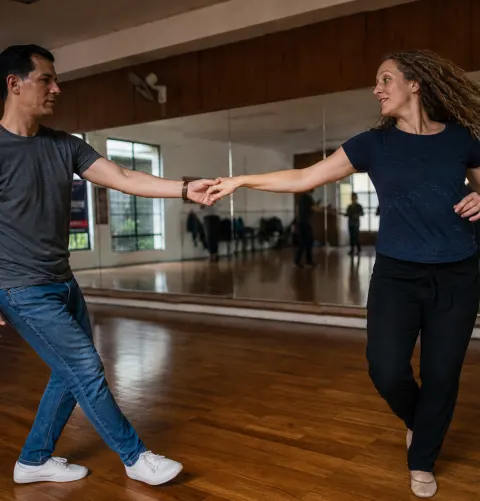
The special thing about this category: many traditional dances completely forgo the fixed relationship of leader and follower. In circle dance, you hold onto the hands or shoulders of your neighbors, which puts the cohesion of the group at the center. If you want to broaden your dance horizons, you will always find inspiring international dance influences at the KunstFestSpiele Herrenhausen, for example, which show how lively folkloric traditions continue to have an impact today.
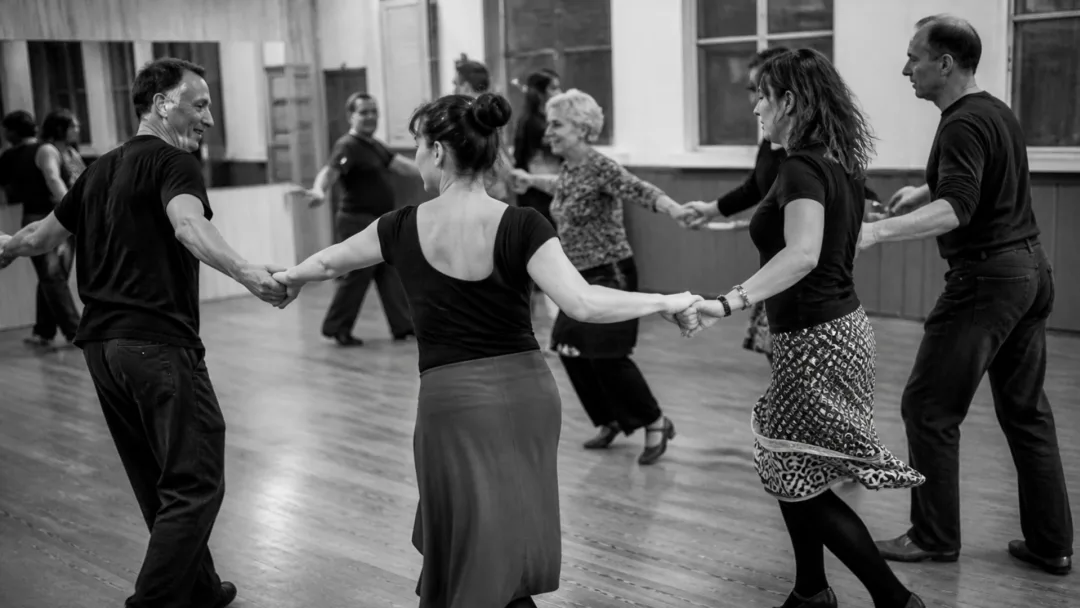
In an open circle, everyone dances at the same eye level, carried by the shared basic step.

Body awareness between precise footwork and isolation

World and folk dances place completely different demands on posture, footwork, and coordination. While you keep your upper body perfectly still and upright in Irish Dance, channeling all your energy into lightning-fast foot changes and rhythmic clicks, oriental dance works with subtle muscle isolation in the torso area. Here, the chest, pelvis, and arms move in wave-like patterns, while the steps glide gently across the floor.

Southeastern European and Greek dances, in turn, are characterized by odd time signatures like 7/8 or 9/8 rhythms. For beginners, this is initially unusual, but it trains the musical ear enormously. If you are still unsure which focus best suits your personal movement preferences, you can use Which dance style suits me in Hannover? The self-test to specifically determine whether rhythmic footwork, torso isolation, or social chain dances are the right choice.

Getting started with traditional dance styles

Recommended

  • Ask about the typical footwear for the respective dance style before you start
  • Join without a dance partner and take advantage of the group dynamics
  • Listen to the pulse of the music, especially with odd time signatures
  • Start with comfortable, stretchy clothing for freedom of movement

What to avoid

  • Buying expensive special shoes on your own before the first lesson
  • Staying away out of shame because you do not have a fixed partner
  • Trying to force complex rhythms with your mind alone
  • Training in restrictive everyday clothes or stiff street shoes

Dance courses for world dance and folklore near you

Find open dance groups, workshops, and courses for traditional dance styles in Hanover.

When you learn traditional folk dances, you quickly understand that the rhythm is not created in the head, but in the collective walking and breathing of the entire dance line.

Dance instructor for traditional dances

Choosing the right course for traditional dance

Since folklore and world dance styles rarely dominate the programs of classic dance school chains, searching for the right group requires a close look at the training formats. Many offers are supported by independent dance groups, cultural associations, or initiatives for international folk dance. Before you sign up, it is worth arranging a non-binding trial class for dancing in Hannover.

During your first meeting, pay attention to whether the instruction is designed purely for social circle dancing or if a fixed choreography is being rehearsed for stage performances. Ask the instructors specifically about the appropriate footwear: while chain dances usually require comfortable shoes with flexible leather soles, Irish Dance demands special ghillies or hard shoes, and oriental dance is usually learned barefoot or in thin slippers.

Two dance cultures in direct comparison

Irish

Precision in a fast rhythm

Vertical tension and accentuated footwork

In tap dance, the focus is on vertical alignment, firm body tension, and absolutely precise floor contact in the rhythm of the reels and jigs.

Orient

Fluid energy in the torso

Muscle isolation and soft contact with the floor

The dance style thrives on isolated movements of the pelvis and ribcage as well as fluid arm lines, performed barefoot or on soft balls of the feet.

Frequently Asked Questions

  1. No, for the vast majority of folk dances like Irish group forms, Greek dances, or oriental dance, you do not need a fixed partner. The dances mostly take place in circles, in rows, or as individual dances within the group.

Bernhard De Lucaudansa editorial team ·
Share
Know-how for the floor

From the guide

View all articles