Dance scene Hannover4 minutes

Argentine Tango Hannover: Milongas, culture and dance schools

By Bernhard De LucaUpdated

In short
  • Unlike standard tango, Argentine Tango is based entirely on free improvisation and non-verbal leading through the body axis.
  • In Hanover, beginners and advanced dancers can find regular classes, in-depth practicas, and traditional milongas.
  • At milongas in Hanover, tandas and cortinas structure the evening, while cabeceo and ronda ensure a respectful environment on the dance floor.

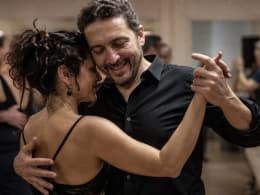
Argentine Tango is not a rehearsed stage dance, but a silent dialogue in a confined space. In Hannover, the established scene combines traditional milongas with modern dance pedagogy.

DefinitionWhat is a milonga?

A milonga refers to both the traditional dance event for Argentine Tango and an independent, usually cheerful and faster form of music and dance within tango. At the dance evening, social interaction is the focus.

Improvisation instead of step patterns in class

Anyone stepping onto the dance floor in Hannover to learn Argentine Tango will immediately feel the difference compared to the classic ballroom tango taught in dance schools. There are no rigid step sequences or counted beats here. Argentine Tango is pure communication between partners: every step is created in the moment through axis shifts, weight transfers, and subtle impulses in the upper body. A vibrant culture has developed around this principle in Hannover. Those looking for a solid introduction often use specialized studios or open workshops, such as those found within the offerings for a dance course in Hannover.

The local scene is characterized by a mix of tradition-conscious dancers and an open, younger community. Typical for the capital of Lower Saxony is the close networking of dancers across district boundaries: whether in Nordstadt, Linden, or Südstadt, regular practicas can be found everywhere. These practice evenings are ideal for deepening what you have learned in class without the formal setting of a social.

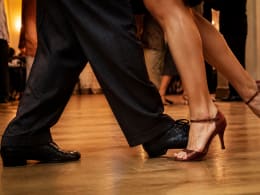
The ronda keeps the flow of the dance in motion: At Hannover's milongas, all couples move in a counter-clockwise direction.

Understanding the dance floor: Ronda and Cabeceo

The heart of tango culture is the milonga. At these dance evenings, unwritten but binding rules apply to ensure a harmonious flow. The most important orientation on the dance floor is the so-called ronda: all couples move counter-clockwise in concentric lanes along the outer edge. Overtaking through the middle or abrupt changes of direction are considered a major disruption of the flow.

Inviting someone to dance also follows a fixed ritual that prevents misunderstandings and awkward rejections. Through eye contact (mirada), two people signal interest. If both confirm the gaze, a minimal head movement (cabeceo) follows, which seals the invitation. Only then do you approach each other. This ritual gives both sides the freedom to discreetly overlook an invitation without losing face. If you want to get an overview of related partner dances, you will find suitable comparisons for dance styles in Hannover on the portal.

Tango etiquette: Proper behavior at the milonga

How to succeed at a milonga

  • Wait for an invitation via eye contact (cabeceo)
  • Flow evenly in the ronda counter-clockwise
  • Enjoy the music at the milonga instead of correcting steps
  • Thank your partner at the end of a tanda and clear the floor

Typical missteps

  • Walking across the dance floor and approaching someone verbally
  • Stopping abruptly in the middle of the dance floor or overtaking others
  • Giving your partner unsolicited advice during the tanda
  • Continuing to dance after the cortina without changing partners

In Argentine Tango, we do not lead figures, but we share our weight in space. If you listen, you do not need to memorize steps.

Tango instructor, Hannover

Musical structure: Of tandas and cortinas

Argentine Tango is danced in Hanover in thematic blocks, known as tandas. A tanda usually consists of three to four pieces by the same orchestra or in the same style, such as dramatic tangos from the golden age, lively valses, or rhythmic milongas. Between two tandas, a cortina is played: a short piece of music from a completely different genre, such as rock, pop, or jazz.

The cortina is the signal to switch. The couple says thank you, leaves the dance floor together, and clears the space for the next tanda. Anyone who leaves the dance floor in the middle of a set signals dissatisfaction to their partner. Conversely, anyone who simply keeps dancing after the cortina blocks the opportunity to meet new dance partners. This balance of respect, distance, and closeness makes the tango scene in Hanover one of the most enduring dance communities.

Learning space or dance evening: Where you do what

Practice

The Practica

Learning space without etiquette

The Practica is the space for analysis and experiments. Here, you stop, ask questions, correct, and repeat steps multiple times, often in casual training clothes.

Dancing

The Milonga

Social dance evening with rituals

At the milonga, the focus is on the shared flow of dance. Conversations during the dance are paused, clothing is elegant, and corrections on the dance floor are taboo.

Frequently Asked Questions

  1. No, you can book almost all Tango Argentino courses in Hannover without a fixed partner. In the courses and workshops, partners are rotated regularly so that all participants learn leading and following with different partners.

Find Tango courses in Hannover

Find your perfect start in Argentine Tango with current courses near you.

View all matching courses

You never dance Tango alone

Connect with Hanover's milongas, compare courses in your area, or discover dance partners who share your enthusiasm for Argentine Tango.

You never dance Tango alone