Choosing a class5 minutes

Contemporary Dance: Which class in Nuremberg is right for you?

By Mary De LucaUpdated

In short
  • For contemporary dance classes in Nuremberg, floorwork, improvisation and assumed prior technique are more informative than the course name alone.
  • Floorwork ranges from gentle weight shifts to challenging transitions between lying down, sitting and standing.
  • Improvisation uses movement tasks and can offer a guided introduction even if you have no existing repertoire.
  • A suitable class connects your learning goal with movement demands you can already manage or will learn systematically in the class.

A video shows you the result, but rarely the learning process behind it. When choosing a class, what matters is whether you want to understand movements, develop your own solutions, or confidently dance a set sequence.

DefinitionMovement phrase

A movement phrase is a connected sequence of movements with a recognizable beginning, progression, and end. It can be set or arise within an improvisation exercise.

The Course Name Does Not Yet Describe a Learning Path

If you’re looking for a contemporary dance course in Nuremberg, you may also come across the term Contemporary Dance. It does not refer to a teaching plan that is identical everywhere. Under this name, classes may focus on set movement phrases, physical foundations, or developing your own movements. Modern Dance and contemporary dance are not automatically the same either, although their course content may overlap.

For example, a technique-focused class breaks down a change of direction: How does the foot leave the floor, where does the weight move, when does the upper body follow? A choreography-focused class uses these foundations as part of a longer sequence. An improvisational approach, by contrast, gives you a prompt such as “Change direction as soon as your elbow leads the way.”

This reveals three different learning goals: controlling movements, remembering sequences, and making your own decisions. Describing the activity is more informative than a style name or the word creative. Details such as slow transitions, short phrases, and guided movement tasks make it clear what you’ll be working on. Whether you can consolidate what you’ve learned also depends on repetition. The guide to practicing between two classes offers another perspective.
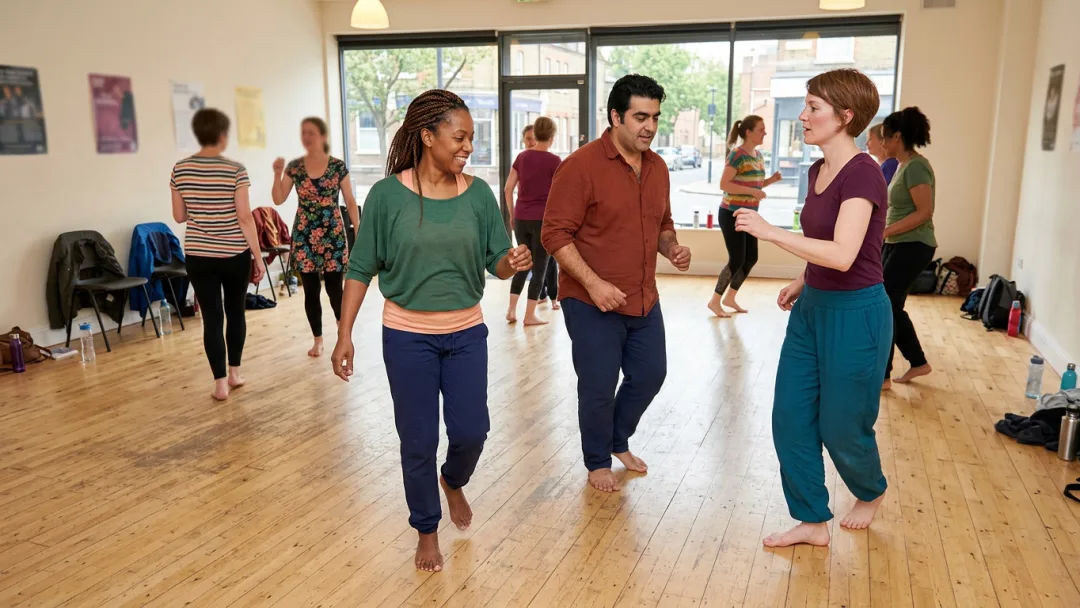
A suitable floor allows movement, but it can’t replace a clearly explained weight transfer or carefully controlled exertion.

Floorwork and Improvisation Have Clear Demands

Floorwork means, first of all, that the floor becomes an active part of the movement. You can shift your weight while lying down, find a path from sitting to standing, or use a hand as a point of support. These tasks draw on different abilities. A calm rolling pathway requires spatial awareness and controlled release of weight; a fast transition over the hands also requires strong support.

That is why a high proportion of floorwork alone says little about the difficulty. Movement pathways, tempo, and variations are more informative. When transitions are built up one at a time, you can follow where the weight lands. When they are immediately incorporated into a fast phrase, you already need to be more familiar with these pathways. For the physical side, see the article on gradually increasing your dance training load.

Improvisation also does not mean dancing around without guidance. A clear task might limit the body parts you use, the direction you move in, or the tempo. This creates a manageable range of choices. Open-ended tasks can be more challenging because you have to choose and develop movement ideas yourself. So having few fixed steps does not automatically mean there is little to learn. Guidance can come through verbal imagery, demonstrations, and feedback, not just by showing a sequence.

Meaningful information and its blind spots

Informative

  • Floorwork with explained points of support and transitions
  • Improvisation with named tasks and room to play
  • Technique level described through specific movements

Too vague

  • Floorwork announced only as spectacular rolling
  • Improvisation promoted only as complete freedom
  • Technique level described only as open to everyone

A course name tells you little about whether you’re meant to dance a move or learn to understand how it’s structured.

Editorial team for dance classes

Prior experience counts as skills, not a label

Prerequisite technique is easier to understand in terms of actions than as a number of years spent dancing. Can you consciously shift your weight onto one leg? Can you stay oriented when changing direction? Can you remember a short movement phrase while your attention shifts to your breath or dynamics? These skills say something about the demands of the class without making a specific previous dance style a ticket to entry.

For more technically demanding classes, controlled landings, coordinated turns, and experience with points of support may also be important. When these elements are prerequisites, there is less time during class to explain them from the ground up. When they are taught, that explanation is part of the learning objective. Quickly demonstrated sequences also put demands on your movement memory, even if the individual positions are physically accessible.

This distinction helps you make a focused choice: for more control, look for a focus on weight shifts and transitions. For your own movement ideas, look for guided improvisation. For dancing in a continuous flow, look for work on phrases and their dynamics. Several focuses can come together. What matters is that the progress you want is actually addressed in class. This makes it possible to assess a Contemporary Dance course in Nuremberg based on its content, without inferring a particular level from its name.

Two equally valuable paths to your own movement

Technique

Understand a movement in greater detail

Repetition makes differences easier to feel

A set phrase lets you examine the same transition several times. You notice how a different point of support or a later weight transfer changes the sequence. This works well if you want to recall movement patterns reliably.

Improvisation

Discover multiple solutions

A task leaves decisions open

A constrained task lets you try out different movement pathways. You notice how direction, tempo, or distance influence your choices. This works well if you want to develop your own movement repertoire and vary it consciously.

Frequently Asked Questions

  1. Ballet experience is not generally required, but it may be expected in a technically focused class. What matters are the specific requirements listed, such as turns, jumps, or learning a phrase quickly. A class that systematically builds up weight shifts, on the other hand, can start without this prior experience.

Dance classes in Nuremberg for your learning goal

On udansa, you'll find the latest classes and dates in Nuremberg, so you can choose technique work or improvisation with a clear focus.

Your learning goal sets the direction

On udansa, you can find dance classes in Nuremberg and choose them based on your interest in technique and improvisation. That way, you look for a learning path rather than just a style name.

Your learning goal sets the direction