Lessons with room for breaks
On udansa, you'll find dance classes in Paris that you can use as a starting point for your search. A course listing is no substitute for a personal assessment.

By Bernhard De LucaUpdated
On udansa, you'll find dance classes in Paris that you can use as a starting point for your search. A course listing is no substitute for a personal assessment.
A booking commits you to a course schedule, while your needs may change during pregnancy. So it’s not just about what you want to take part in today, but also what happens if you need to take a break later.
Training density refers to the ratio between active movement periods and recovery periods within a class. It therefore describes something different from the total duration of the class.
When searching for a class in Paris, “beginner” initially refers to the assumed level of experience. Behind that label, there could be a relaxed technique class, or a class with lots of repetitions to music. Without further details, “gentle” or “for everyone” describes neither the level of physical exertion nor the movements involved. A general class is also not automatically suitable for pregnant participants.
When assessing a class after consulting your doctor, various aspects of the instruction are relevant: How long do you dance without a break? Do demonstrations interrupt the movement? Does the sequence include jumps, quick changes of direction, turns, or transitions between floor and standing? These aspects describe the class, they are not a list of movements that are individually permitted or prohibited.
The tempo of the music only tells you part of the story, too. A slow sequence may require you to hold a position for longer, while a faster exercise may have short active sections. New coordination also takes concentration, regardless of how easy the steps look. So you can’t determine whether a dance is personally suitable for you based on the dance style alone.
The overview of dance classes in Paris can help you understand different class formats. Assessing whether a specific activity is right for you medically, however, is something to discuss with your doctor, not something a class description can tell you.
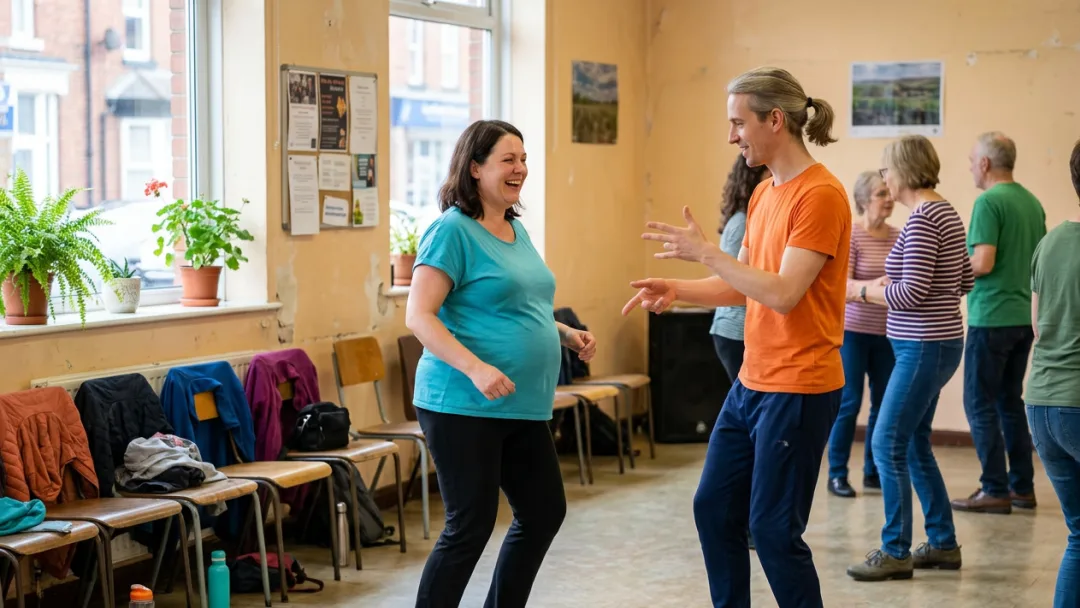
An adaptation is specific when it changes a particular task. For example, instead of a full turn sequence, the teacher could demonstrate a previously agreed step variation without turns. Whether this variation is right for you is not determined by how small it looks. The teacher translates the limits you discussed with your doctor into class organization, they do not set those limits themselves.
The plan also includes what happens during a break. In a group class, the choreography may continue. In that case, there needs to be a clear point for rejoining, or you can watch the rest of the exercise. An allowed break is of little help if you are then expected to immediately know the sequence you missed.
In partner exercises, changes affect both people. A skipped change of partners or a different figure should not be corrected as a mistake without warning. The teacher in charge should know the agreed variation; the group does not need any personal health details.
Clear instructions are important: the start, stop, and difference between the original and the alternative need to be understood. If you understand very little French, the article about the language of instruction in dance classes in Paris covers this communication separately. Another language is neither a medical advantage nor a disadvantage, but misunderstood corrections make it harder to put the adaptation into practice.
Informative
Not sufficient
On udansa, you'll find classes in Paris as a starting point for your search, not as medically vetted pregnancy classes.
Confirmation of the class arrangements is helpful, but it must not be mistaken for medical clearance.
After discussing it with your doctor, you can combine the outstanding practical questions in a single inquiry to the provider. The message does not need a detailed medical history. It outlines what you have in mind and the limitations that are relevant to the lessons. One possible way to phrase it is:
“I’m looking for dance lessons during my pregnancy and have discussed my plans with my doctor. How are active practice sessions and breaks structured? Which activities involve turns, jumps, or changes to and from the floor? Can the limitations we discussed be accommodated with specific alternatives, and how do pausing and returning to class work? What participation requirements, documentation, and arrangements apply if I need to take a break later on?”
A useful answer distinguishes between the regular program, changes that are actually possible, and the limits of the support offered. For example, “You can take a break at any time” does not yet answer whether you can rejoin the same group after a longer break.
A break from lessons and a pause in your contract are not the same thing. Even if you sit out on the sidelines, the booked class may still count as used. A credit is not automatically a refund, either. That is why it is important to have clear terms for missed classes, rescheduling, and ending the contract, without assuming any particular degree of flexibility. This gives you a basis for making an organizational decision, not medical clearance or an individual training plan.
Shared music and set practice sequences
In a group, the exercise continues for everyone else when you sit out. An agreed alternative therefore needs a clear way to rejoin and must not depend on everyone pausing at the same time.
Plan explanations and repetitions strategically
In a one-to-one lesson, the instructor can coordinate activities and breaks with you directly. Medical limitations are still outside their responsibility, and cancellations at short notice are subject to the agreed booking terms.
To coordinate pregnancy-related adjustments, it makes sense to inform the instructor in charge confidentially. You don’t have to share your medical history with the group. What matters are the limits agreed for the class, not a public explanation of your diagnosis or test results.
Whether a medical certificate is required depends on the participation conditions set by the provider. Any required document is a registration requirement, not a blanket guarantee that every exercise is suitable. Your individual medical assessment and the dance school’s organizational approval are two different things.
Being pregnant doesn’t automatically mean you can end a booked course without costs. The agreed terms and any applicable legal rights are what matter. Taking a break, receiving a credit, and cancelling have different consequences for sessions you’ve already paid for, so they shouldn’t be treated as equivalent.
If you experience new or unusual symptoms, stop participating and seek medical advice. For acute or severe symptoms, get immediate help. The dance instructor can stop the class, but can’t medically assess your symptoms. An adjustment discussed in advance isn’t a reason to keep dancing despite your symptoms.