Practice together again
On udansa connect, you can find dance partners in Paris to calmly revisit familiar steps with. Describe your previous dance style and what you’d like to brush up on after your break.

By Bernhard De LucaUpdated
On udansa connect, you can find dance partners in Paris to calmly revisit familiar steps with. Describe your previous dance style and what you’d like to brush up on after your break.
Your mind remembers the whole figure, but your feet stop at the transition. After a break from dancing, this gap can become visible without you having to downplay what you’ve learned so far.
When you look for dance classes in Paris after a break from dancing, your old course name initially describes only your past. You may recognize a figure without being able to start it on your own. Likewise, your body may still be able to perform a sequence of steps even if you can't remember its name. What matters is what you can repeat without someone constantly demonstrating it. That distinguishes solid foundations from mere familiarity.
When you test yourself, separate three things: Do you remember the sequence? Do you hit the right counts? Do you stay stable and keep breathing normally? A long break can affect these areas differently. Forgetting figure names doesn't mean you need to repeat all the basics. Repeatedly stumbling during weight changes, on the other hand, suggests focusing right there, even if you learned more advanced sequences in the past.
When relearning, it helps to watch your feet and direction of movement first, rather than trying to copy your whole body shape at once. The guide to common mistakes when copying dance movements explains this distinction in more detail. Your return test is neither an exam nor a promise of a particular level. It gives you a concrete picture of what you need to work on. The overview of dance classes and dance evenings in Paris offers local guidance without making your previous course name the benchmark.

Note the dance style, your previous dance role, and the basics you regularly used before the break. Add whether you most recently danced freely to music or mainly copied set sequences, so you can assess your memory against a specific practice.
Start by walking at an easy pace, moving your joints without swinging and making small weight shifts. Only increase your range of motion afterward. If you feel pain, dizziness or significant instability, stop the test instead of trying to force your previous range of motion.
First, dance your familiar basic step without music or a video. Notice whether you can remember the footwork, direction, and complete weight changes on your own. Make a note of any gaps before using a reference to help.
Put on a familiar piece of music and first find the pulse with small steps in place. Then begin the basic step and notice whether you stay in time with the music over several repetitions or have to start again after each round.
Add a simple sequence you have danced often before, then consciously return to the basic step. In partner dance, practice with small cues and without pulling; in a solo choreography, connect two familiar sections without skipping missing transitions by speeding up.
Write one sentence each about what you have a solid foundation in, a specific gap, and your current capacity. For example: “I can keep the basic step to the music, but after a turn I lose track; short practice sequences work well for me, while I’d like to dance longer ones with breaks at first.”
Choose your level based on the steps and technique explicitly listed as prerequisites, not just the level names. If this information is missing, send your three sentences about what you need to learn, along with a question asking whether the course reviews these exact basics or already assumes you know them well.
Use the refresher topics you noted to narrow down current classes and dates in Paris with the course filter on this page.
Like this
Not this way
Reminder
Observation
Matching
The length of your break alone does not determine whether you should start all over again. Some fundamentals remain accessible, while others need targeted practice. If you can repeat a basic step steadily to the music, that counts as useful prior experience. You can refresh missing transitions separately instead of automatically learning all the material again.
Returning dancer refers to people with previous dance experience who are coming back after a break, but it is not a course level with a universally agreed meaning. A course like this may review fundamentals and help you reconnect with moves you learned before. When choosing a course, what matters is which sequences you are already expected to know confidently. The label alone does not tell you the pace of learning or how much support is available for forgotten fundamentals.
Describe the movement if you cannot remember the name of a move. The starting position, direction of the steps, and ending position make your level of experience clearer than a term you only partly remember. Different teaching traditions may also use different names. When returning, what matters is whether you can perform the sequence with control and keep dancing afterward, not whether you can recall every name straight away.
You can test basic steps, how you move to the music, and simple sequences on your own. In partner dancing, though, this test does not show how steady your connection, leading, or following is after the break. So note this area as not yet tested. Remembering a footwork sequence does not replace coordinating impulses and responses with a partner.
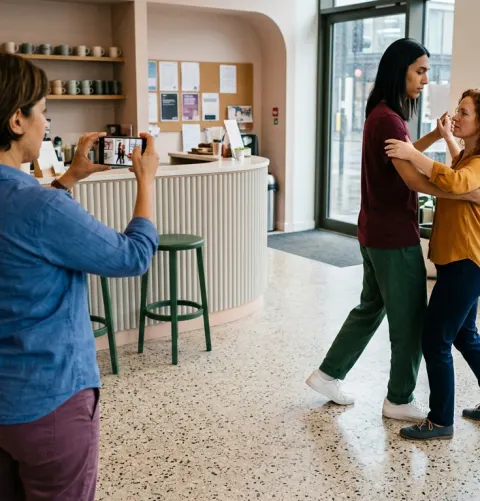
An old practice video can help you recognize a sequence you have forgotten, but it does not replace testing yourself without a reference. Watch a short section, put the video away, and repeat the sequence on your own. If you document a class later, follow the guidance for a short, easy-to-recognize practice video in a dance class, including getting consent from identifiable people.
You cannot measure how long it will take to get back to your old level by a set number of class hours. The length of your break, your previous practice, and your current stamina all play different roles. Start with an observable intermediate goal, such as making a confident transition after a familiar turn. Once you can do that consistently, you can add more connections without having to relearn everything at once.