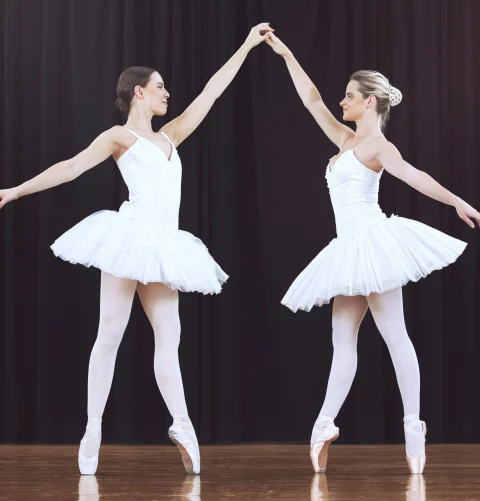
Watch dance in Paris together
On udansa connect, you can find people in Paris to watch dance with and talk about the moves you’ve seen.

By Mary De LucaUpdated
On udansa connect, you can find people in Paris to watch dance with and talk about the moves you’ve seen.
From a distance, fast-moving legs and bright petticoats can easily blur into a single image. If you deliberately shift your gaze, the stage effect becomes a clear sequence of movements.
When you come across the term Cancan in Paris, it helps to make a distinction: the historical dance and the carefully choreographed revue number are not the same thing. According to the documented history of the city, the Cancan was danced in Paris's public dance halls, including by students in the 1830s. It later developed into an independent revue number at the Moulin Rouge; in the 1920s, choreographer Pierre Sandrini created the French Cancan there. The page about the Cancan as a Moulin Rouge revue number explains the historical context.
This development matters when identifying it: you don't just see individual high kicks, but a sequence arranged for a shared effect. A leg kick gains emphasis through repetition, a jump through the group landing together, and a skirt through several layers of fabric opening at once. So don't focus only on the most striking performer, but also on their relationship to the group.
A number can include solo moments, staggered entrances and changing formations. So a straight line doesn't have to remain throughout. Nor is the sequence of figures fixed. The following guide helps you focus your attention, not learn the choreography. For a related way to observe space and relationships between bodies, see how to read a contemporary choreography, though the two dance forms do not share the same movement vocabulary.

First, let a short movement sequence play without interruption. Listen for the steady pulse and watch for where the group clearly starts or finishes together. You have a useful excerpt if you see not only a spectacular ending pose, but also the transition into it.
Focus on one person: One foot bears the weight while the other leg is lifted forward and lowered again. This is a leg throw. You can identify repetitions or changes of side by noticing which leg remains on the ground each time.
Then follow the path of the raised foot. If it traces an arc, you’re seeing a circling leg movement rather than a straight throw. If the leg is held up by the hand, the held position is the defining feature, not just the height reached.
Now watch both feet of the same person. If they leave the ground at the same time, it’s a jump. Legs spread wide in the air and a split on the ground are different moments; identify the move only once you see the landing.
Shift your focus from the individual to the group. When the leg throws begin simultaneously, they create a shared accent; when they start one after another, the movement travels down the line. Even as the formation changes, you can track whether spacing and alignment stay orderly.
Finally, look at the hands: they grasp the fabric, open it to the sides, or lift it for a leg throw. Then name the combination, for example, repeated leg throws in a row with fanned-out skirts. This connection is more meaningful than costume or music alone.
If you'd like to dance yourself after watching, you'll find classes in Paris for various dance styles on udansa.
Like this
Not like this
Framing
Matching
Result
No, a high kick alone is not enough to identify Cancan. Similar leg movements appear in other stage dances. Also pay attention to their repetition, the alternation between springing movements and clear accents, and how they connect with skirt work and group formations. An isolated pose doesn't show these connections.
No, you don't have to see a split to identify a Cancan sequence. It's part of the well-known repertoire of figures, but it isn't required in every excerpt. A clip might end before then or show a different passage. What matters is how the visible features work together, not checking off a complete list of figures.
The music offers a clue, but it isn't conclusive proof of Cancan. A fast, clearly structured pulse supports the springing movements and shared accents. However, the same music can also be choreographed differently. So listen for the relationship between sound and movement: when leg throws or landings hit audible accents, the choreography becomes clearer.
You can recognize a leg throw by the working leg's upward path and its subsequent return, while the supporting leg bears the weight. Slow motion helps you distinguish this movement from a held pose. Then return to normal speed: only then can you see how energetically the figure is performed and what accent it creates within the sequence.
You shouldn't try high leg throws, jumps, or splits without preparation. Watching doesn't tell you about warming up, strength, flexibility, or safe landings. This guide is for recognition, not training. If you're discussing a clip, it's better to describe the direction, floor contact, and group participation instead of trying out the highest possible leg lift.