Take a closer look together
On udansa, you can find people in Paris to watch dance with and discuss what you noticed afterwards.

By Mary De LucaUpdated
On udansa, you can find people in Paris to watch dance with and discuss what you noticed afterwards.
On stage, a small distance can become more compelling than a big leap. If you don't immediately look for an action, you'll notice choices that get lost between the spectacular moments at first glance.
When you watch contemporary dance in Paris, you don't need a fixed dictionary for gestures. A bent back doesn't automatically mean sadness, and a jump doesn't automatically mean joy. Choreographies can show movement as a physical process, develop a situation, or combine both. First describe what happens, and only then say how it affects you.
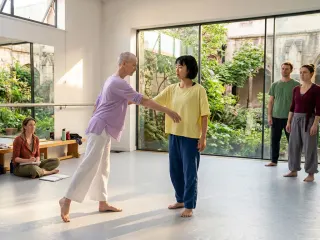
You can see the difference in an example: One person stretches out an arm, another steps back. That's an observation. “The first person is threatening the second” is already an interpretation. It could just as well be play, a refused encounter, or the testing of a boundary. Which reading holds up depends on what happens before and after, and when the action is repeated.
Part of Paris's cultural context is Chaillot's focus on contemporary dance, introduced in 2008. The institutional history is outlined in the overview of dance culture in Paris; it doesn't provide a ready-made meaning for an individual work. The terms Contemporary Dance and Danse contemporaine don't refer to a single movement language either. You may encounter abstract forms, everyday gestures, language, or physical encounters. The guide to observation biases in dance movements explains how easily the eye can overemphasize individual body parts. That's why it helps to shift between details and the overall picture as you watch.
First, let your gaze travel across the entire performance space: Where are the bodies positioned, which areas remain empty, where do the pathways lead? Notice a striking arrangement, such as a dense group with one person outside it, without drawing a story from it just yet.
Choose a short, recognizable movement: an arm circle, a sinking motion, or a step back. Describe its beginning and end in simple words. Your motif is useful if you recognize it, even when another person performs the same movement later.
When your motif appears again, compare its size, direction, and body level. Does the arm circle get smaller, shift toward the floor, or get taken over by the group? Note one change and observe whether it continues or returns to its original form.
Now pay attention to how the movement is performed: jerky, gliding, heavy, or springy. Separate speed from force, because moving slowly can feel tense. Compare two versions of your motif and name which physical quality has changed.
Track who reacts to whom: Do people begin at the same time, does one follow with a delay, does a gaze go unanswered? Also observe proximity without touch and contact without eye contact. Describe the sequence specifically, for example, “one person moves closer, two turn away,” instead of assigning fixed roles.
Listen for whether movement responds to a sound, moves against its rhythm, or continues independently. Pay attention to footsteps, breathing, and speaking voices as well as music. You have recognized a connection when you can describe a specific cue, contrast, or shift to silence.
After the conclusion, connect two observations into a tentative reading: “The group seems distant because it moves apart whenever someone approaches and avoids eye contact.” Then look for an alternative explanation. This keeps your interpretation easy to follow without claiming to know the choreography’s intent.
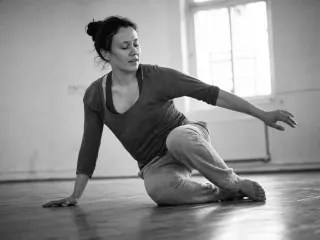
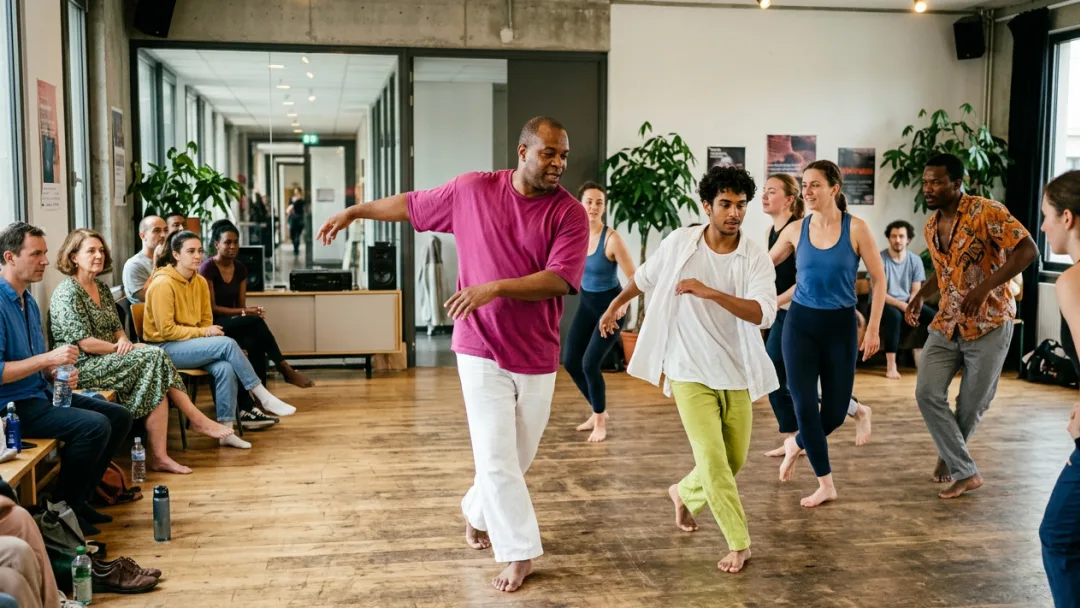
With dance improvisation, you can experience for yourself how distance, direction, and quality of movement change a gesture.
Like this
Not like this
Orientation
Comparison
Context
You don't need any dance experience of your own to observe choreography attentively. Technical knowledge can help you recognize balance or shifts in weight, but it doesn't replace observation. Start with directions, distances, and changes. These features are visible even without knowing the names of steps, and they give your interpretation a basis.
Contemporary dance doesn't have to tell a story. A piece can work with duration, exhaustion, geometric arrangements, or the effect of a repeated movement. So don't force yourself to look for characters and a plot. If the same action becomes increasingly difficult, that physical change alone can carry the progression without depicting a narrated situation.
A long passage with little movement can draw your attention to small changes. Observe breathing, muscle tension, gaze, and the duration of the wait. You may then notice that the apparent calm involves physical effort. Whether the passage creates tension, distance, or stillness can only be interpreted in relation to the rest of the piece.
Floor movements are not evidence of poor technique. Lowering yourself in a controlled way, rolling, and rising again require coordinated shifts in weight and a conscious use of momentum. As you watch, you can follow how contact with the floor changes. What matters for your interpretation is what this change alters in the piece, not how high someone jumps.
It's often impossible to tell just by watching whether a passage is improvised. Movements that seem spontaneous may be precisely choreographed, and improvisation can follow clear rules. So describe the visible sense of openness instead: different timings, changing paths, or immediate reactions. These features show an effect, but don't prove how the movement was created.
An interpretation can be implausible if it contradicts what you see or leaves out important details. Still, several interpretations can coexist. Distinguish your personal response from a claim about the piece: “This makes me uneasy” doesn't need proof, while “the group is excluding someone” should be supported by specific actions.