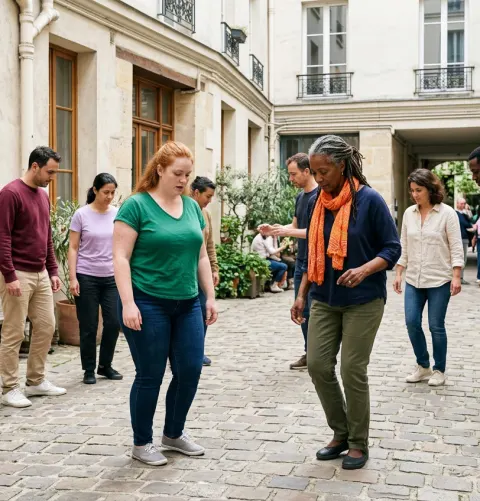
Your evening, your plan
On udansa connect, you can find dancers in Paris to talk about going dancing together and what you expect when switching partners.

By Mary De LucaUpdated
On udansa connect, you can find dancers in Paris to talk about going dancing together and what you expect when switching partners.
You may be picturing an evening for two, while the person you're with may also be picturing dances with other people. Those expectations don't have to conflict, but you shouldn't wait until the first invitation from someone else to find out.
Rotation refers to the guided switching of dance partners within a practice group after a set signal. The dance pairs are re-formed, but the Lead and Follow roles are not automatically switched.
If you want to go dancing as a couple in Paris, you’ll come across notices that cover different things. “Booking as a couple” first describes how places are booked. “Fixed dance couples,” on the other hand, describes who dances with whom. “Partner rotation” concerns how things work on the dance floor. These details aren’t interchangeable.
A dance evening in Paris for couples may require you to book together and still include an introduction with rotating practice partners. Conversely, two individually booked places may be part of a visit where you dance only with each other. The word “couples” by itself doesn’t specify gender or role assignments either.
A phrase like “Introduction with rotation, followed by free dancing” places the rotation in a specific part of the event. “Partner rotation possible” indicates there’s a choice. If the details aren’t clear and staying together matters to you, it’s a good idea to check with the organizer. The overview of dance evenings in Paris helps you decide whether the event is right for you. Booking as a couple alone doesn’t answer your most important question.

In a rotation, the person leading it directs the partner changes. Dancers release their practice hold, turn toward the next person and begin again. This can help you experience a movement independently of your familiar partner. However, anyone who stays together outside the rotation may change how the group is divided. That is why an announced rotation is organizational information, not just an invitation to be more sociable.
At a social dance, on the other hand, invitations happen individually. Each person asked can accept or decline. Going together does not make your companion a mediator or someone who can accept on your behalf. And agreeing to one dance does not mean agreeing to dance for the rest of the evening.
So for a dance party in Paris, partner rotation is not a clear-cut label: what matters is whether a rotation is part of the program or invitations happen freely. A change can also involve the partners while the roles stay the same. For example, both people can continue to lead or follow. The guide to your first dance party in Paris explains what to expect from a visit in general; as a couple, your decision here is mainly about how you interact.
Correct
Misconceptions
An invitation is for the person it is addressed to, and reaching an agreement together does not take away their right to decide for themselves.
A useful agreement describes a wish without controlling invitations from others. “I’d mainly like to dance with you tonight” is clearer than “You know how I’d like the evening to go.” This is just as specific: “I’d like to dance with others now and then, then take a break with you.” That way, your partner knows whether shared dance time, meeting others, or both are important to you.
You don’t have to assign every dance in advance. Starting together, choosing a meeting point beside the dance floor, or taking a break after dancing separately can be enough of a guideline. If only one of you wants to switch partners, that doesn’t make it an obligation for the other. Watching or sitting a dance out is also a personal choice.
An agreement never replaces consent to an individual dance. You can turn down an invitation even if you’re generally open to switching partners. You may also decide later that you’d rather stay together. These changes are best discussed calmly between dances, not debated with the person who just asked you to dance. That way, you can still enjoy the evening together, even if you don’t spend every minute on the dance floor together.
Shared dances set the tone for your visit
You want to share the music with the person you're dancing with and enjoy familiar moves together. A format without required partner rotation leaves room for that. You can politely decline other invitations without explaining your relationship status.
A night out together, with time to dance separately
You want to go out with your partner and meet other dancers in between. Different dance styles can make the evening even more enjoyable. Taking breaks together or agreeing on a few dances gives your night out some structure, without having to decide together about every invitation.
With voluntary invitations, each person decides for themselves. You don't have to dance with others at the same time. In a guided rotation, however, the practice group's flow is affected; one person may be able to take a break while the other participates according to the planned rotation.
No, when changing partners, the dance pairs are simply rearranged. The same person can continue leading and the other following. Changing roles is an additional agreement that both dancers should be aware of, so they can clearly interpret movement cues during the dance.
You can politely say: “Thanks, today I'm dancing with my partner.” You don't need to explain yourself. Clearly decline before the dance starts rather than reluctantly going along; this gives the other person a clear answer and lets them invite someone else.
Yes, you can change your mind during the evening. An earlier yes doesn't commit you to more dances or physical closeness. Calmly mention the change between dances, so the other person doesn't have to guess from you pulling away or declining an invitation.