Partner communication6 minutes

Learn to improvise in an Argentine Tango class in Stuttgart

By Bernhard De LucaUpdated

In brief
  • An improvisation-focused Argentine Tango course in Stuttgart combines walking, the embrace, role work, and musical choices.
  • You can recognize this teaching approach by the fact that steps are varied rather than danced exclusively as fixed sequences.
  • Leading offers movement possibilities, while following involves maintaining your own balance and giving a perceptible response.
  • Suitable exercises help both roles coordinate direction, step size, and pauses with each other.

A long sequence of steps can look impressive and still reveal little about how two people dance together. The lesson gets interesting when you can find a clear next step even without having agreed on a sequence in advance.

DefinitionWeight transfer

Weight transfer means shifting your body weight from one supporting leg to the other. The leg that is relieved can then begin a new step.

Walking makes the foundations of a class visible

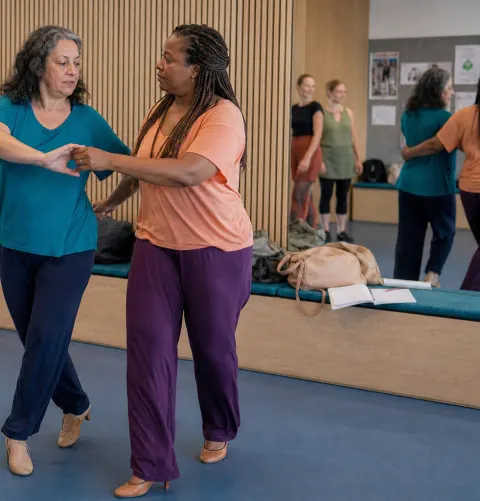
If you want to learn Argentine Tango in Stuttgart, the work on walking tells you a lot about the class. This is not casual warming up: you practise carrying your weight clearly, moving your free leg and coordinating your next step with your partner. A small step can be more challenging than a long, learned combination.

For example, one person walks forward while the other walks backward. Both should arrive on the new standing leg without pushing or catching each other. If the step gets smaller, the communication still needs to work. If a pause is added, neither person should automatically continue the familiar sequence. These variations show whether you are actually sensing a movement or simply remembering the sequence.

Classes focused on improvisation explain why a step works, not just where the foot should go. Feedback therefore also covers balance, direction and the timing of the weight transfer. Figures are useful when they build on these foundations. For practising between classes, you can also find ideas for practising between two classes. Even consciously carrying your own weight can be explored without running through an entire sequence of figures.

Professional Argentine Tango dancers
You can often recognize quality of movement better up close than when looking at a spectacular overall figure.

The Embrace Transmits Movement, Not Commands

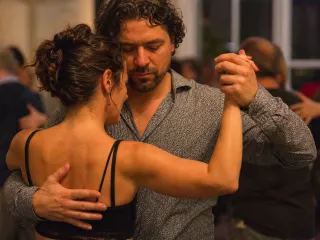
The Tango embrace connects the upper bodies and arms so changes in movement can be felt. Open or close initially describes the distance, not the quality. You can communicate clearly even with space between you, and a close embrace can still be unclear if shoulders tense up or hands constantly make adjustments.

A common misunderstanding concerns the roles: leading is confused with pulling, and following with guessing a figure. Both make improvisation more difficult. A movement invitation arises from coordinated body movement and is conveyed through the connection. The following person then organizes their own step in response. The leading person, in turn, needs to sense whether and how that step has been received.

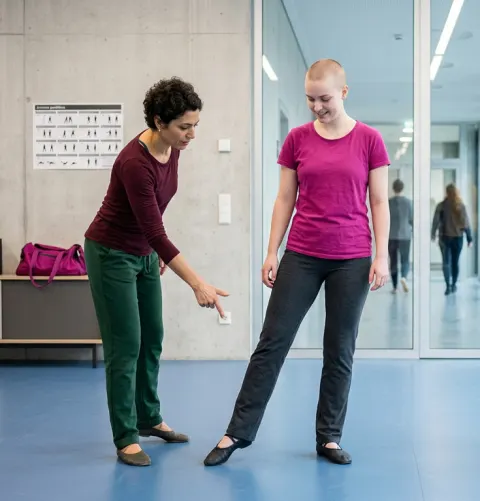
Good teaching makes this feedback understandable. For example, a teacher can demonstrate the same change of direction first with little arm tension and then with unnecessary pulling. The difference can be felt physically without needing a complicated figure. Boundaries are part of this: no one has to accept closeness or touch that feels uncomfortable. Differences in body size call for adjustments, not a forced ideal form. Both roles need their own balance and awareness of the other person. That is why corrections should not focus exclusively on the leading role.

How to spot classes with a focus on improvisation

That's right

  • Connect the same steps in a changing order
  • Communicate a pause without pulling on the arms
  • Correct both roles during weight changes
  • Adjust step size to the music and available space

Not like this

  • Repeating a sequence from memory the same way every time
  • Pulling your partner along by the arms to keep them moving
  • Giving technical guidance only to the leading role
  • Prescribing fixed paths for every movement

A figure is only truly available when you can leave it out without the communication breaking down.

Dance guide editorial team

Improvisation Needs Choices, Not a Constant Stream of New Figures

Improvisation in Argentine Tango does not mean coming up with something surprising on every beat. You choose from movements you can already dance with confidence. A walk, a side step or a pause is enough to make different musical choices. What matters is that your partner can understand those choices.

A fixed practice sequence is therefore not automatically unsuitable. It can explain how movements connect and give both roles a sense of direction. It only becomes a problem when repeating it unchanged is the sole focus. Lessons open it up to improvisation by allowing one element to be left out, another direction to be taken or the timing of the next move to remain open.

Musical practice connects these choices with audible events: a clear pulse, a sustained melody or the end of a phrase. You do not have to respond to every impulse with a step. A pause shared by both partners can be just as precise. The quality of a lesson is reflected in whether the explanation reaches both roles. When practice partners rotate or the group has an uneven number of people, fair solutions for uneven group sizes can help ensure everyone gets active practice time. This way, working on communication remains a task for everyone, not just the pair currently dancing.

Two roles, the same responsibility for connection

Leading

An offer with an open outcome

Communicate direction, notice the response

In the leading role, you prepare a movement and give your partner time to shift their weight. Their response may change your original plan. Responding to it is just as much part of your role as the initial impulse.

Following

Responding with your own balance

Take in movement without rushing ahead

In the following role, you interpret the movement invitation and organize your own step. You don't wait passively for a pull, but stay mobile and attentive. Your actual movement path influences how the couple can continue.

Frequently Asked Questions

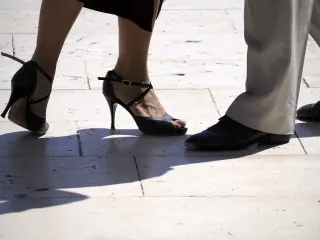
  1. You don't need heeled shoes to get started. What matters is a secure fit around your foot and a sole that allows controlled turns without slipping unintentionally. Flat shoes can work well; soles with too much grip, on the other hand, make it harder to turn on the weighted leg.

Tango lessons in Stuttgart

On udansa, you can find courses and events in Stuttgart and filter offerings focused on Argentine Tango.

Understanding needs a partner

On udansa, you can find dance partners in Stuttgart to practice Argentine Tango and improvisation together. Describe your preferred role and what you're currently working on.

Understanding needs a partner