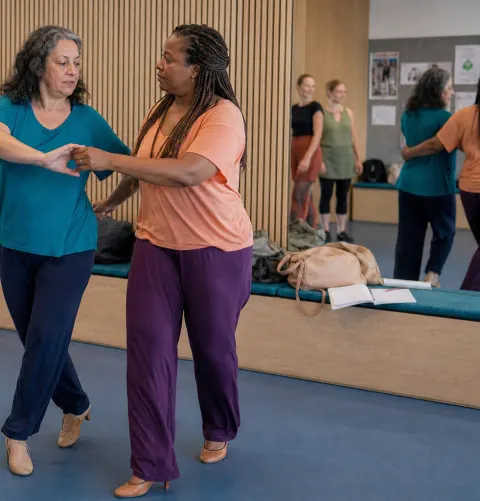
Dance Classes5 minutes

Ballet for Adults in Stuttgart: Getting Started and Course Structure

By Bernhard De LucaUpdated

In short
  • Ballet classes for adults in Stuttgart can be categorized by prior experience, barre work and exercises in the center.
  • A class for beginners explains foot positions, body alignment and simple movements instead of assuming you already know familiar combinations.
  • Barre work supports balance, while exercises in the center require independent weight shifts and coordination.
  • You can start later in life without being able to do the splits, dance en pointe or having professional ballet goals.

Between your desire to dance and your first plié, there is often an image of perfect bodies. In adult classes, by contrast, you can let others see what you’re only just beginning to understand.

DefinitionEn dehors

En dehors refers to the outward rotation of the legs from the hip joints in ballet. Its usable range varies from person to person and should not be forced by twisting the feet.

Getting started depends on the basics, not your age

If you’re looking for adult ballet classes in Stuttgart, the age label is initially just a description of the target group. It doesn’t tell you whether the class starts from scratch. An adult class may also be aimed at participants who already know foot positions, technical terms, and the structure of a ballet class. The term open training also doesn’t automatically mean you can join with no prior experience.

In a fundamentals class, movements are broken down clearly. With a plié, or bending the knees, for example, you focus on keeping your knees aligned over your toes and your torso upright. In a tendu, your foot glides along the floor until your leg is straight, then returns in a controlled way. You learn not just the shape of the movement, but how to get there.

General fitness doesn’t replace knowledge of these movements. Strength and endurance can help, but coordination is a learning task of its own. Conversely, you don’t need to be especially flexible already: the connection between dancing and flexibility explains why usable range of motion matters more than spectacular stretches. Stuttgart’s ballet tradition doesn’t tell you what prior experience a specific adult class requires.

Soft ballet slippers make your footwork visible, but they are no substitute for a suitable floor or controlled movement.

The barre provides support without doing the technique for you

Barre work is neither just a warm-up nor automatically easy. The barre gives you a point of reference and supports your balance. This leaves you with more attention for your feet, knees, pelvis, and upper body. But its support should not turn into gripping it with a raised shoulder: Rest your hand lightly on the barre while continuing to support your own weight.

A clear progression connects simple bends and stretches with increasingly challenging leg movements. En dehors comes up again and again. For adults starting later in life, this means that your feet should only turn out as far as your hips and knees can control the movement. If your toes point far outward but your knees move inward when you bend, the position does not suit the movement.

Tempo also changes the level of difficulty. A sequence explained slowly leaves room to focus on how your body feels; the same sequence with quick transitions already requires automated movement patterns. Many barre exercises can therefore be advanced training. The training stimulus comes from active control, not simply standing at the barre. The guide to building muscle through dance explains in more detail what demands strength.

How to find the right place to start

A good fit

  • Foot positions are demonstrated and explained one by one
  • Combinations stay short and are repeated
  • Corrections take your flexibility into account
  • Free exercises are introduced gradually

Still too demanding

  • Foot positions are referred to only by their technical names
  • Long combinations change after one run-through
  • Everyone is expected to achieve the same maximum turnout
  • Free exercises start straight away with fast turns

The height of a lifted leg says little about how securely you manage your weight on your supporting leg.

udansa Editorial Team

In the room, the connection between the exercises becomes clear

Working in the room, often referred to as Centre, applies the fundamentals without support. Now you have to organize your weight over your standing foot while also paying attention to your arms, gaze and the music. So it makes sense that a familiar movement suddenly feels more difficult: new tasks have been added, the progress you have already made has not disappeared.

An introductory course may begin with simple weight shifts, arm movements and short sequences of steps. A diagonal is a sequence of movements across the room, not necessarily big jumps. Small jumps are introduced along with the task of cushioning the landing through your foot and knee. Turns, in turn, require a stable axis and a sense of direction. A well-structured class builds up these demands rather than combining every form right away.

You can tell you have a good foundation when the free practice builds on movements you already know. The teacher demonstrates the sequence, explains its direction and gives you the chance to repeat it. Adults can use different movement sizes without dropping out of the shared activity. So when choosing a course in Stuttgart, what matters is not how close the result looks to a stage performance. What matters is whether you can follow the transition from individual fundamentals to dancing in connected sequences.

Two learning tasks within the same lesson

Barre

Distinguishing movements more precisely

Less balance work, more attention

At the barre, you can notice whether your pelvis turns as you lead your leg or your shoulders lift. Repetition gives you a chance to actually feel a small adjustment.

Space

Bringing movements together

Coordinate direction, arms, and legs

Without the barre, spatial direction comes into play: You move to the side, forward, or diagonally. A short sequence gives you the chance to experience your gaze, arms, and steps as one coordinated movement.

Frequently Asked Questions

  1. Comfortable sportswear and soft ballet slippers are suitable for beginners, unless the class requires different clothing. Long, very loose pants cover the knees and make corrections more difficult. A leotard is practical, but not required to learn foot positions and simple movements.

Ballet classes for adults in Stuttgart

On udansa, you can find current classes and dates in Stuttgart and tailor the lessons to your ballet level.

Starting ballet needs space

On udansa, you can find ballet classes for adults in Stuttgart. That way, you can choose a class that explains the fundamentals of technique and gives you time to move freely.

Starting ballet needs space