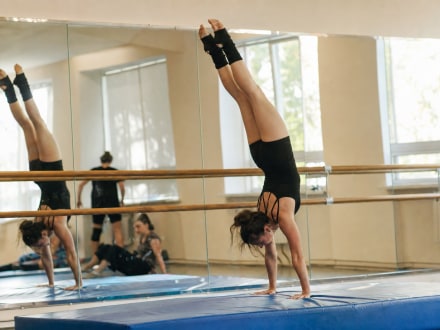
Train safely with udansa
Here you can find professional dance schools and experienced instructors in your area who will guide you step by step into dance acrobatics. Exchange ideas with like-minded people and learn in a safe environment.


The combination of fluid dance and powerful acrobatics is fascinating, but it demands peak performance from your body. With the right routine, you effectively protect your joints and muscles from strain.
Anyone who loves the dynamic fusion of dance and acrobatics quickly feels the enormous forces acting on the body. To avoid injuries in Acro Dance, it is not enough to just get started. Every cartwheel, every handstand, and every fluid transition to the floor challenges your joints and muscles in a way that does not occur in everyday life. The greatest risk for acrobatic injuries usually lies not in the complexity of the figures themselves, but in a lack of preparation and insufficient joint protection.
Smart training starts exactly here: it strengthens weak points before they become overloaded. The focus is on stabilizing the wrists, ankles, and shoulder joints, as well as activating the deep muscles. Unlike pure stretching for extreme flexibility or splits, protecting against joint damage is about active control in space. Only those who stand stably and cushion movements softly can sustainably reduce the risk of acrobatic injury and enjoy the fascination of this form of movement pain-free.

Always use a soft mat when learning new floor-based elements at the beginning. This not only takes away the fear of falling, but also cushions unplanned landings to protect your joints.
Get your pulse up slightly for three to five minutes with light jogging, jumping jacks, or jump rope. This promotes blood circulation in your muscles and makes your tendons more elastic.
Kneel down, place your hands on the floor, and gently circle your weight over your wrists. Turn your fingers in different directions to optimally prepare the joint capsules for weight-bearing loads.
Roll your shoulders generously forwards and backwards. Afterwards, get into a quadruped position and actively push yourself up from your shoulders to activate the stabilizing muscles.
Circle your ankles while standing and actively pull your toes towards you. Afterwards, consciously roll through the balls of your feet to prepare your ankles for landings.
Hold the tension throughout your entire body in a forearm plank for 30 to 45 seconds. A firm core protects your spine during all subsequent turns and lifting phases.
An effective warm-up for Acro Dance should take at least 15 minutes. During this time, you get your circulation going and specifically mobilize all joints from your feet to your neck.
Find the right studio to learn your dance acrobatics safely and professionally.
 Minimizing acrobatics injury risk in danceSafety first: Learn how to minimize the risk of injury in acrobatic dance through targeted strength building, proper spotting, and optimal preparation.
 Building Strength for Dance Acrobatics: Targeted TrainingTo master lifts and floor work in acro dance safely, you need targeted strength training. Learn which muscles really matter and how to strengthen them effectively.