

Growing beyond boundaries together safely
On udansa you will find like-minded people who share your passion for movement, as well as suitable studios that support you in learning safely.


The path to spectacular movements on the dance floor starts with a solid foundation of strength and prevention. If you understand and protect your body, you will not only dance more expressively, but also pain-free for the long term with udansa.
Safety during acrobatic training includes all preventive measures such as warming up, building strength, spotting, and the use of crash mats to avoid injuries. This structure enables fear-free and healthy learning of complex movement patterns.
Anyone wanting to master spectacular jumps and fluid transitions in dance faces a unique physical challenge. The combination of dance aesthetics and acrobatic elements demands peak performance from the musculoskeletal system. This is precisely where there is an increased risk of injury in acrobatics if the body is not specifically prepared for these stresses. In contrast to classic floor gymnastics, dance often involves unforeseen centrifugal forces and dynamic changes in direction acting on joints and muscles.
To be able to avoid typical acrobatics injuries in dance, a deep understanding of the biomechanics of your own body is necessary. Injuries rarely occur due to the move itself, but rather due to a lack of preparation, fatigue, or a misjudgment of your own strength reserves. Anyone who understands the physical forces acting on the body during a no-handed cartwheel or a bridge can specifically stabilize weak points and make training healthy in the long term.
A well-founded strength training for acrobatics forms the foundation for every safe movement in the air and on the ground. Without stable core and deep muscles, the body lacks the necessary control to cushion landings and protect joints from overload. One-sided training quickly leads to muscular imbalances, which in an emergency promote injuries. Therefore, strength and flexibility should always be trained in balance to actively secure the joints.
In addition to pure muscle strength, active spotting for acrobatics plays a decisive role in the learning process. An experienced training partner or coach not only provides physical support, but also conveys the necessary confidence to practice new movement sequences without fear. Anyone training at home should also rely on a suitable acrobatics mat at home to cushion hard falls on parquet or tiles and to offer the joints a cushioning surface upon impact.
For new overhead elements, always use a soft landing mat at the beginning and have a second person spot you until the movement sequence is absolutely flawless.
A strong core and the right falling technique are the best protection against injuries. Anyone who learns to roll off in a controlled manner takes the danger out of every fall.
A professional warm-up for acrobatic dance prepares the cardiovascular system and the entire musculoskeletal system for the upcoming strain. Cold muscles and stiff tendons are extremely sensitive to sudden stretching or compression, which drastically increases the risk of injury. The warm-up should therefore include dynamic stretching exercises, joint mobilization, and a gradual activation of the supporting muscles.
For all-round safe training, it is advisable to learn the basics in a professional environment. Anyone who wants to learn more about acrobatics in dance, for example, will find the right guidance in specialized courses. A look at related styles such as Modern Dance and Contemporary also shows how fluid floorwork and acrobatics can merge harmoniously and without injury. The right technique protects the body in the long term and ensures lasting joy in movement.
Learning new movement sequences safely
Active support and guidance from a partner provides physical security and helps to store the correct movement sequence in your muscle memory.
Building body awareness and balance
Independent training with cushioning mats promotes self-perception and strengthens the deep stabilizing muscles through continuous balance work.
A thorough warm-up prepares muscles, tendons, and joints for extreme stretching and compression. This increases tissue elasticity and significantly reduces the risk of muscle tears or strains.
Find the right studio to safely develop your acrobatic skills under professional guidance.
Wednesday · 17:00-18:00 · Nov 5
Mehrgnerationenhaus Brück
Monday · 17:40-18:30 · Sep 8
Flow Motion Studio Neukölln
Wednesday · 17:50-17:50 · Sep 10
Flow Motion Studio Wedding
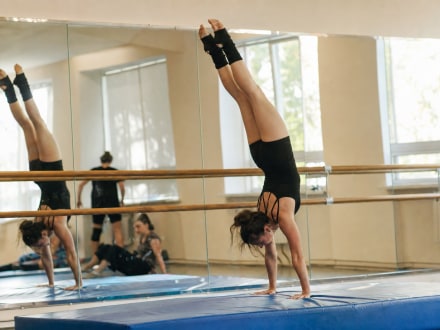 Acro Dance: Acrobatics for Teens & AdultsAcro Dance fascinates through the fusion of athleticism and elegance. Learn how teens and adults can safely master this demanding style.
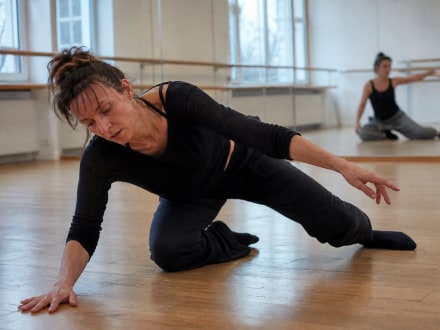 Modern and Contemporary Dance for Adults: Getting StartedThe ideal introduction to the world of contemporary dance for adults. Discover how you can express your creativity and improve your fitness in the studio, even without prior experience.
 Injury-free Acro Dance: Your routineProtect your joints and muscles during Acro Dance. With this targeted warm-up routine, you avoid strains and train pain-free in the long run.
 Building Strength for Dance Acrobatics: Targeted TrainingTo master lifts and floor work in acro dance safely, you need targeted strength training. Learn which muscles really matter and how to strengthen them effectively.