Dance acrobatics4 minutes

Learning to fall safely in dance acrobatics: A guide

By Mary De LucaUpdated

In a nutshell
  • When falling from a lift or a floor element, the impact energy must never be absorbed abruptly.
  • The most important protective measure is to roll in a controlled manner over the rounded muscle areas of the back and shoulders.
  • Arms and legs must never be kept stiff and straight when falling, in order to avoid bone fractures and joint damage.
  • Systematic training on soft mats reduces the natural fear of falling and anchors protective reflexes in muscle memory.

If you want to reach for the stars, you need to know how to land softly. With the right technique, any fall loses its fear and becomes a fluid movement that protects your body.

What you need for fall training

  • Soft exercise mats or thick gym mats as a base
  • Form-fitting, elastic sportswear without zippers
  • Sufficient free training space without hard edges nearby
  • Warmed-up neck, shoulder, and wrist muscles
  • An attentive training partner for visual monitoring

Why fall training is the foundation of every dance acrobatic

In the dynamic world of acro dance, spectacular floor elements and lifts are part of the standard repertoire. However, where boundaries are pushed, the risk of missteps also increases. Anyone who ignores the art of falling risks serious injuries to their wrists, ankles, or spine. Professional fall training takes away the fear of losing control and ensures that a failed element does not mean the end of your dance career. By learning to dissipate impact energy through a continuous rolling motion, you effectively protect your bones and joints from hard impacts.

This is especially important during the transition from the air to the floor. While you need extreme body tension as a flyer to prepare for your figures, falling at the crucial moment requires the exact opposite: a controlled yielding and the deliberate rounding of the body. This knowledge also helps you with fluid transitions in modern dance. If you would like to explore floor-based movement sequences more intensively, it is worth taking a look at the topic Acro Dance in Contemporary: floor elements in modern dance to fully understand the connection between fall prevention and aesthetics.

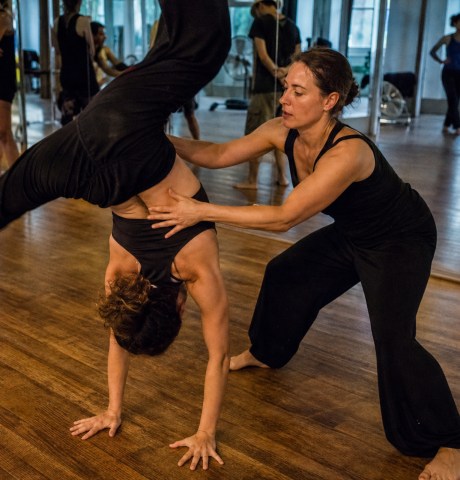
Step by step: Learn controlled rolling

  1. Lower your center of gravity and round your back

    Get into a deep squat so that your center of gravity is as close to the floor as possible. Pull your chin firmly onto your chest to protect your cervical spine, and make your entire back completely round.

  2. Placing the lead arm

    Guide one arm diagonally across your body and place the outside of your forearm flat on the floor. The palm should face downwards to prevent your fingers from bending.

  3. Roll diagonally over the shoulder

    Initiate the movement by pushing yourself forward over the shoulder of the arm that is placed down. Roll diagonally over your shoulder and rounded back, without your head or vertebrae directly touching the floor.

  4. Let the movement flow to a stop

    Use the momentum of the rolling movement to bring your legs along in a bent position. Let the kinetic energy fade out by sliding gently over your glutes and arriving in a secure seated position or directly back to a standing position.

The golden rules of fall technique in comparison

Like this

  • Round your body and roll like a ball
  • Keep your joints slightly bent to cushion impacts
  • Tuck your chin firmly to your chest to protect your head
  • Redirect the impact energy into a forward motion

Not like this

  • Land flat on your back with a perfectly straight spine
  • Keep your arms stiff and extended downwards
  • Jerk your head backwards during the fall
  • Try to stop the movement abruptly

Your checklist for safe fall training

Before training

Preparation

When rolling

Meanwhile

After the fall

Afterwards

Frequently Asked Questions

  1. When falling, you must never break your fall with stiff, outstretched arms. The joints will lock up immediately upon a hard impact, which leads to severe fractures in the wrist, forearm, or collarbone. Instead, bend your elbows slightly and roll over your side.

Acro Dance & acrobatics courses near you

Find the right studio to train your acrobatic skills and falling techniques under professional guidance.

View all matching courses

Landing safely together

On udansa connect, you meet like-minded people who share your passion and with whom you can practice controlled rolling in a safe environment. Find the right course or partner for your acrobatic training near you now.

Landing safely together