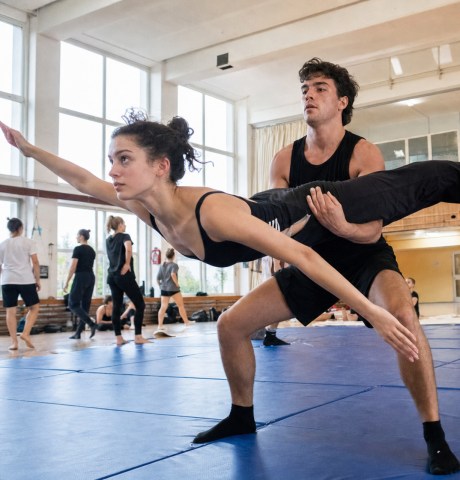
Show dance acrobatics4 minutes

Body tension as a flyer: technique for the lead

In a nutshell
  • As the lead, you contribute significantly to the success of every lift through active body tension.
  • By consciously engaging your core and deep muscles, you make yourself predictable and noticeably lighter for the person lifting you.
  • A stable pelvis and extended limbs prevent dangerous collapsing and the sinking of your center of gravity.
  • The tension must not turn into stiffness, but must dynamically react to the partner's balancing movements.

Lifts in show dance appear playful and light as a feather. However, behind the apparent weightlessness lies precise physics and demanding body control, which above all demands everything from the leader.

DefinitionBody tension

Body tension refers to the conscious and coordinated activation of the skeletal muscles to stabilize the body against external forces. In partner dance, it allows the follower to maintain a firm, yet adaptable form.

Why the flyer is half the battle

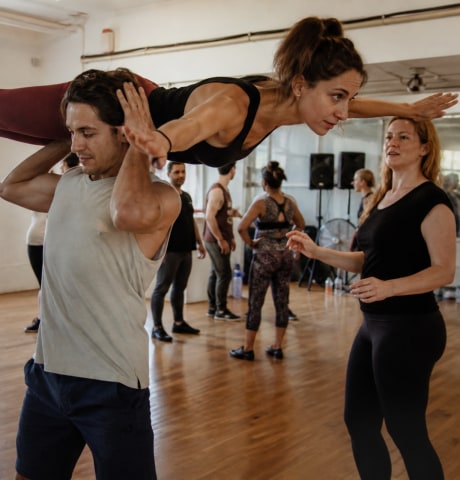
When watching spectacular lifts in show dance, most people admire the strength of the lifter. But that is a misconception: the true art of flying lies with the flyer. A lifeless body that simply lets itself be lifted feels twice as heavy to the lifter and endangers the balance of the entire couple. As a flyer, you are not a passive package being transported, but an active, supporting pillar of the entire construction.

The most important foundation for this is complete body tension. Every fiber of your body, from your fingertips to your toes, must be under controlled tension. As soon as a joint gives way, the line of force collapses. When you stabilize your core, you make yourself predictable and seemingly feather-light for your partner. Only in this way does raw physical exertion turn into weightless art.

The illusion of stiffness in show dance

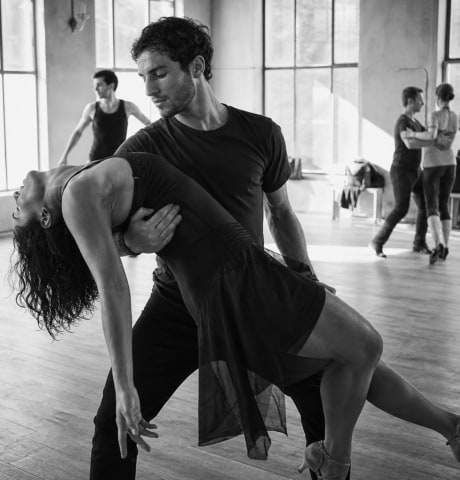
A common misconception in show dance is the assumption that maximum body tension means tensing all muscles as hard as possible. However, anyone who stiffens up completely loses their adaptability. If the base has to compensate for a minimal fluctuation, a rigid flyer will break like a rotten pole. The art lies in dynamic, reactive tension.

Your joints must remain stable, but your perception must remain flexible. You maintain the prescribed shape, but correct fine shifts in the center of gravity via your deep core muscles. This requires a high level of body awareness. A typical mistake is letting the pelvis "sag." As soon as the hip collapses, the weight shifts backwards and downwards, and the base loses their secure footing. To prevent this, targeted regeneration after acrobatics training often helps to keep the deep supporting muscles elastic and responsive.

The most important do's and don'ts for the lead

Correct

  • Actively tilt and stabilize the pelvis
  • Extend your limbs all the way to your toes
  • Push out from your partner's shoulders
  • Let your breath flow despite high muscle tension

Wrong

  • Collapsing the hip and arching the back
  • Letting legs and feet hang loosely
  • Leaning passively on the partner
  • Holding your breath and tensing up your upper body

Only when the flyer stabilizes their own center, can the lifter use their strength optimally. Lifts are precision work, which is decided in the core of the upper partner.

Dance instructor for show dance, Cologne

Controlling your center of gravity in the air

To hold a lift, you must place your center of gravity exactly over the support area of the lifter. This only works if you treat your arms and legs as levers. Every movement in the air must be controlled and timed exactly with your partner. Uncontrolled flailing or sudden changes in position will inevitably lead to a fall.

Focus on actively pushing yourself up from your partner's shoulders. Imagine you want to stretch yourself even further toward the ceiling instead of resting on the lifter. Keep your legs firmly closed and your feet neatly pointed. If you internalize this body tension as a flyer in show dance, you will take a huge load off your partner. If something does go wrong, it is important to keep the basics of mistakes in floor acrobatics in dance in mind to roll safely and avoid injuries.

Two ways of muscle activation when flying

Dynamic

Elastic body tension

Responsive stability in the air

The flyer maintains continuous basic tension throughout the torso. They react elastically to minimal shifts in the base's center of gravity and thus remain stable in the air, without tensing up.

Static

The stiff blockage

Cramping blocks the balance

The flyer blocks all joints and falls into a state of shock. Every smallest compensatory movement of the base cannot be cushioned, which makes the figure unstable and can lead to a fall.

Frequently Asked Questions

  1. A limp flyer feels significantly heavier to the lifter because their center of gravity fluctuates uncontrollably. Without muscle tension, the pelvis sags, which unfavorably extends the leverage for the lifter.

Acrobatics and dance courses near you

Find the right course on udansa now and learn the art of lifts from professional instructors.

View all matching courses

Take off together instead of alone

Do you want to develop your acrobatic skills in a team or with a fixed partner? On udansa, you can find like-minded people and professional courses for Dance Acrobatics in your area.

Take off together instead of alone