

Take off together with udansa
At udansa, you will find like-minded people who share your passion, as well as suitable courses for Dance Acrobatics in your area. Discover the perfect dance partnership for your next acrobatic project now.


Lifts are fascinating due to their weightlessness and dynamics. Learn how to overcome gravity and take to the air safely with the right technique, trust, and systematic approach.
Show dance lifts refer to acrobatic elements in dance where at least one partner loses contact with the floor completely and is carried, lifted, or thrown by one or more partners.
Anyone who sees spectacular show dance lifts on stage often admires the apparent ease of execution. Yet behind every elegant ascent lies a precise interplay of physics, biomechanics, and blind trust. Contrary to the widespread assumption that the supporting partner (base) must lift the entire load with pure muscle power, successful partner acrobatics is based on the optimal alignment of bone axes. When the base stacks the joints vertically on top of each other, the weight of the flying partner (flyer) is transferred directly into the floor.
For the flyer, in turn, extreme, continuous body tension is essential. A limp body feels twice as heavy to the person carrying it and is difficult to control. Anyone who wants to successfully learn lifts should therefore first train the so-called plank tension on the floor. Only when this can be held stably do the first joint lifting attempts follow in a controlled environment such as a professional studio for body tension and balance.
Entering the world of aerial acrobatics is best achieved through proven classics. The most well-known entry figure is the flyer lift. In this move, the flyer rests their pelvis on the base's hands or thighs and extends their body horizontally into the air. This position is excellent for developing a feel for the shared center of gravity, as the support surface is relatively large and both partners can maintain close eye contact.
A structured guide to lifts divides every movement into three phases: the preparation (prep), the flight phase (execution), and the controlled landing (dismount). The landing, in particular, is often neglected in beginner training, even though this is where the greatest risk of injury lies. A safe descent is always performed actively and with cushioning, never by falling passively. Those who proceed systematically build the necessary trust through simple standing holds before dynamic throws or overhead lifts appear on the curriculum.
Always use a third person as a spotter when learning new figures. This assistant stands right next to you, intervenes immediately if you lose your balance, and provides valuable feedback on your alignment.
Lifting is not about raw strength, it is about precise timing and the perfect alignment of bone axes to one another.
Systematic lift training differs fundamentally from a normal dance class. Since the physical strain is extremely high, there is always a specific warm-up at the beginning that mobilizes the wrists, core, and shoulders. In show dance and guard dance, choreographies are structured so that lifts are specifically placed on musical highlights to maximize the dramatic effect.
Besides pure strength, non-verbal communication is the key to success. Since eye contact is often impossible during a lift, both partners must be able to rely on the subtlest weight shifts and firm grip points. If you are interested in this fascinating sport, it is worth taking a look at specialized offers for Dance Acrobatics to learn the techniques from scratch without injury.
The stable foundation on the ground
The supporting role provides the stable foundation. It works with bent knees using the legs and stacks the joints vertically to transfer the weight safely into the ground.
Lightness and tension in the air
The flying role provides aesthetics and body tension in the air. She maintains body tension like a board and actively shifts her weight to make lifting easier for the base.
For getting started, a solid basic level of fitness and good body tension are important. Previous knowledge from gymnastics is helpful, but not a mandatory requirement, as the technique is built up step by step during training.
Find the right school on udansa to learn lifts safely from the ground up.
Sunday · 14:30-16:00 · Nov 15, 2026 - Jan 17, 2027
Limbach-Oberfrohna
Sunday · 14:30-16:00 · Sep 6 - Nov 8
Limbach-Oberfrohna
Sunday · 14:30-16:00 · Nov 15 - Nov 29
Limbach-Oberfrohna
 Lifts in dance: Physics over brute forceLifts in partner dance often look weightless, but they are based on pure physics. Learn how to use leverage and weight distribution to lift safely.
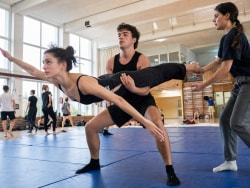 Learn the Airplane lift: step-by-step guideThe Airplane is the perfect entry-level lift for show dance. Learn how to master this move safely, step by step, using the right technique.