

Find your stable dance partner
Are you looking for the perfect opportunity to test your newly gained stability on the dance floor? On udansa, you will find the right courses and like-minded people in your area.


True elegance in Kizomba shows itself in apparent effortlessness. Only through precise control of your own core do you transform complex styling elements into fluid, stable works of art on the dance floor.
In partner dance, body tension refers to the controlled activation of the core muscles, which provides the body with stability without restricting its freedom of movement. It is the key to precise leading and harmonious interaction within the pair.
Kizomba is a dance of subtle nuances, where visual calm in the upper body often masks the enormous muscle work hidden beneath. Anyone who ventures into sophisticated styling quickly realizes that without a solid base, every embellishment looks shaky. Kizomba balance and body tension form the invisible foundation upon which every elegant movement is built. If you want to take your Kizomba Body Movement: Styling for advanced dancers to the next level, you must learn to use your center as an energetic anchor.
Many dancers mistakenly confuse necessary body tension with stiffness. The opposite is true, however: only through controlled, elastic basic tension in the torso, also known as core tension, do you retain the necessary flexibility in your limbs. This dynamic allows you to react lightning-fast to weight shifts and remain stable even during complex styling elements like syncopations or tight turns.
To master advanced Kizomba posture, a deep understanding of your own body's biomechanics is required. The Kizomba body tension technique is based on an active alignment of the pelvis and a deep activation of the abdominal and back muscles. As soon as you consciously engage these muscle chains, you stabilize your spine and relieve your joints. This is particularly important when movements become slower and the pauses between steps are set more deliberately.
When it comes to Kizomba balance, it is not about standing rigid like a pillar. Rather, balance resembles a constant, minimal counterbalancing over your own standing leg. Advanced dancers use the principle of grounding for this: energy is actively directed into the floor through the forefoot, while the crown of the head reaches upwards. This vertical stretch creates the necessary space in the body to perform soft, isolated movements in the pelvis or chest without losing the connection to your partner.
Stand barefoot on one leg at home and close your eyes. Try to maintain your balance for one minute by actively engaging your foot muscles and your core.
Only when you learn to stand absolutely stable in your own axis, can you give your partner the freedom to lose themselves completely in the dance.
A common misconception in partner dance is that balance is a purely individual matter. In Kizomba, however, the centers of gravity of both dancers merge into a shared center. Anyone who cannot control their own center endangers the stability of the entire couple. If you want to learn how to move safely without affecting your partner, it is recommended to take a look at the basics in Learning to dance Kizomba: The guide for partner dance.
As soon as both partners possess excellent self-tension, a feeling of weightlessness emerges. Signals are transmitted without delay, and styling elements from the follower can be effortlessly caught and balanced by the leader. This deep, non-verbal communication requires that you maintain control over your own axis at every moment of your dance. This is how every complex sequence becomes a harmonious and fluid dialogue on the dance floor.
The elastic connection in the upper body
Active body tension ensures immediate signal transmission between partners. It enables precise, fast weight shifts and gives your partner the necessary security for demanding styling elements.
The blockage in the flow of movement
A rigid, blocked body prevents the subtle feeling of the mutual axis. Without elastic flexibility, movements appear wooden and the connection within the pair is lost.
Good body tension feels elastic and active, but never cramped. You should be able to breathe deeply while your abdominal and back muscles stabilize your spine.
Find the right course to specifically improve your technique and balance in Kizomba.
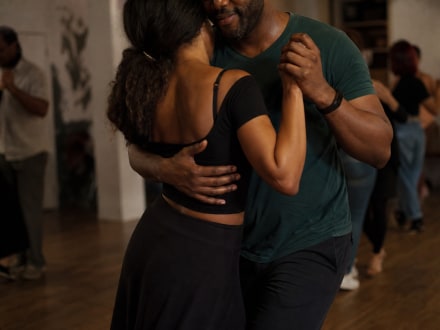 Kizomba Body Movement: Styling for Advanced DancersTake your Kizomba to the next level. Learn how to add more feeling to your dance with subtle body movement, precise Tarraxinha technique, and elegant improvisation.
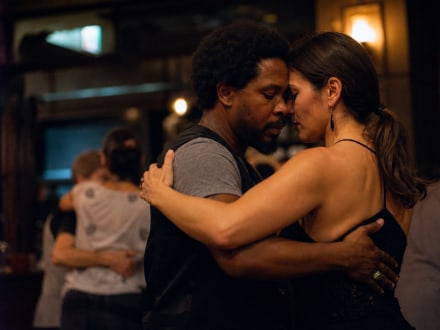 Learn to dance Kizomba: The guide to the partner danceKizomba combines African rhythms with a deep, emotional connection in partner dance. Learn how to master this fascinating dance style from scratch.
 Kizomba Body Movement: Styling for Advanced DancersTake your Kizomba to the next level. Learn how to add more feeling to your dance with subtle body movement, precise Tarraxinha technique, and elegant improvisation.
 Kizomba Show Styling: The best moves for your performanceMake your choreography unforgettable. With these Kizomba show styling moves, you are guaranteed to turn heads on stage and in social media videos.
 Kizomba Head Movement: Leading gentle head movements correctlyGentle head movements give Kizomba an incomparable elegance. Learn here how to lead and follow head styling safely and harmoniously through subtle body impulses.
 Kizomba Lady Styling: Expressive Arms in Partner DanceAdd more expression to your Kizomba with elegant arm and hand movements, all while keeping your connection to your partner stable.
 Mastering Kizomba hip movement: Subtle pelvic tilts for your stylingDiscover how to refine your Kizomba hip movement through targeted pelvic tilts and add noticeable elegance and softness to your dance style.
 Learn Tarraxinha Technique: Gentle Kizomba IsolationsMaster the art of sensual micro-movements. With our guide, you will learn the precise Tarraxinha technique for smooth isolations in Kizomba partner dance.
 Kizomba Styling Level: Take the body awareness self-testFind out what level your Kizomba body movement is at with our targeted self-test. Analyze your body control beyond the basic steps.