

Find your dance connection
On udansa you will find like-minded people who share your passion, as well as suitable courses in your area to take your styling to the next level together.

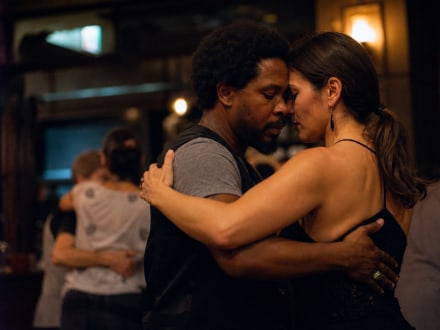
Kizomba thrives on close connection and shared flow. With gentle head movements, you add a fascinating depth to your dance when you interpret the signals correctly and execute them softly.
Kizomba Head Movement refers to the controlled, aesthetic tilting and flowing of the head in partner dance. This movement is initiated by the partner's weight shift and requires completely relaxed neck muscles.
If you want to add advanced accents in Kizomba, you can hardly avoid head styling. However, an elegant Kizomba head styling never arises from an abrupt movement or even muscle power. The basis for this fluid aesthetic lies in a deep, trusting connection within the pair. The leader does not give the impulse through the hands or arms, but transfers the movement directly from the weight shift of his own upper body. Only in this way can the follower feel the subtle inclination and react to it organically.
To get started with this technique, it is advisable to first familiarize yourself with the foundation of the dance. If you would like to strengthen your basic connection, you will find valuable tips in the article Learning to dance Kizomba: The guide for partner dance. As soon as the shared axis is stable, the Kizomba head movement technique can be wonderfully integrated without losing the balance in the pair.
For successful Kizomba head styling, the follower's posture is crucial. The neck remains long and relaxed, while the movement of the cervical spine acts like a gentle extension of the spine. A common mistake is actively throwing the head independently. A true Kizomba head movement as a follower waits patiently for the leader's invitation instead. This invitation usually occurs via a minimal change in the angle of the ribcage within the close embrace.
To decode these subtle signals without misunderstandings, it is worth taking a look at further styling concepts. In the article Kizomba body movement: styling for advanced dancers, it is explained in more detail how the entire body serves as a resonance body for the lead. Head styling is ultimately the crown of this interplay and requires a high degree of sensitivity and letting go.
Practice the movement standing still first, without steps. Focus only on how the tilt of the ribcage affects the partner's head, before you integrate it into the dance.
Elegant head styling in Kizomba is the result of absolute trust and the courage to completely surrender control of the neck to the movement of the body.
The art of Kizomba head movement technique lies in the perfect dosage. Less is almost always more here. Leaders should take care never to physically push or force the partner's head in a direction. The lead is rather a gentle guiding and offering of a space into which the follower's head can tilt. As soon as pressure is applied, the neck muscles reflexively block, which immediately destroys the elegance of the moment.
For this harmonious dynamic to succeed on the dance floor, both partners must be able to perfectly control their own axis. The gentle head styling unfolds its full effect especially in the slow, sustained passages of the music. It enhances the dance by creating an optical weightlessness that elegantly underscores the intimate character of Kizomba.
Leading from the core
The impulse for the movement is initiated exclusively through weight shifting and the inclination of your own upper body. Your hands remain completely relaxed while doing so.
Reaction with a soft neck
The movement is allowed as a passive reaction to the partner's impulse. The neck remains soft, and the head follows the tilt of the ribcage with a tiny delay.
The leader initiates the movement through a minimal tilt of their own upper body within the close embrace. This impulse is transferred to the follower's chest, whose head follows the movement as a natural extension of the spine.
 Learn to dance Kizomba: The guide to the partner danceKizomba combines African rhythms with a deep, emotional connection in partner dance. Learn how to master this fascinating dance style from scratch.
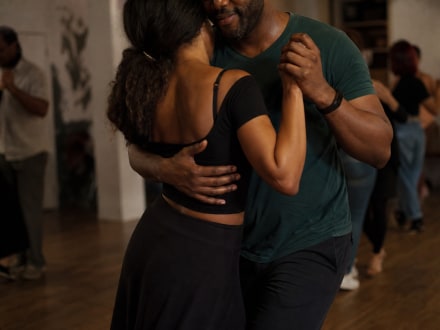 Kizomba Body Movement: Styling for Advanced DancersTake your Kizomba to the next level. Learn how to add more feeling to your dance with subtle body movement, precise Tarraxinha technique, and elegant improvisation.
 Kizomba Body Movement: Styling for Advanced DancersTake your Kizomba to the next level. Learn how to add more feeling to your dance with subtle body movement, precise Tarraxinha technique, and elegant improvisation.
 Kizomba Lady Styling: Expressive Arms in Partner DanceAdd more expression to your Kizomba with elegant arm and hand movements, all while keeping your connection to your partner stable.
 Mastering Kizomba hip movement: Subtle pelvic tilts for your stylingDiscover how to refine your Kizomba hip movement through targeted pelvic tilts and add noticeable elegance and softness to your dance style.
 Learn Tarraxinha Technique: Gentle Kizomba IsolationsMaster the art of sensual micro-movements. With our guide, you will learn the precise Tarraxinha technique for smooth isolations in Kizomba partner dance.
 Kizomba Styling Level: Take the body awareness self-testFind out what level your Kizomba body movement is at with our targeted self-test. Analyze your body control beyond the basic steps.
 Kizomba isolations: How to isolate your upper bodyFind out how to refine your dance style with precise Kizomba upper body isolations and achieve maximum flexibility in your chest.
 Kizomba Body Movement for Leaders: Leading from the coreLearn how to shift your Kizomba leading entirely to your core. This way, you dance more elegantly, musically, and completely without effort.