

Find your dance connection on udansa
On udansa, you will find like-minded people and professional courses to take your isolations and your overall dance feeling to the next level.


Fine waves and precise accents make Kizomba so magical. With the right techniques for your chest, you give your dance a fascinating depth, completely without restless steps.
In Kizomba, the deep connection between partners is not created by expansive steps, but by minimal, precise movements in the upper body. When you learn to move your ribcage independently of your shoulders and pelvis, your dance gains incredible depth and elegance. Many dancers initially tend to move the entire torso as a rigid unit, which makes the leading feel stiff. The targeted Kizomba Body Movement: Styling for advanced dancers technique addresses exactly this: By decoupling the individual sections of the spine, you can send or receive the finest impulses without causing restlessness in your steps.
To achieve this independence, you must activate your deep core muscles while simultaneously learning to remain completely relaxed in the shoulder girdle. The focus is exclusively on the ribcage. While your legs maintain stable ground contact, you gently shift your upper body in all directions. These isolations are the foundation for expressive styling and make the subtle difference between mechanical imitation and true, soulful Learning to dance Kizomba: The guide for partner dancing.
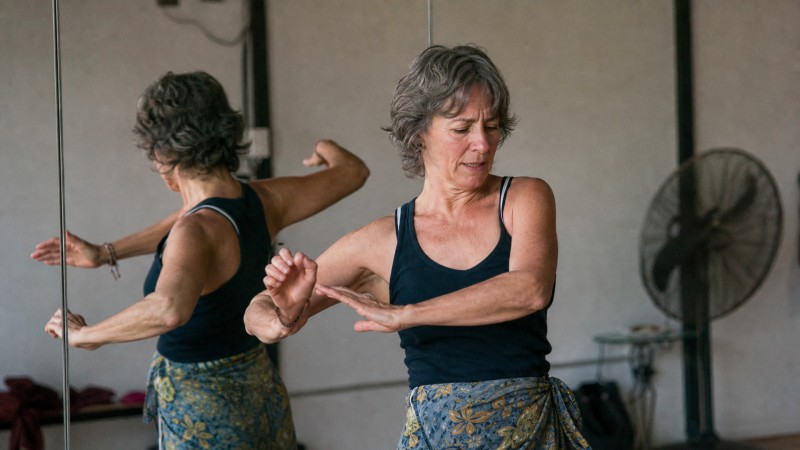
Use your hands to provide feedback: place one hand on your belly and the other on your sternum to feel immediately whether only your ribcage is actually moving.
Stand with your feet hip-width apart and bend your knees very slightly. Place your hands on your hip bones to ensure that your pelvis remains absolutely still and stable throughout the entire exercise.
Push your chest straight forward without shrugging your shoulders. Then pull it far back so that your shoulder blades open slightly, while keeping your gaze directed straight ahead.
Now shift your ribcage exactly to the left and right, as if you were moving it along a horizontal rail. Pay close attention to ensure that your shoulders do not tilt, but remain horizontal.
Connect the four points at the front, right, back, and left into a fluid circular motion. As soon as you can manage the circle without any jerking, switch directions to train both sides equally.
Kizomba upper body isolations describe the ability to move the ribcage independently of the shoulders and the pelvis. This technique allows you to visually and physically express subtle accents in the music.
Find the right course now and refine your dance technique with professional guidance.
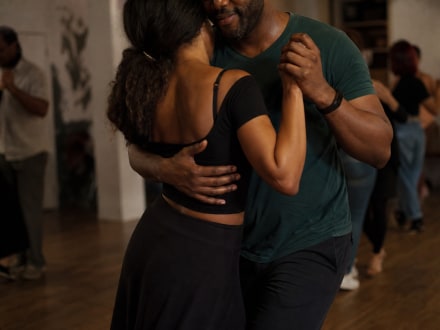 Kizomba Body Movement: Styling for Advanced DancersTake your Kizomba to the next level. Learn how to add more feeling to your dance with subtle body movement, precise Tarraxinha technique, and elegant improvisation.
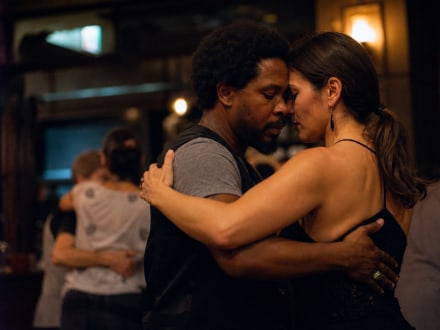 Learn to dance Kizomba: The guide to the partner danceKizomba combines African rhythms with a deep, emotional connection in partner dance. Learn how to master this fascinating dance style from scratch.
 Kizomba Body Movement: Styling for Advanced DancersTake your Kizomba to the next level. Learn how to add more feeling to your dance with subtle body movement, precise Tarraxinha technique, and elegant improvisation.
 Kizomba Body Movement for Leaders: Leading from the coreLearn how to shift your Kizomba leading entirely to your core. This way, you dance more elegantly, musically, and completely without effort.
 The 7 biggest Kizomba styling mistakes and how to fix themKizomba styling thrives on subtle, fluid movements from the core. We show you the seven most common body movement mistakes and how to fix them immediately.
 Kizomba Body Wave: Guide to the perfect body waveThe Kizomba body wave is one of the most elegant movements in partner dance. With our guide, you will learn the sophisticated technique for maximum harmony as a couple.
 Train Kizomba flexibility: Exercises for fluid movesWith specific Kizomba flexibility training, you can free up your hips and spine for fluid body waves and elegant isolations on the dance floor.
 Kizomba styling in partner dance: Harmony and connectionKizomba styling in partner dance requires sensitivity and body control. Learn how to integrate your movements seamlessly without disrupting the connection.
 Practicing Kizomba styling alone: Your solo training planImprove your Kizomba styling at home without a partner. With targeted solo exercises, you can train your isolations, balance, and body awareness highly effectively.