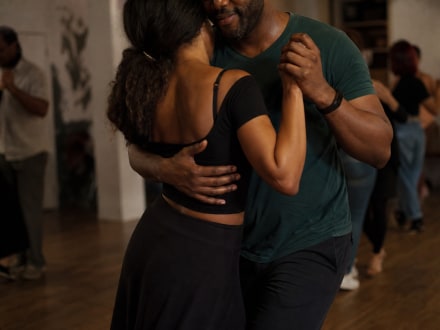
Find your dance connection on udansa
Whether you are looking for courses or the right dance partner for your Kizomba practice, on udansa you connect directly with the community in your region.
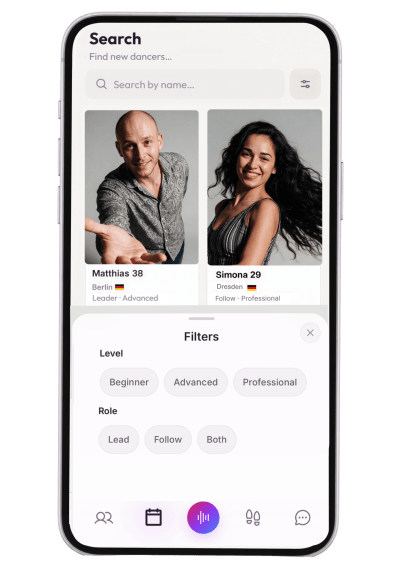

Kizomba fascinates with its deep connection and flowing elegance. But how do you manage to lead your partner across the dance floor seemingly effortlessly, without using force? The answer lies in conscious leading from your core, as taught by udansa.
Kizomba body movement for leaders describes the targeted control and isolation of the chest, torso, and pelvis for the leading dance partner. This technique makes it possible to transmit signals for steps and changes of direction purely through body contact, without using the arms.
Anyone who has ever watched a first-class Kizomba couple immediately notices the almost magical connection. The leader moves, and the partner follows as if by itself, without any visible signals being given. The secret behind this lies in the precise use of the core. When you, as a leader, learn to send your signals not through your hands or arms, but directly from your core, your entire dance quality changes. Your arms serve merely as a stable, yet soft frame that transmits the movement of your center one-to-one.
This subtle Kizomba leader technique requires a high level of body awareness. Instead of pushing or pulling your partner in a direction with muscle power, you move your own center of gravity. Since the upper body remains in close contact in Kizomba, the partner feels every weight shift of your chest immediately. When you plan a step forward, the movement begins in your hips and your stomach, even before your foot leaves the floor. This type of leading feels incredibly light, fluid, and organic for the partner.
To use Kizomba leading body movement effectively, you need to understand the anatomy of your stance. A common mistake is a completely stiff upper body while the legs try to work through the steps. For precise leading, you need active but relaxed deep muscles. Imagine your spine is as elastic as a spring. Every rotation, every lowering, and every lifting of your ribcage is transmitted directly to the connection with your partner. The power comes from the legs and the pelvis, is modulated in the torso, and is gently passed on.
An important aspect for Kizomba styling men is so-called dissociation, which is the conscious separation of upper and lower body movements. You can tilt your pelvis slightly or move your ribcage in isolation without your feet moving from the spot. This allows you to interpret subtle accents in the music, such as soft syncopations, directly with your body without throwing your partner off balance. Anyone who masters these isolations not only dances with more musical precision but also conserves their energy over a long evening of dancing.
Your arms have only one task when leading from the center: they keep the frame stable. As soon as you start pushing with your hands or pulling your shoulders up, you block the flow. Keep your shoulders low and relaxed while your elbows maintain a firm but elastic connection. When you rotate in your torso, your entire frame rotates as a unit. This way, every signal arrives undistorted.
When practicing in class, consciously place your hands flat on your partner's shoulder blades without gripping. Then, try to move her through the space using only the rotation of your ribcage.
Anyone trying to lead with their arms in Kizomba blocks the flow. True leading is a silent conversation between two centers of gravity.
The transition from mechanical step sequences to intuitive leading takes time and patience. An excellent way to get a feel for these subtle nuances is to attend workshops or specialized courses. If you want to delve deeper into the subject, it is worth taking a look at the comprehensive guide Kizomba Body Movement: Styling for advanced dancers, which dives deeper into the various levels of movement. There, you will learn how to further refine your coordination.
To get started on the dance floor, it helps to put your ego aside and focus entirely on the music and your own center of gravity. In social dance, consciously begin with simple basic steps and try to initiate them exclusively through the weight transfer of your pelvis and chest. You will quickly notice that your partner reacts much more sensitively when you give her the space to follow your movement instead of actively positioning her. A harmonious dance is created in exactly this moment of effortless transmission.
Leading from the core
Here you actively control every movement through the rotation of your ribcage and the weight shift of your pelvis. Your arms only passively transmit these signals as a stable frame.
Leading via the extremities
Here, the attempt is made to force changes in direction by pushing, pulling, or leveraging with the hands and arms. This leads to tension and disrupts the shared flow.
No, your arms should not be limp. They form a stable yet elastic frame that transmits the movements of your upper body directly to your partner, without you having to grab or push with your hands.
Find the right dance school and learn the art of subtle leading directly from professionals.
 Kizomba Body Movement: Styling for Advanced DancersTake your Kizomba to the next level. Learn how to add more feeling to your dance with subtle body movement, precise Tarraxinha technique, and elegant improvisation.
 The 7 biggest Kizomba styling mistakes and how to fix themKizomba styling thrives on subtle, fluid movements from the core. We show you the seven most common body movement mistakes and how to fix them immediately.
 Kizomba Body Wave: Guide to the perfect body waveThe Kizomba body wave is one of the most elegant movements in partner dance. With our guide, you will learn the sophisticated technique for maximum harmony as a couple.
 Train Kizomba flexibility: Exercises for fluid movesWith specific Kizomba flexibility training, you can free up your hips and spine for fluid body waves and elegant isolations on the dance floor.
 Kizomba styling in partner dance: Harmony and connectionKizomba styling in partner dance requires sensitivity and body control. Learn how to integrate your movements seamlessly without disrupting the connection.
 Practicing Kizomba styling alone: Your solo training planImprove your Kizomba styling at home without a partner. With targeted solo exercises, you can train your isolations, balance, and body awareness highly effectively.
 Kizomba balance and body tension: Stay stable in every moveStability in every step: Learn how to control your body tension in Kizomba and maintain perfect balance even during demanding styling elements.