

Find your smooth dance partner on udansa
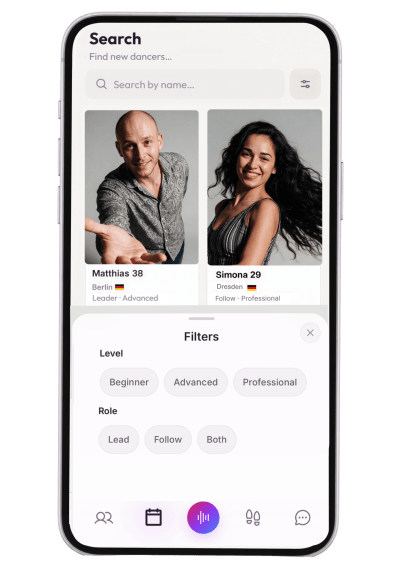
On udansa you will find like-minded people who share your passion, as well as suitable dance schools to put your newly gained flexibility to use directly on the dance floor.

Kizomba thrives on fluid movements and a deep connection between partners. With targeted exercises for your hips and spine, you release tension from your body and make your movements noticeably smoother.
The soft, wave-like movements in Kizomba do not arise from pure muscle power, but from a delicate interplay of deep muscle control and targeted mobility. While many standard dances require a firm posture, this Angolan dance thrives on the organic isolation of individual body parts. If you want to take your Kizomba Body Movement skills to the next level, you cannot avoid targeted training of the spine and pelvis. A stiff back or a blocked hip prevents your partner's signals from flowing or you from aesthetically executing your own styling elements.
Forget general fitness exercises or pure endurance training when it comes to your suppleness. To achieve the typical elasticity in Kizomba, you need special kizomba flexibility training that strengthens the deep muscles around the lumbar spine while simultaneously stretching the hip flexors and gluteal muscles. Only through this combination can you create the space in your body that you need for soft waves and precise isolations. Once you have mastered the basics, you can take the next step and execute the typical Kizomba steps with a completely new lightness and elegance.
Breathe deeply into your belly during stretching exercises and consciously release all tension in your hips as you exhale. Only a relaxed muscle can be effectively lengthened.
Stand up straight, bend your knees slightly, and tilt your pelvis forward and backward in a controlled manner. Feel how your lumbar spine gently stretches and curves, without your upper body moving along with it.
Step into a deep lunge and slowly push your pelvis forward and down to feel the {{accent:Kizomba}} hip stretch intensely. Hold the position for at least thirty seconds per side to effectively lengthen your hip flexors.
Get into a quadruped position and move your spine, alternating between a cat-cow stretch and a slight hollow back. This mobilization loosens the fascia along the spine and prepares you optimally for fluid waves.
Sit on the floor with your upper body upright, bend one leg, and place your foot over the other knee. Gently pull your knee toward your chest to stretch the deep gluteal muscles, which are crucial for hip rotation.
Stand up straight and try to shift only your rib cage to the left and right, while your pelvis remains absolutely stable. This trains coordination for Kizomba body movement training in partner dance.
A daily ten-minute short program provides the best results for Kizomba flexibility training. The muscles and fascia around the hips and spine need regular stimulation to become permanently more supple and to reduce blockages.
Find the right studio to try out your new body awareness directly in partner dance.
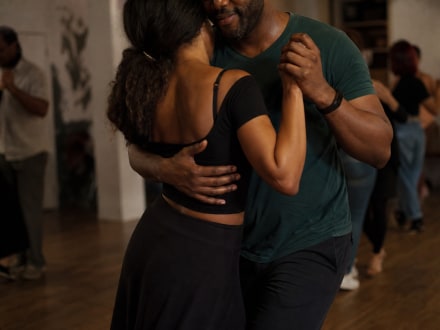 Kizomba Body Movement: Styling for Advanced DancersTake your Kizomba to the next level. Learn how to add more feeling to your dance with subtle body movement, precise Tarraxinha technique, and elegant improvisation.
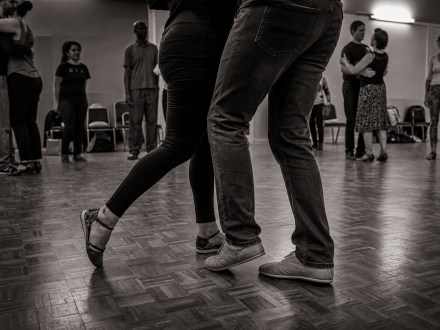 Learn Kizomba steps: An easy start for beginnersGetting started is easy: With our practical guide, you will learn the most important Kizomba basic steps and the correct posture for a harmonious dance experience.
 Kizomba Body Movement: Styling for Advanced DancersTake your Kizomba to the next level. Learn how to add more feeling to your dance with subtle body movement, precise Tarraxinha technique, and elegant improvisation.
 Kizomba styling in partner dance: Harmony and connectionKizomba styling in partner dance requires sensitivity and body control. Learn how to integrate your movements seamlessly without disrupting the connection.
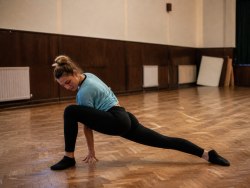 Practicing Kizomba styling alone: Your solo training planImprove your Kizomba styling at home without a partner. With targeted solo exercises, you can train your isolations, balance, and body awareness highly effectively.
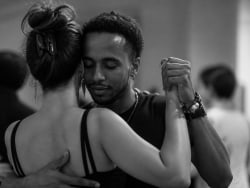 Kizomba balance and body tension: Stay stable in every moveStability in every step: Learn how to control your body tension in Kizomba and maintain perfect balance even during demanding styling elements.
 Kizomba Show Styling: The best moves for your performanceMake your choreography unforgettable. With these Kizomba show styling moves, you are guaranteed to turn heads on stage and in social media videos.
 Kizomba Head Movement: Leading gentle head movements correctlyGentle head movements give Kizomba an incomparable elegance. Learn here how to lead and follow head styling safely and harmoniously through subtle body impulses.
 Kizomba Lady Styling: Expressive Arms in Partner DanceAdd more expression to your Kizomba with elegant arm and hand movements, all while keeping your connection to your partner stable.