

Find your partner for fine styling
Find like-minded people on udansa who share your passion for smooth isolations. Discover suitable workshops and make connections in the community.
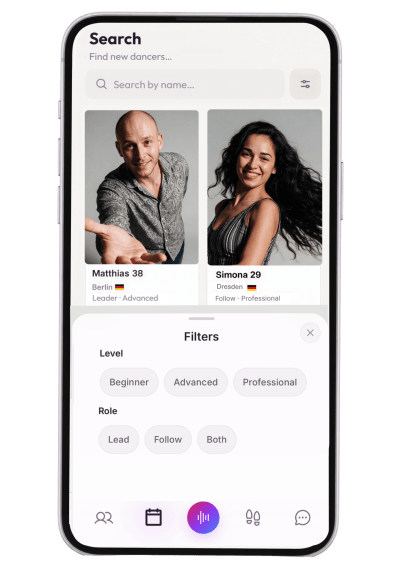

Kizomba thrives on subtle connection and body isolation. Find out with our self-test how developed your body control really is and where your styling level lies.
Kizomba is far more than just flawlessly completing basic steps. The true magic happens when you start to interpret the music with your entire body. A precise sense of body awareness and fine movement control are the key to adding a personal touch to your dance. However, many dancers reach a point where they find it difficult to assess their own level of body movement. A well-founded Kizomba styling level test helps you to realistically classify your current skills and develop them in a targeted manner.
Control over your own muscles is the basis for every successful embellishment. While beginners are often still busy keeping their balance, advanced dancers can move their upper body and pelvis completely independently of each other. If you would like to delve deeper into the theoretical and practical foundations of these forms of movement, you will find valuable detailed instructions for your training in the guide on Kizomba body movement: styling for advanced dancers.
You are at the beginning of your styling journey. Your priority is to build a stable base tension and to get to know the fundamental movement directions of your pelvis. Focus on simple isolation exercises while standing in the near future to develop a better feeling for your center.
You have already developed a good sense for your body and can move your pelvis and upper body separately in simple patterns. Your next step is to refine these movements to make them smoother and more musical. Practice varying the tempo of your isolations.
Your body control is at a very high level. You isolate different muscle groups effortlessly and can set complex waves and rhythmic accents with precision. Specialized masterclasses that focus on minimal nuances and highly elegant micro-styling are perfect for you.
| Criterion | Beginner styling | Advanced styling | Professional movement |
|---|---|---|---|
| Focus | Maintaining basic tension | Soft pelvic movements | Complex full-body waves |
| Isolation | Barely present | Hips and chest separated | Precise fine isolations |
| Musicality | Keeping the beat | Embellishing melodic arcs | Playing with micro-rhythms |
| Partner harmony | Concentration on steps | Styling without interference | Breathing together in the move |
The transitions between the levels are fluid and depend heavily on regular solo training.
Film yourself during solo practice with your smartphone from different angles. Often, your own body awareness differs significantly from what is actually visible on the dance floor.
As soon as you know your test result, you can structure your training much more purposefully. It makes little sense to attempt complex upper body waves if the basic isolation in the pelvis is still imprecise. Use your result to specifically search for workshops that address exactly your areas for improvement. If you want to try things out on the dance floor and test your new styling directly with a partner, it is worth taking a look at the regional offers. A comprehensive introduction to the entire spectrum of dance awaits you in the overarching guide Learning to dance Kizomba: The guide for partner dance.
Don't forget that styling in Kizomba must never come at the expense of the connection to your partner. Every movement you perform in isolation should flow harmoniously into your shared rhythm. Use solo exercises in front of the mirror to target specific muscle groups before you apply the movements at the next social party.
A Kizomba styling test focuses exclusively on your body control, isolations, and the aesthetics of your movements. Unlike general level assessments, walking steps, figure sequences, or the mastery of step combinations play no role here.
Find the right dance school to take your body movement to the next level.
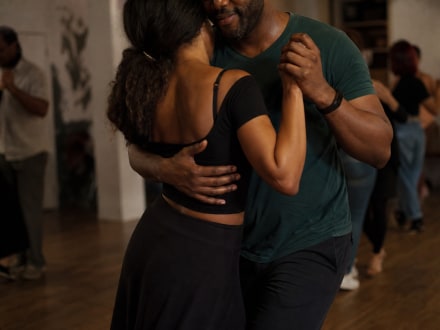 Kizomba Body Movement: Styling for Advanced DancersTake your Kizomba to the next level. Learn how to add more feeling to your dance with subtle body movement, precise Tarraxinha technique, and elegant improvisation.
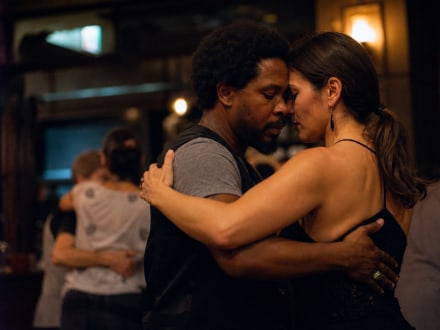 Learn to dance Kizomba: The guide to the partner danceKizomba combines African rhythms with a deep, emotional connection in partner dance. Learn how to master this fascinating dance style from scratch.
 Kizomba Body Movement: Styling for Advanced DancersTake your Kizomba to the next level. Learn how to add more feeling to your dance with subtle body movement, precise Tarraxinha technique, and elegant improvisation.
 Kizomba isolations: How to isolate your upper bodyFind out how to refine your dance style with precise Kizomba upper body isolations and achieve maximum flexibility in your chest.
 Kizomba Body Movement for Leaders: Leading from the coreLearn how to shift your Kizomba leading entirely to your core. This way, you dance more elegantly, musically, and completely without effort.
 The 7 biggest Kizomba styling mistakes and how to fix themKizomba styling thrives on subtle, fluid movements from the core. We show you the seven most common body movement mistakes and how to fix them immediately.
 Kizomba Body Wave: Guide to the perfect body waveThe Kizomba body wave is one of the most elegant movements in partner dance. With our guide, you will learn the sophisticated technique for maximum harmony as a couple.
 Train Kizomba flexibility: Exercises for fluid movesWith specific Kizomba flexibility training, you can free up your hips and spine for fluid body waves and elegant isolations on the dance floor.
 Kizomba styling in partner dance: Harmony and connectionKizomba styling in partner dance requires sensitivity and body control. Learn how to integrate your movements seamlessly without disrupting the connection.