
Find your Kizomba partner on udansa
On udansa, you meet like-minded people who share your passion for Kizomba, and find suitable dance courses to take your technique to the next level together with a partner.



By Mary De LucaUpdated
On udansa, you meet like-minded people who share your passion for Kizomba, and find suitable dance courses to take your technique to the next level together with a partner.
The soft, flowing movements in Kizomba do not originate in the feet, but in the core. With the right pelvic tilt technique, you give your dance its typical elegance and lightness.
Kizomba fascinates through its deep, almost hypnotic connection between partners. While beginners often focus on footwork, the true secret of the dance lies in the upper body and, above all, in the hips. To be able to learn Kizomba hip movement, you need to understand the mechanics of your pelvis. This is not about expansive, circular movements like in Salsa or classic Bachata. Kizomba requires a fine, controlled micro-movement that originates deep in the core and gently transfers outward.
This fine technique is based on targeted pelvic tilting. By learning to move your pelvis in isolation forward, backward, and to the side, you create the characteristic softness in the dance. This movement is so subtle that it is barely perceptible as an effort to outsiders, yet it unfolds an enormous effect in partner dancing. It ensures that every step feels organic and that the connection to your partner remains stable yet elastic. With the right technique, you improve your overall body awareness and add an elegant touch to your dance style.

Stand with your feet hip-width apart and bend your knees slightly. Keep your feet flat on the floor and relax your shoulders to create a stable base.
Gently engage your lower abdominal muscles and pull your tailbone downwards and forwards. Your pelvis tilts backwards, which causes your lumbar spine to straighten slightly.
Now, push your tailbone back and up in a controlled manner so that your pelvis tilts forward. Make sure not to create an extreme hollow back, but keep the movement smooth.
Connect the tilting forward and backward into a single, fluid wave movement. Visualize a horizontal figure eight that you gently draw in the air with your tailbone.
Check in the mirror whether your shoulders and rib cage are absolutely still while only your pelvis moves. This is the only way to achieve the necessary isolation.
Like this
Don't do this
Preparation
In the meantime
Follow-up
The difference lies in the range and direction. While Salsa movements are often circular and Bachata movements are emphasized laterally, Kizomba is based on a vertical pelvic tilt forward and backward, which is performed in a very small and controlled manner.
Yes, absolutely. You can practice the pelvic tilt perfectly on your own in front of a mirror to build the necessary muscle control and flexibility before you apply it in partner dancing.
Tense abdominal or gluteal muscles block the movement. Try to keep your knees slightly bent and consciously relax the muscles in your lower back to let your hips swing freely.
Find the right course on udansa now and refine your technique.
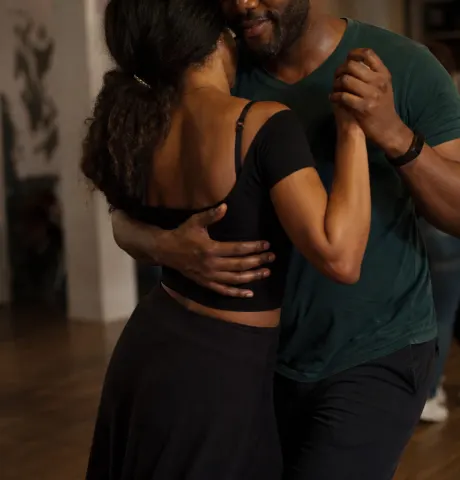 Kizomba Body Movement: Styling for Advanced DancersTake your Kizomba to the next level. Learn how to add more feeling to your dance with subtle body movement, precise Tarraxinha technique, and elegant improvisation.
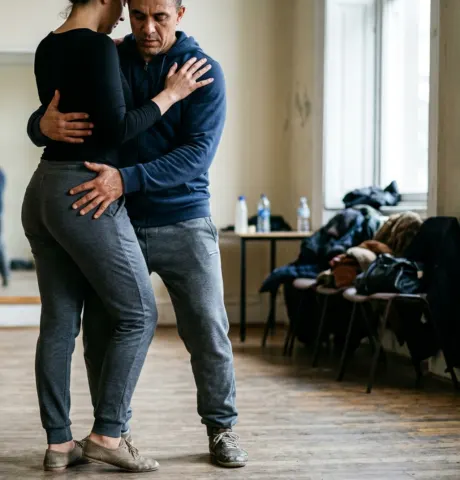 Learn Tarraxinha Technique: Gentle Kizomba IsolationsMaster the art of sensual micro-movements. With our guide, you will learn the precise Tarraxinha technique for smooth isolations in Kizomba partner dance.
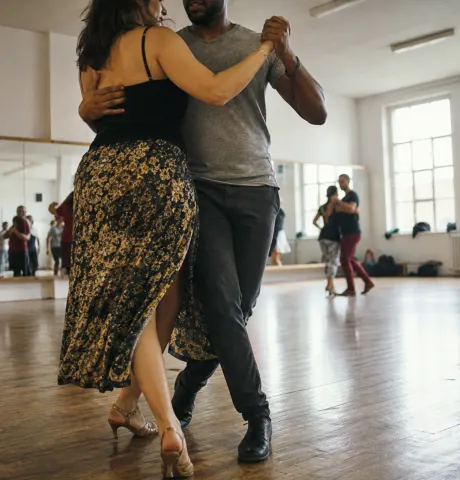 Kizomba Styling Level: Take the body awareness self-testFind out what level your Kizomba body movement is at with our targeted self-test. Analyze your body control beyond the basic steps.
 Kizomba isolations: How to isolate your upper bodyFind out how to refine your dance style with precise Kizomba upper body isolations and achieve maximum flexibility in your chest.
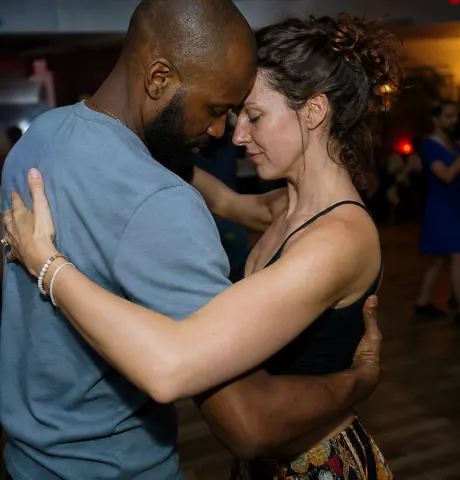 Kizomba Body Movement for Leaders: Leading from the coreLearn how to shift your Kizomba leading entirely to your core. This way, you dance more elegantly, musically, and completely without effort.
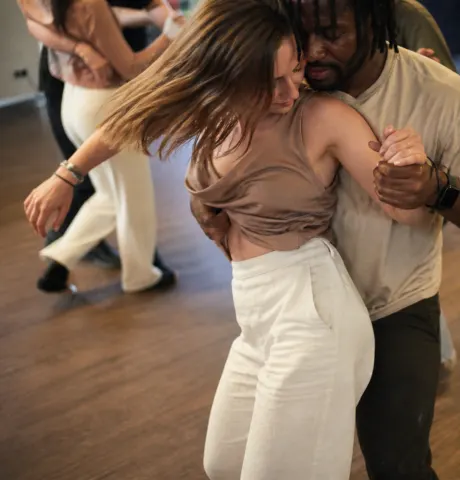 The 7 biggest Kizomba styling mistakes and how to fix themKizomba styling thrives on subtle, fluid movements from the core. We show you the seven most common body movement mistakes and how to fix them immediately.
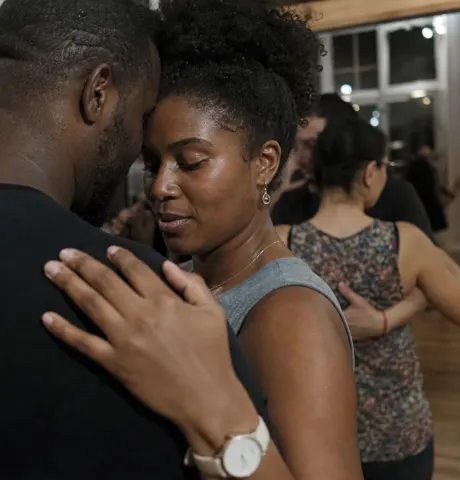 Kizomba Body Wave: Guide to the perfect body waveThe Kizomba body wave is one of the most elegant movements in partner dance. With our guide, you will learn the sophisticated technique for maximum harmony as a couple.