Partner acrobatics5 minutes

Lifts with a height difference: Which grip works for you?

By Mary De LucaUpdated

In a nutshell
  • Choosing the optimal grip for lifts depends significantly on the height and weight difference between the dance partners.
  • With a large height difference, lower grip points on the pelvis and thighs compensate for the changed leverage.
  • A balanced pair benefits from classic armpit and hip grips, while more extreme differences require more stable support grips.
  • The correct technique protects the lifter's spine and allows the flyer to maintain a stable balance in the air.

If you want to reach new heights in partner acrobatics, you need to understand your own laws of leverage. This test helps you find the perfect grip technique for your individual body measurements.

Use the laws of leverage instead of muscle power

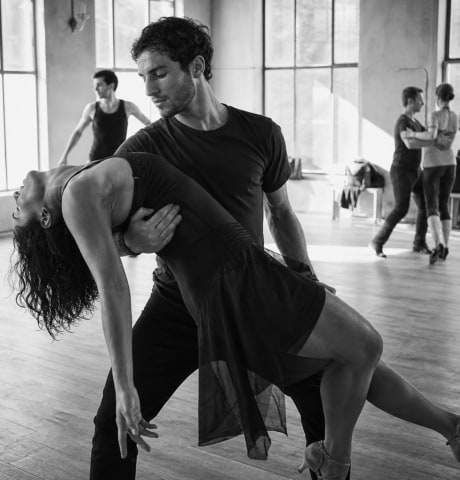
In show dance and partner acrobatics, it is not raw muscle power that determines whether a lift looks effortless or becomes a shaky moment. It is the physics of the laws of leverage. When a couple has significant differences in height and weight, the anatomical pivot points shift. A standard grip that works perfectly for couples of the same height often leads to blocked hips or forces the flyer to arch their back when there is a large difference. To avoid injuries, you should specifically adapt your grip technique.

For the lifter, it is essential in the case of a large height difference to compensate for the leverage by using a lower stance. Anyone working deeper in the knees lowers their own center of gravity and can fix the hips of the smaller partner more stably. At the same time, the flyer must build up extreme body tension as a flyer in order not to collapse. The right coordination ensures that the weight is optimally transferred to the supporting bone structures instead of overloading the muscles of the lifter in the lumbar region.

Lifts and height difference test: Which type are you?

  1. What is the height difference between the two of you?

    • A: Less than 10 centimeters, we are almost at eye level
    • B: Between 10 and 20 centimeters, a classic difference
    • C: More than 20 centimeters, we have a clear contrast
  2. How does the weight ratio in your dance couple compare?

    • A: We weigh about the same or the difference is minimal
    • B: The flyer is noticeably lighter, but within a normal range
    • C: There is a very significant weight difference between us
  3. At which point does the grip feel most stable?

    • A: Directly under the armpits and on the shoulders
    • B: Classically on the hip bones of the lead partner
    • C: Low on the pelvis or with support on the thighs
  4. How does the flyer react when taking off into a lift?

    • A: Can ascend almost vertically and without much extra force
    • B: Needs a noticeable impulse from the lifter's legs
    • C: Must push themselves upwards strongly using the lifter's arms

Your evaluation

Mostly A: The symmetrical pair

You are physically very close to each other, which makes classic lifts easier because your centers of gravity are at a similar height. Use classic grips, such as the armpit-hip grip, to generate maximum dynamics. Make sure that you synchronize perfectly during the jump.

Mostly B: The harmonious lever pair

You have a noticeable, but well-controllable difference in height and weight. The base should actively use their knee joints as shock absorbers and position themselves a bit lower, while the flyer must particularly emphasize core tension. The wrist grip offers you optimal safety here.

Mostly C: The leverage specialist pair

Your significant difference in height or weight requires a targeted adjustment of physics. The base grips low on the pelvis or thighs to control the flyer's long lever. The flyer must ascend extremely quickly and immediately fix their hips above the base. Use stabilizing support grips.

The lift variants in direct comparison

CriterionType A: SymmetricalType B: HarmonicType C: Lift specialists
Height differenceUnder 10 cm10 to 20 cmOver 20 cm
Recommended gripArmpit-shoulder gripWrist-hip gripLow pelvic-thigh grip
ChallengeAvoid hip blockageTiming of the jumpLong leverage of the flyer
Safety focusSynchronous jumpStable core tensionLow stance of the base

The optimal grips are based on the biomechanical laws of leverage in partner acrobatics.

From static grip to fluid choreography

As soon as you have determined your ideal grip technique and lift variation using our test, it is time for practical training in the studio. Never try to force a new lift directly with full momentum from the dance step. Instead, start in the static position and focus on the moment of the jump and the precise grip. Only when the grip is second nature and both partners feel absolutely secure can you incorporate the move into a fluid motion.

If the weight difference is particularly large, it helps to make the ascent easier by using intermediate steps, for example by briefly bracing on the carrier's thigh. If you are returning after breaks due to injury, you should also look into the topic of Back to Acro Dance to gently reintroduce your body to the stresses of partner acrobatics. A systematic approach protects your joints and ensures long-term success on stage.

Frequently Asked Questions

  1. With a large weight difference, the lifter should stand with their knees bent deeply to lower the center of gravity. Additionally, grip techniques that are close to the flyer's center of gravity, such as the double hip grip or the thigh support grip, are helpful.

Acrobatics courses near you

Find the right course on udansa now to learn how to guide your lifting technique professionally.

View all matching courses

Reach new heights together with udansa

On udansa you will find like-minded people who share your passion for acrobatics, as well as suitable courses in your area to take your lifting technique to the next level.

Reach new heights together with udansa