

Glide across the dance floor together safely
On udansa connect, you will find like-minded people who share your passion for acrobatics, as well as the right workshops in your area. Sign up and find the ideal dance partner for your next lift.


Forget the myth that lifts are only for bodybuilders. With an understanding of leverage and axes, acrobatics in partner dance become a safe and elegant art of movement for every couple.
The center of gravity is the theoretical point where the entire weight of a body acts. In partner dance, the relative position of both partners' centers of gravity to each other significantly determines stability and the effort required for lifts.
Anyone watching spectacular lifts in partner dance often assumes it requires years of intensive strength training at the gym. However, the reality is different: the true magic behind an effortless-looking lift is based on the incorruptible laws of physics. Without the right lifting technique, even the greatest muscle strength is of little use, as an unfavorable lever arm multiplies the weight to be lifted. As soon as both dance partners learn to purposefully use the leverage laws of their own bodies, gravity loses its terror.
The key lies in keeping the distance between the centers of gravity of both partners as small as possible. The further the upper partner is from the carrier's center of rotation, the greater the torque acting on the lower partner's back. By consciously pulling the partner toward one's own body axis, the load arm is minimized. The result is a noticeable relief for the spine and a stable stance that makes even demanding poses safely portable.
A successful lift is never the work of a single person, but the result of a perfectly coordinated weight transfer between the couple. Many couples fail at first because the partner being lifted passively waits to be lifted up. In practice, however, both dancers must actively contribute to the movement. Before the actual lift begins, there is a joint preparation where the centers of gravity are optimally aligned with each other.
Through a targeted weight transfer just before the jump, kinetic energy is generated that significantly supports the ascent. The lifter uses the power from the legs and the pelvis, while the flyer actively shifts their center of gravity over that of the lifter. This synchronization ensures that the lift is not perceived as a mere push, but as a fluid transition. Once you have internalized the physical principles, you will also understand why a solid ballroom dance posture forms the ideal basis for stability in space.
Take a deep breath together before the jump and use the exhalation for the upward impulse. This synchronizes your timing perfectly and provides a natural boost of power at the moment of the lift.
As soon as couples stop working against each other, and start moving their masses over physical axes, every lift in partner dance suddenly becomes playfully easy.
The biggest source of error in lifts in partner dance is the attempt to compensate for instability through pure muscle strength in the upper body. If the lifter bends their arms or the flyer collapses in the pelvis, the power transmission immediately breaks down. For a safe lift, seamless body tension is essential. The flyer's body must act like a solid, inherently stable column that distributes the weight evenly onto the lifter's support surface.
This firmness allows the lifter to transfer the weight directly into the floor through their vertical bone structure, instead of laboriously holding the load with the muscles of the arms and shoulders. Bone work beats muscle work by a long shot here. Only when this structural connection is established does the figure become stable and safe. If you want to dive deeper into the world of dance movement control, you will find the perfect foundations in the Acrobatics in Dance section to systematically refine the interplay of balance and body tension.
The stable foundation of the lift
The lifter acts as a stable foundation. They keep their center of gravity low, use leg strength for the lift, and channel the partner's weight vertically through their bone axis into the floor.
Maintaining balance in the air
The flyer provides the necessary body tension and balance. By actively shifting your own center of gravity over the base, the lift becomes light and controllable.
No, body weight is secondary as long as the lifting technique is correct. By correctly aligning the centers of gravity and using the laws of leverage, even petite people can safely lift heavier partners.
Find the right dance school on udansa now and learn lifts with professional guidance.
Sunday · 14:30-16:00 · Nov 15, 2026 - Jan 17, 2027
Limbach-Oberfrohna
Sunday · 14:30-16:00 · Sep 6 - Nov 8
Limbach-Oberfrohna
Sunday · 14:30-16:00 · Nov 15 - Nov 29
Limbach-Oberfrohna
 Ballroom Dance Posture: How to build the perfect frameProper posture and a stable frame are the foundation of every ballroom dance. Learn how to glide elegantly across the floor with the right body tension and orientation.
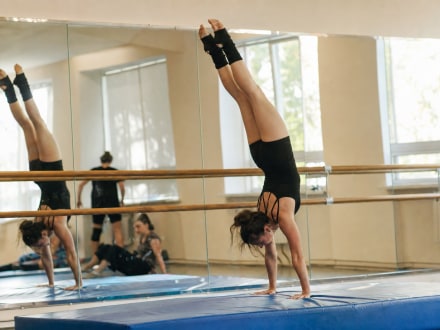 Acro Dance: Acrobatics for Teens & AdultsAcro Dance fascinates through the fusion of athleticism and elegance. Learn how teens and adults can safely master this demanding style.
 Learning lifts: Take off safely in show danceLifts add that special something to every choreography. Learn how to take off successfully using the right physics, body tension, and safe introductory exercises.
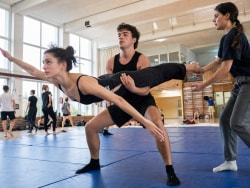 Learn the Airplane lift: step-by-step guideThe Airplane is the perfect entry-level lift for show dance. Learn how to master this move safely, step by step, using the right technique.