Grow beyond your limits together safely
On udansa, you connect with ambitious dance partners and find professional courses for show dance and acrobatics in your region. Start now and take your choreographies to the next level safely!

By Bernhard De LucaUpdated
On udansa, you connect with ambitious dance partners and find professional courses for show dance and acrobatics in your region. Start now and take your choreographies to the next level safely!
The most beautiful flight loses its shine if the landing feels uncertain. With the right technique, you catch your partner gently and finish every lift elegantly and without injury.
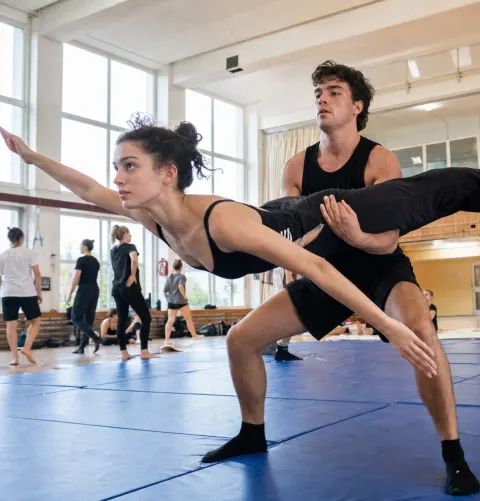
A spectacular lift magically draws the audience's attention in show dance, but the applause is often decided only during the descent. Whoever shines at the top must arrive safely at the bottom. When lowering, enormous physical forces are at play that briefly multiply the body weight of the person flying. Without the right technique for catching, there is a risk of painful falls or joint strain. Landing in partner acrobatics therefore requires the same precision and concentration as the ascent.
To consistently avoid injuries during training and on stage, both partners must act as a well-coordinated team. The lifter does not catch the mass with the pure muscle power of the arms, but directs the energy into the ground through their legs. The flyer, in turn, supports this process through active body tension until the final contact with the floor. It helps to familiarize yourself with the basic safety rules for dance acrobatics before training to ensure you train injury-free from the start and internalize the movement patterns cleanly.
The base initiates the landing with a clear, gentle signal or a controlled downward pulse. The flyer keeps their torso firmly engaged to avoid collapsing.
The base guides the flyer's pelvis down close to their own body. The closer the centers of gravity stay to each other, the less leverage is placed on the base's arms.
The flyer lands on the balls of their feet first to cushion the initial impact. Only then do the heels lower in a controlled manner, while the knees yield slightly.
At the moment of contact with the floor, the person goes deep into their knees to softly absorb the remaining falling energy. The arms accompany the movement, but they do not carry the main load.
Both partners maintain the supporting hold on the hips, hands, or shoulders until the flyer is standing stably and is in complete control of their own balance.
Find the right training to learn lifts from scratch in a professional way.
Student DanceBurgstädt · Germany
Aufbaukurs Burgstädt Montag Schuljahr 2026/27Monday · 13:30 · Nov 9, 2026 - Jan 25, 2027
Burgstädt
Modern Dance for kidsBerlin · Germany
Modern Dance & Akrobatik ab 10 J.Wednesday · 17:00 · Nov 11
Flow Motion Studio Wedding
Student DancePenig · Germany
Aufbaukurs Penig Schuljahr 2026/27Monday · 14:30 · Nov 9, 2026 - Jan 25, 2027
Penig
Like this
What to avoid
Preparation
During
Afterwards
The lifter absorbs the weight by bending their knees deeply at the moment the partner makes contact with the floor. This dissipates the vertical impact force through the thighs and protects the spine.
The flyer must maintain core tension until they are standing stably. Relaxing too early causes the body to collapse, which throws the lifter off balance and can cause serious falls.
Partners should only release their grip once the flyer is standing firmly on the floor with both feet and has completely balanced their equilibrium on their own.
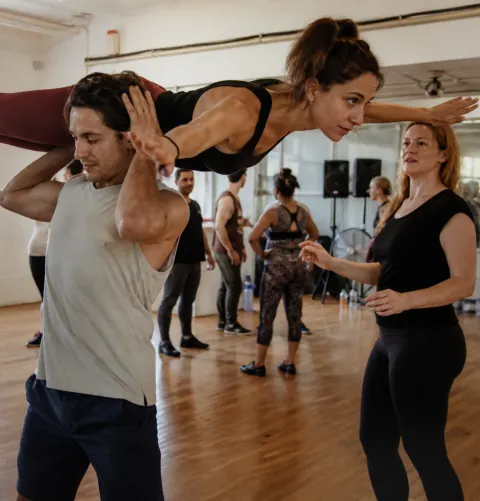 Learning lifts: Take off safely in show dance
 Lift Trends 2026: Dynamics and New Poses
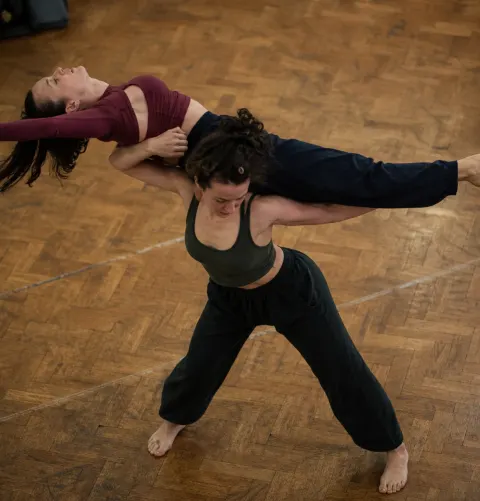 Gender-neutral lifts: Dynamic role switching
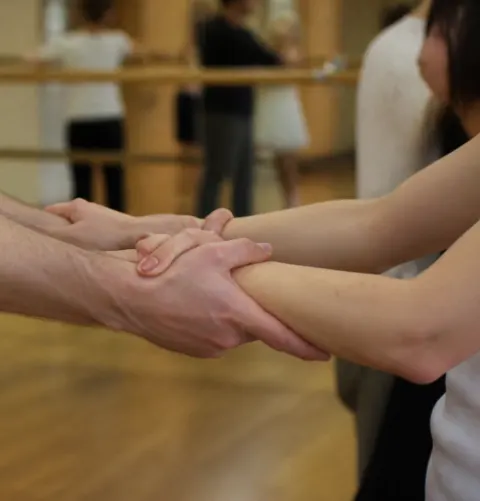 The 5 most common grip mistakes in show dance lifts
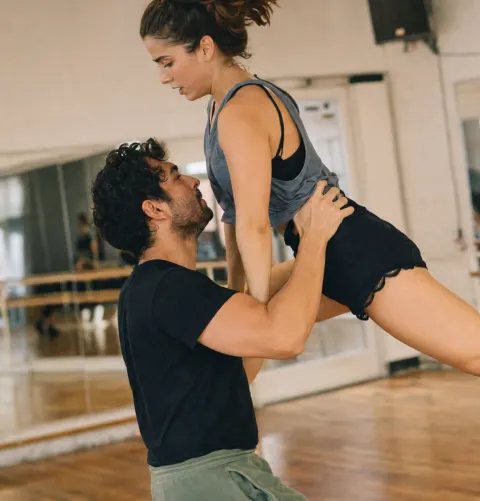 Lifts with height differences: Which grip works for you?
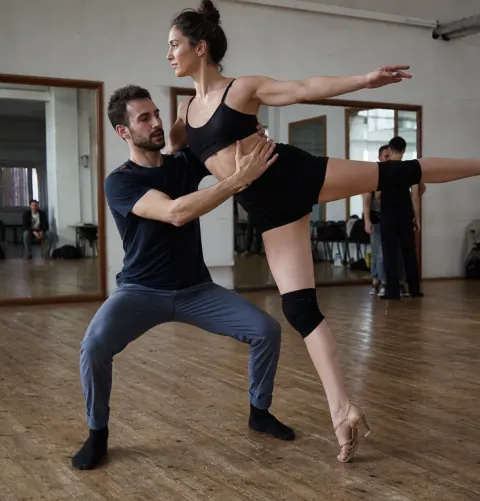 Lifts in dance: Physics over brute force
 Learn the Airplane lift: step-by-step guide