Dance acrobatics4 minutes

Training core strength for acrobatics: step by step

By Mary De LucaUpdated

In a nutshell
  • Stable core tension protects the spine from dangerous shear forces during lifts and overhead elements.
  • Training the deep muscles improves balance and enables precise power transmission throughout the entire body.
  • Through targeted breathing techniques, body tension remains elastic and dynamically controllable even under high strain.
  • Regular core training noticeably minimizes the risk of injury during demanding dance acrobatic elements.

If you want to take off in Acro Dance, you have to lay the foundation on the ground. A stable core protects your spine during every lift and provides the necessary lightness in the air.

What you need for training

  • A non-slip exercise mat
  • Basic body awareness for pelvic tilts
  • Pain-free wrists and elbows
  • Five minutes of time for a short warm-up

Why deep core muscles determine your balance

In acro dance, success or a fall often comes down to millimeters. When you hold a lift or go into a handstand, your joints are subjected to many times your body weight. Without activated deep core muscles, your spine shifts, your pelvis tilts, and you lose your balance. A safe execution of dance acrobatics is only possible if the power transmission between your upper and lower body works seamlessly. The secret lies not in superficial muscle groups, but in the conscious activation of the transversus abdominis, the deepest transverse abdominal muscle, which acts like a natural corset.

The connection between the pelvic floor and the diaphragm

To train core tension for acrobatics, you must learn to decouple your breathing from your muscle activity. Many beginners fall into breath-holding as soon as they tense their core, which drives up blood pressure and blocks endurance. Only the interplay of a slightly pulled-in pelvic floor, a flat lower abdomen, and fluid flank breathing creates the elastic stability you need for dynamic movements. This technique differs fundamentally from the classic posture in ballroom dance, where the axis is aligned differently, as you can read in our guide on the stable ballet axis. In acro dance, the core must withstand extreme leverage forces while simultaneously reacting flexibly to changes in direction.

Step by step to maximum core strength

  1. Activate the deep layer

    Lie flat on your back, bend your legs, and place your feet on the floor. Breathe in deeply and, as you exhale, gently pull your belly button towards your spine without moving your pelvis. You will feel a deep firmness in your lower abdomen.

  2. Keeping the hollow body position stable

    From a lying position, lift your head and shoulder blades slightly while keeping your legs stretched and hovering a few centimeters above the floor. Keep your lower back pressed firmly against the floor to securely stabilize the position.

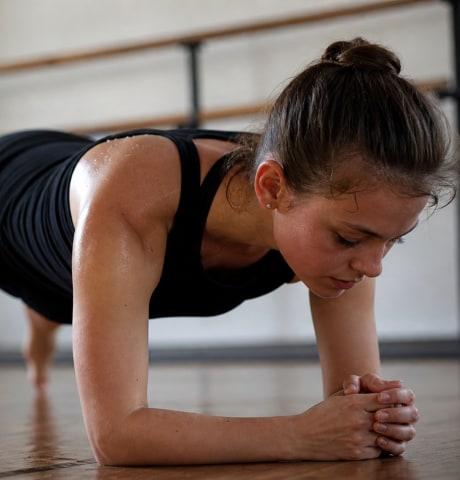
  3. Refining the forearm plank

    Move into the forearm plank and form a straight line from your heels to your head. Actively push your elbows into the floor and tuck your tailbone slightly to consistently prevent sagging in the lumbar region.

  4. Building diagonal balance

    On all fours, lift your left arm and right leg diagonally. Keep your pelvis perfectly level and pull your elbow toward your knee under your body in a controlled manner to train the dynamic balance of your core.

The most important do's and don'ts for core training

Correct

  • Gently pull your belly button inward and upward
  • Breathe deeply into your sides while holding the position
  • Release the position immediately as soon as your form suffers

Wrong

  • Push your stomach out excessively
  • Hold your breath and tense up
  • Force the exercise despite having a hollow back

Your checklist for a stable core

Before training

Preparation

While practicing

During

Frequently Asked Questions

  1. You can recognize good core tension by the fact that your hips do not buckle during lifts and overhead elements, and you maintain your balance without compensatory movements. In addition, you can continue to breathe calmly and evenly despite maximum muscle activity in your core.

Acro Dance courses near you

Find the right training to refine your technique and strength under professional guidance.

View all matching courses

Find your partner for the middle

On udansa connect, you will find like-minded people who want to refine the perfect balance with you, as well as suitable workshops for your dance-acrobatic development.

Find your partner for the middle