
Find your dance partner for the next turn
On udansa, you will find like-minded people in your city who keep the beat with you and make the next dance night unforgettable.


By Bernhard De LucaUpdated
On udansa, you will find like-minded people in your city who keep the beat with you and make the next dance night unforgettable.
The exhilarating speed of the Viennese Waltz captivates every ballroom. With the right technique, you will master the continuous rotation without feeling dizzy at all and glide elegantly across the dance floor.
The Wiener Walzer fascinates with its dynamics, but the high speed of almost 60 bars per minute puts the balance system to a tough test. Anyone who wants to learn the Wiener Walzer turn almost always struggles with dizziness at the beginning. This dizziness occurs because the eyes and the inner ear send contradictory signals to the brain. While your eyes try to fixate on the fast-moving surroundings, the semicircular canals in the ear register a continuous rotation. The solution lies not in superhuman balance, but in precise dance technique and conscious gaze control.
To stay dizzy-free while turning in the Wiener Walzer, both dance partners must interlock like a single gear. As soon as one of the two leaves the axis or takes steps that are too large, the rotation falters, which drastically increases centrifugal force and thus dizziness. Focus on understanding the turn as a joint forward and backward gliding motion. If you want to prepare optimally and consolidate the basics, it is worth taking a look at our guide on learning Wiener Walzer for beginners, which gives you the necessary foundation for the dance floor.

Stand in front of each other and shift your feet slightly to the left, so that you can each look past your partner on the right side. This asymmetrical stance ensures that your legs do not block each other when turning.
The leading partner dances a wide forward step with the right foot between the partner's feet, while the following partner takes a small step back with the left to make room.
Use the end of the first step to shift your body weight onto the balls of your feet and perform a half turn clockwise. Bring your feet together at the end of the bar.
Now the roles switch fluidly: The person previously moving forward takes a soft backward step with their left, while the partner pushes forward with their right and continues the rotation.
Fix your gaze on a point just behind your partner's shoulder throughout the entire sequence. Avoid moving your head independently of your body to give your inner ear maximum stability.
Turning correctly
Avoid mistakes
Preparation
Arrival
While
Dizziness occurs because the vestibular system in your inner ear registers the continuous rotation, while your eyes try to track the passing environment. This conflicting information briefly overwhelms the brain.
Do not fixate on a spot in the room while turning, instead look slightly to the right past your partner at their shoulder or neck. This keeps your visual field stable relative to the movement and prevents your brain from panicking as the walls fly by.
The right turn is easier for most couples to learn because it follows the natural clockwise movement along the line of dance. It requires less extreme spatial coverage in the corners of the room.
Find the right dance course now to refine your turning technique under professional guidance.
Couple danceLimbach-Oberfrohna · Germany
PaartanzkreisFriday · 18:15 · Oct 23
Limbach-Oberfrohna
BallroomMeißen · Germany
Tanzkreis | PROFESSIONALTuesday · 20:15 · Oct 27, 2026 - Jan 5, 2027
“Ein Haus für Vieles” - Saal Tanzkurse
Couple danceBurgstädt · Germany
Paarkurs - Goldstar TanzkreisSunday · 15:00 · Oct 25
Burgstädt
 Classic Ballroom Dances: The 5 Essential StylesDiscover the five most important classic ballroom dances. From the lively Viennese Waltz to the elegant Foxtrot, learn all about their unique character here.
 Learn Viennese Waltz for beginners: Step by step to ballroom successLearn the Viennese Waltz from scratch. Our compact guide shows beginners the first steps and how to master the basic step without getting dizzy.
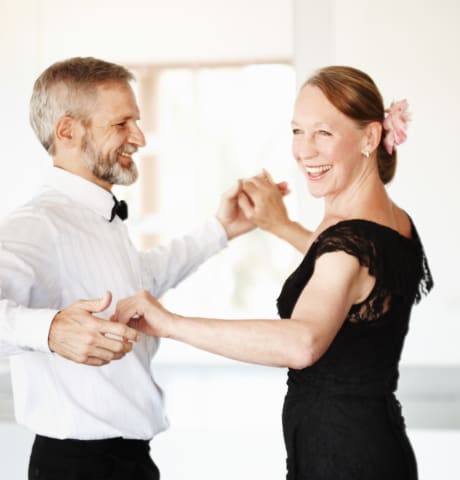 Dance floor direction: Rules for smooth movementDance floor direction is the most important traffic rule for dance couples. Learn how to move correctly in a counter-clockwise circle and elegantly avoid collisions.
 Learn ballroom dancing and master floor etiquetteGet ready for the glamorous ball season. Learn everything about the most important ballroom dances, the Viennese Waltz, and proper floor etiquette.
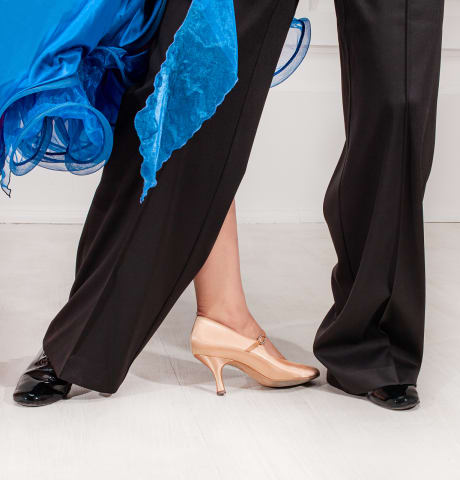 The 7 biggest mistakes on the ballroom dance floor and how to avoid themKnowing the typical pitfalls on the dance floor helps you move with style and consideration. Our guide shows you the most important rules for a harmonious experience in the ballroom.
 Fledermaus-Quadrille: The midnight tradition explainedDiscover how the traditional Fledermaus-Quadrille works at midnight and how to shine with the right steps. Your guide to this legendary group dance.
 Ballroom Crash Course vs. Dance Class: Which is worth it?The ball date is approaching and your dance steps aren't ready yet? Our comparison between a ballroom crash course and a regular dance class shows you the most stress-free way to the dance floor.Learn Viennese Waltz for beginners: Step by step to ballroom successLearn the Viennese Waltz from scratch. Our compact guide shows beginners the first steps and how to master the basic step without getting dizzy.Dance floor direction: Rules for smooth movementDance floor direction is the most important traffic rule for dance couples. Learn how to move correctly in a counter-clockwise circle and elegantly avoid collisions.Classic Ballroom Dances: The 5 Essential StylesDiscover the five most important classic ballroom dances. From the lively Viennese Waltz to the elegant Foxtrot, learn all about their unique character here.