
Find your perfect partner for the dance ball
On udansa you will meet other dance enthusiasts who, just like you, want to prepare for the next festive ball night. Make connections and find the ideal partner for unforgettable hours on the dance floor.


By Mary De LucaUpdated
On udansa you will meet other dance enthusiasts who, just like you, want to prepare for the next festive ball night. Make connections and find the ideal partner for unforgettable hours on the dance floor.
A glamorous ball night promises elegance, captivating music, and magical moments on the dance floor. With the right dance preparation and knowledge of classic etiquette, you will move through the ballroom with absolute confidence.
The dance direction describes the predetermined path of movement for all couples on the dance floor, who always move counter-clockwise around the center of the room during partner dancing. This ensures a smooth flow of traffic and effectively prevents collisions on crowded dance floors.
Anyone who dares to venture into learning ballroom dancing for a festive night is usually faced with a venerable tradition with its own set of rules. A glamorous ball is not an ordinary club visit, but an elegant interplay of music, movement, and mutual respect. The most important foundation for a harmonious evening is mastering the classic dances of the ballroom category, above all the Viennese Waltz. However, Foxtrot, Slow Waltz, or a lively Rumba are also part of the standard repertoire of a brilliant ball night.
To move confidently on the dance floor, early preparation is recommended. Many dance schools offer special crash courses where the most important steps are taught in a compact way. If you want to dive deeper, use a regular dance course to strengthen your posture and develop a real feeling for movement in the room. A solid foundation takes away the nervousness and ensures that you can enjoy the evening to the fullest instead of constantly having to stare at your feet.

The Viennese Waltz is considered the king of ballroom dances, but it often presents couples with an athletic challenge. With around 60 bars per minute, it is extremely fast. If you want to successfully learn the Viennese Waltz, you should first focus on the right turn and moving fluently in the direction of dance. Only when these basics are mastered by heart is it time to dance the left waltz. Since the axes of the dancers shift during the left turn, this step requires precise leading and blind trust between the partners.
An absolute highlight at traditional balls, especially those modeled after Vienna, is the legendary midnight quadrille. Usually, a detailed midnight quadrille guide is announced live by the master of ceremonies while the couples stand opposite each other in long lanes. The historical basis is the famous Fledermaus Quadrille by Johann Strauss, whose steps are lively but often confusing for laypeople. If you internalize the basic gallop and promenade steps in advance, you won't stumble aimlessly through the lanes, but instead become part of a majestic, collective dance experience.
Correct
Wrong
Safety on the dance floor is not created by complicated figures, but by a shared sense of rhythm and consideration for the couples around you.
Beyond the steps, traditional etiquette defines what happens in the ballroom. The classic way to ask someone to dance at a ball follows strict rules of politeness. Traditionally, one partner asks the other with a slight bow and eye contact. Declining a charming invitation is considered impolite, unless you have already promised this dance to someone else or urgently need a break. After the dance, it is customary to escort your partner back to their table or the edge of the dance floor and thank them for the dance.
A beautiful custom, which is primarily maintained at traditional Viennese balls, is the so-called Damenspende. But what meaning does the Damenspende have today? Originally, it was a small, artistic gift that ladies received at the entrance to the ballroom, often combined with a decorative dance card on which gentlemen could sign up in advance for specific dances of the evening. Today, the Damenspende is a charming souvenir and a symbol of appreciation that underscores the festive atmosphere and the anticipation of an unforgettable ball night.
The dynamic classic in three-quarter time
The Viennese Waltz captivates with its high speed and continuous rotation around the room. It requires stamina, firm body tension, and clear orientation so you do not lose your balance in the fast three-quarter time.
Historical formation dance for all guests
The quadrille is danced as a formation dance in alleys of four couples each. It is not about turns here, but about the synchronous execution of historical step sequences upon announcement, which creates a particularly sociable atmosphere.
For beginners, we recommend a classic crash course at a dance school, specifically designed to prepare you for the ball season. There, you will learn the most important steps for the Viennese Waltz, Slow Waltz, and Foxtrot in just a few hours.
If you get bumped into, apologize briefly with a friendly smile, even if it is not your fault. On a crowded dance floor, light contact is part of the experience and should always be taken with composure.
Yes, that is absolutely common and modern today. Anyone can politely ask anyone else to dance regardless of gender, as long as it is done respectfully and with eye contact.
The Fledermaus-Quadrille consists of six traditional figures with established French names. The steps, such as chassé, balancé, and promenade, are announced clearly for everyone by the dance master during the ball.
Prepare yourself perfectly for your big moment and learn the classic steps at a dance school in your area.
BallroomMeißen · Germany
Tanzkreis | PROFESSIONALTuesday · 20:15 · Oct 27, 2026 - Jan 5, 2027
“Ein Haus für Vieles” - Saal Tanzkurse
Couple danceLimbach-Oberfrohna · Germany
PaartanzkreisThursday · 18:50 · Oct 8
Limbach-Oberfrohna
 Learn Viennese Waltz for beginners: Step by step to ballroom successLearn the Viennese Waltz from scratch. Our compact guide shows beginners the first steps and how to master the basic step without getting dizzy.
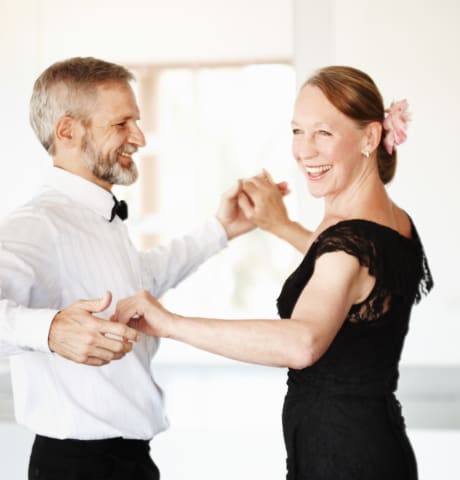 Dance floor direction: Rules for smooth movementDance floor direction is the most important traffic rule for dance couples. Learn how to move correctly in a counter-clockwise circle and elegantly avoid collisions.
 Classic Ballroom Dances: The 5 Essential StylesDiscover the five most important classic ballroom dances. From the lively Viennese Waltz to the elegant Foxtrot, learn all about their unique character here.
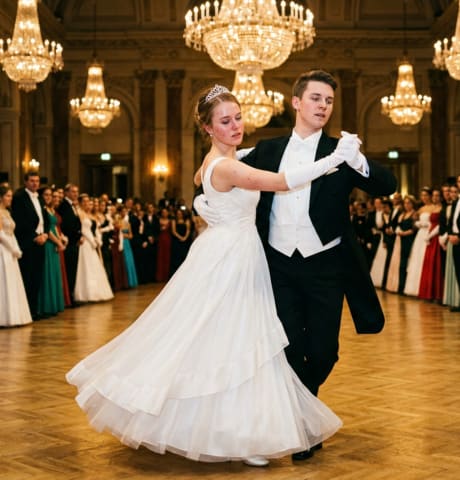 Which dance course for the ball? Take the self-testIs the ball season just around the corner and you are not sure which course will best prepare you for the dance floor? Our self-test shows you the ideal path for your time budget.
 Asking for a dance: Etiquette for the perfect ball nightAsk with style and decline with charm: With our etiquette guide for dance invitations, you will navigate every ball with absolute confidence.
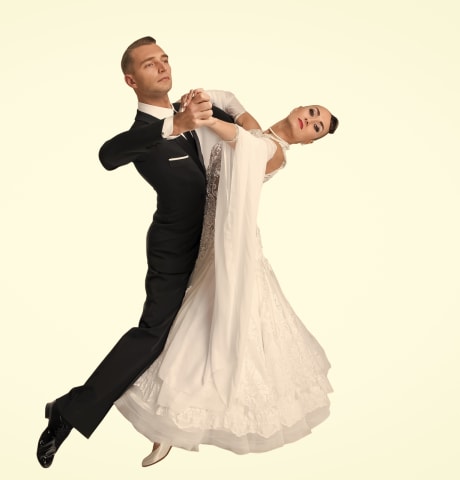 Foxtrot at the ball: Your reliable savior in the crowdFoxtrot is the secret hero of every ball night. Learn how this uncomplicated dance saves your evening when the floor is crowded and the music is unclear.
 Ladies' Choice & Gentlemen's Gifts: Modern Ballroom EtiquetteDiscover how ladies' choice and gentlemen's gifts bring a fresh breeze to the dance floor and how to behave elegantly in the modern ballroom.
 Crowded Ballroom: Tips for Dancing on a Full FloorA crowded ballroom floor requires maximum concentration. With our field-tested tips, you and your partner will navigate the festive bustle elegantly, efficiently, and completely collision-free.
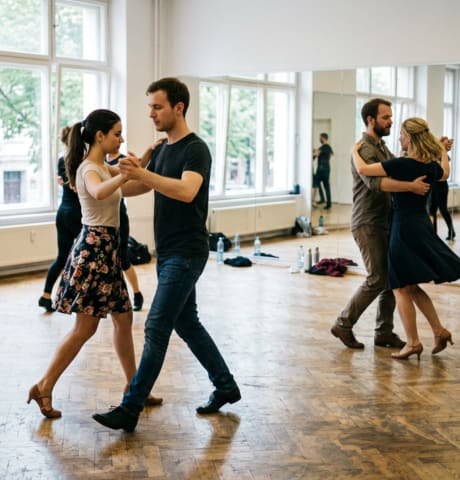 Learn to spin in the Viennese Waltz without getting dizzyNo more spinning heads on the dance floor. Learn how you and your partner can master the perfect turn in the Viennese Waltz without feeling dizzy.
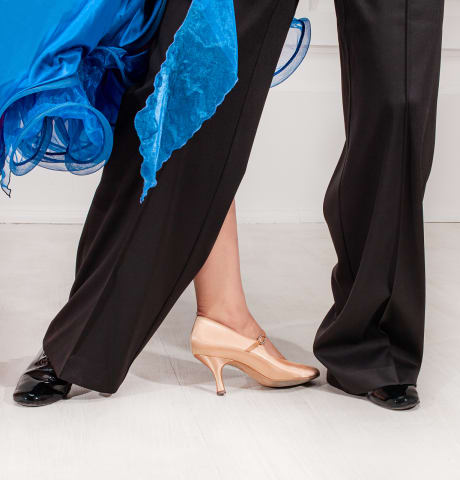 The 7 biggest mistakes on the ballroom dance floor and how to avoid themKnowing the typical pitfalls on the dance floor helps you move with style and consideration. Our guide shows you the most important rules for a harmonious experience in the ballroom.
 Fledermaus-Quadrille: The midnight tradition explainedDiscover how the traditional Fledermaus-Quadrille works at midnight and how to shine with the right steps. Your guide to this legendary group dance.
 Ballroom Crash Course vs. Dance Class: Which is worth it?The ball date is approaching and your dance steps aren't ready yet? Our comparison between a ballroom crash course and a regular dance class shows you the most stress-free way to the dance floor.