

Find your partner for the next social
On udansa, you will meet other Kizomba enthusiasts from your area who, just like you, want to experience the magic of socials and festivals. Simply create your free profile and find the perfect dance connection.

By Mary De LucaUpdated

On udansa, you will meet other Kizomba enthusiasts from your area who, just like you, want to experience the magic of socials and festivals. Simply create your free profile and find the perfect dance connection.
Kizomba is pure connection in the moment. Why dancing with changing partners at socials revolutionizes your sense of rhythm and how you can easily find your place in the scene.
Social Dance refers to dance events where socializing and dancing freely with changing partners are the main focus. It is not about rehearsed choreographies or competitive sports, but about spontaneous interaction with the music.
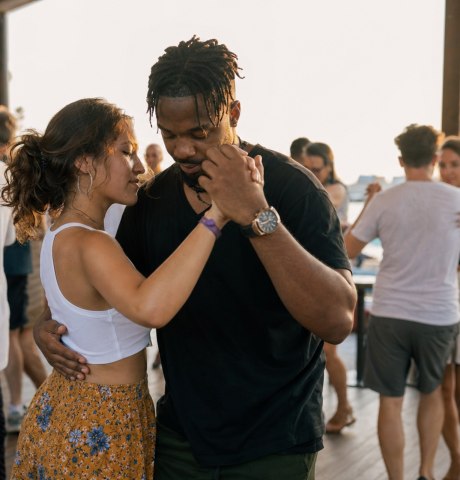
Anyone venturing to a Kizomba festival for the first time will quickly notice a very special dynamic. In contrast to classic dance schools, where couples often train in a fixed pairing for months, the Kizomba scene thrives on constant exchange. Dancing at a Kizomba social and changing partners is not an awkward necessity, but the heart of the entire community. Every festival and every social is designed so that dancers change partners after every song.
This openness has a simple reason: Kizomba is based on a deep, almost wordless connection and a refined Kizomba posture. If you only get used to a single body, you often only learn to compensate for its individual quirks. Only constant Kizomba partner switching brings advantages that really move you forward as a dancer. You learn to adjust lightning-fast to different heights, weight shifts, and dynamics, which enormously strengthens your own axis and flexibility.

A Kizomba festival is the perfect place to take this flexibility to the next level. Here, dancers from all over the world meet, all bringing their own style and different interpretations of the music. You do not need to be a professional to find partners at a Kizomba festival. The willingness to engage in non-verbal communication is completely sufficient.
Dancing with strangers trains your adaptability far beyond what is possible in regular classes. As a leader, you must send your signals so clearly and gently that they are immediately understood by every person. As a follower, you learn to switch off your expectations completely and fully engage with the moment. This intense experience of feeling together is what makes it so appealing and ensures that you often learn more after a weekend at a festival than in half a year of individual training.
Correct
Wrong
Only when you have danced with ten different people do you truly understand what leading means and how flexibly your own body can react.
For many beginners, the threshold to attend their first social is high. The worry of not being good enough or not knowing anyone keeps some from attending. However, finding a Kizomba social partner has become much easier thanks to modern networks than it seems at first glance. On udansa, you can specifically search for like-minded people who also share a passion for Kizomba and want to attend events together.
A well-maintained profile helps you make contacts before you even step onto the dance floor. If you make plans in advance or join a small group, your nervousness will almost disappear on its own. Once you arrive at the social, the golden rule of respect applies: a dance usually lasts two to three songs, after which you thank your partner and look for a new one. This keeps the energy in the room flowing and gives everyone the chance to experience the unique connection of this dance.
Clarity through subtle impulses
You will learn how to transmit your signals in an extremely precise, gentle, and effortless way, so that every follower understands you regardless of their prior experience or height.
Surrender to the moment
You let go of all expectations, react purely to the leader's weight shift, and develop deep trust in your own balance and axis.
At Kizomba socials, it is absolutely common and encouraged to show up without a fixed partner. The vast majority of dancers come alone and immediately find connections on-site due to the constant rotation.
The rotation usually takes place after each set, which typically consists of two to three consecutive songs. This gives you enough time to adjust to one another while remaining flexible.
Yes, switching partners is the fastest way to solidify the basics. By doing this, you learn from the very beginning to rely on actual leading instead of just running through memorized steps.
Experience the magic of socials and meet the community at upcoming events.
 Kizomba Etiquette: Rules for respectful dancingDance safely and respectfully: our udansa Kizomba etiquette guide shows you the most important unwritten rules for a harmonious time at every social.
 Kizomba posture: How to master the perfect connection and dance frameThe right Kizomba posture is the foundation for a harmonious connection on the dance floor. Learn how to dance with stability and fluidity through correct upper body contact.
 Find a Kizomba dance partner: Your guide to the scene and socialsFind your perfect Kizomba dance partner and dive deep into the global community. With our guide, you will be perfectly prepared for your next social and your first festival.
 Kizomba Outfits and Shoes: The Style Guide for SocialsThe right style for a Kizomba social: Learn in our guide how to ensure the perfect connection on the dance floor with the right clothing and shoes.
 Finding a Kizomba dance partner for festivals: A guideDo you want to travel to an international Kizomba festival but don't have a companion yet? Learn how to find the perfect dance partner in this guide.
 Hygiene in Kizomba: How to stay fresh in a close danceKizomba is a dance full of closeness and intensity. With our practical hygiene tips, you will stay fresh even at hot parties and be a welcome dance partner.Kizomba Etiquette: Rules for respectful dancingDance safely and respectfully: our udansa Kizomba etiquette guide shows you the most important unwritten rules for a harmonious time at every social.
 The best Kizomba festivals worldwide for your travel plansReady for the big dance floor? Discover the most important Kizomba festivals worldwide, where you can meet the international community and take your dancing to the next level.
 Closeness and distance in Kizomba: Boundaries on the dance floorKizomba fascinates with its intense closeness, but it also requires a great deal of sensitivity. Our guide shows you how to respect boundaries and build a harmonious connection.