

Find your Kizomba dance partner on udansa
Create your free profile on udansa and find like-minded people to share the perfect flow on the dance floor with.

By Mary De LucaUpdated

Create your free profile on udansa and find like-minded people to share the perfect flow on the dance floor with.
Kizomba thrives on the close, almost magical connection between partners. To ensure you can focus entirely on the rhythm and your partner, your outfit needs to fit like a second skin.
Kizomba party clothing and shoes refers to the functional wardrobe for Kizomba socials, which is designed for maximum comfort, soft materials, and flat, flexible soles so as not to disturb the close body connection.
Anyone visiting a Kizomba social for the first time will quickly notice that this dance has a very special dynamic. The extremely close connection in the upper body, the synchronized breathing, and the fluid movements require a wardrobe that supports this intimate setting instead of hindering it. Well-thought-out Kizomba party clothing and shoes are therefore not just an end in themselves, but the foundation for a relaxed evening. While other partner dances are often dominated by wide, swinging skirts or stiff shirts, the Kizomba scene focuses on soft, flexible fabrics that follow every weight shift without friction.
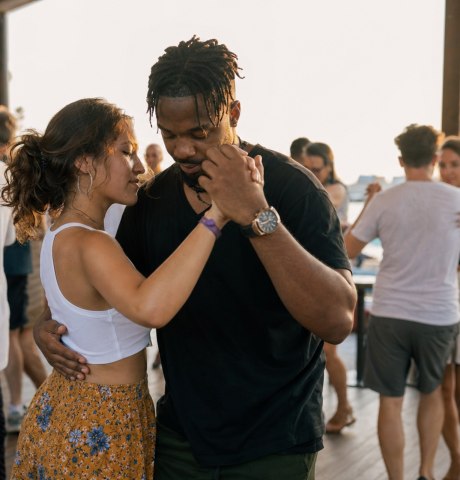
A typical Kizomba outfit for a social is characterized by comfort and functionality. Since the chest and abdominal areas are in constant contact with the dance partner, distracting embellishments such as buttons, sequins, large belt buckles, or zippers on the front are off-limits. They can not only press uncomfortably, but in the worst case, they can also get caught on the other person's clothing. Instead, experienced dancers opt for smooth, supple materials that feel like a second skin and do not block the subtle communication between the pair.

For ladies, the choice of outfit should focus on the balance between elegance and unrestricted freedom of movement. Elastic leggings, slim-fit trousers, or figure-hugging dresses made of stretchy fabrics are ideal for performing the characteristic Kizomba hip movement without interference. Skirts that are too wide carry the risk of the partner's legs getting caught in them, as steps are often placed very close together and between the other person's feet.
When choosing Kizomba shoes for women, many dancers opt for models with a low, stable heel or even elegant dance sneakers and flat jazz shoes. Since body weight in Kizomba is shifted slightly forward to stabilize the close Kizomba posture, flatter shoes often offer better balance and relieve the back during long social nights. Those who still prefer heels should ensure good ankle support and a well-cushioned sole to be able to dance the subtle isolations pain-free.
Like this
Not like this
When dancing Kizomba, we basically move with the entire body as one unit. Clothing that pinches, slips, or scratches your partner destroys this delicate moment immediately.
For men, too, the material determines the comfort factor on the dance floor. Since the upper bodies are in close contact, heavy, rigid fabrics are unsuitable. Modern Kizomba clothing for men usually consists of light, breathable T-shirts, fine long-sleeved shirts, or soft shirts made of elastic blended fabrics. Since Kizomba socials often last for many hours and the physical closeness promotes heat development, at least one spare shirt belongs in your bag to guarantee your partner a fresh feeling at all times.
When it comes to shoes, men rely on flexibility. Classic leather shoes with a hard, inflexible sole make it difficult to roll the foot precisely, which is so important for the smooth basic step. Instead, flat sneakers with a special chrome leather sole or dance shoes made of soft upper leather are popular, as they guarantee optimal rotation on the dance floor without slipping. This way, the connection to the floor remains direct and sensitive.
The focus on well-being and connection
Opt for elastic, smooth fabrics, soft materials, and flat or low, stable heels. This way, you enjoy maximum freedom of movement and a secure footing during tight turns with udansa.
Typical pitfalls at socials
Avoid heavy, stiff fabrics, scratchy sequins, large belt buckles, and extremely high, thin heels. They disrupt the close connection and quickly lead to fatigue.
For Kizomba socials, soft, elastic fabrics like viscose, modal, or fine cotton blends are particularly suitable. They are breathable, feel pleasant on the skin, and do not wrinkle when the upper body is in close contact with your dance partner.
High heels are not a must and are increasingly being replaced at socials by flat dance sneakers, jazz shoes, or special dance ballerinas. If you want to wear heels, choose a moderate height of three to five centimeters with a wider heel for better stability.
Avoid clothing with hard applications, sequins, buttons, or zippers on the front, as these can chafe or get caught during close dancing. Very wide skirts or trousers, in which your feet can get tangled, are also unsuitable.
Find the right dance school and take your new outfit straight to the dance floor.
 Find a Kizomba dance partner: Your guide to the scene and socialsFind your perfect Kizomba dance partner and dive deep into the global community. With our guide, you will be perfectly prepared for your next social and your first festival.
 Finding a Kizomba dance partner for festivals: A guideDo you want to travel to an international Kizomba festival but don't have a companion yet? Learn how to find the perfect dance partner in this guide.
 Hygiene in Kizomba: How to stay fresh in a close danceKizomba is a dance full of closeness and intensity. With our practical hygiene tips, you will stay fresh even at hot parties and be a welcome dance partner.
 Kizomba Etiquette: Rules for respectful dancingDance safely and respectfully: our udansa Kizomba etiquette guide shows you the most important unwritten rules for a harmonious time at every social.
 The best Kizomba festivals worldwide for your travel plansReady for the big dance floor? Discover the most important Kizomba festivals worldwide, where you can meet the international community and take your dancing to the next level.
 Closeness and distance in Kizomba: Boundaries on the dance floorKizomba fascinates with its intense closeness, but it also requires a great deal of sensitivity. Our guide shows you how to respect boundaries and build a harmonious connection.
 Your first Kizomba party: preparation for beginnersIs your first Kizomba party coming up? Don't worry: with the right mental and practical preparation, your first social will be a relaxed and wonderful experience.