

Find your Kizomba partner on udansa
Find like-minded people to take the step to your first social with. On udansa, you can easily connect with other beginners and experienced dancers in your area.

By Mary De LucaUpdated

Find like-minded people to take the step to your first social with. On udansa, you can easily connect with other beginners and experienced dancers in your area.
The leap from a sheltered dance class to your first open party requires some courage. With the right understanding of the dynamics of a social, the evening will become an unforgettable experience.
A social is a dance event where free, improvised dancing and social interaction take center stage. Unlike a class or a show, there are no fixed choreographies here.
For many beginners, the first step onto a Kizomba party floor is a mix of anticipation and nervousness. Often, the so-called social, which is free dancing away from classes, is misunderstood as a kind of test where you have to master flawless choreographies. In reality, a social is the place where the actual learning only begins. It is not about perfection, but about experiencing the music together and feeling the movement as a couple. Anyone who views the party as a safe space, where everyone started at some point, will quickly lose their shyness about the close embrace.
A common misconception is also that you can only shine with advanced figures. Kizomba thrives on simplicity and precision. A cleanly led basic step, danced harmoniously to the beat of the music, is more pleasant for every partner than a complicated sequence of steps that disrupts the flow. If you focus on the basics, you show respect for the dance and your partner. The preparation therefore begins in your head, by letting go of the pressure to perform and engaging with the connection.
The right mindset automatically leads to practical preparation for the evening. Anyone who understands that Kizomba is a dance involving close physical contact makes more conscious decisions for the evening. This primarily concerns the choice of clothing and personal freshness. Since the upper bodies are close together, breathable fabrics and a spare shirt in your bag are not minor details, but a sign of appreciation. A well-thought-out Kizomba evening checklist helps you keep the most important items, such as chewing gum and a small towel, ready.
Expectations regarding your own abilities also change with this understanding. You do not have to accept every dance in the room, nor do you have to dance until dawn. It is perfectly legitimate to stand on the sidelines at first, observe the dynamics of the dance floor, and get a feel for the music. This passive participation is a valuable part of your first kizomba party preparation, as it helps you pick up the rhythm and better interpret the signals of other dancers.
That is how it works
Not like this
The most beautiful connection in Kizomba does not come from spectacular moves, but from breathing together in the same rhythm.
The first party is the milestone that decides whether Kizomba becomes a true passion. If you follow the unwritten rules of the dance floor, you will quickly realize how warm and open the community is. Social dance is not about delivering a flawless show, but about sharing a good time together. Mistakes happen to everyone, even the most experienced dancers, and are usually brushed off with a smile.
To make the start as easy as possible, it is worth realistically assessing your own level of knowledge beforehand. A quick look at the basics, as taught in learning the Kizomba basic step, gives you the necessary confidence for your first rounds on the dance floor. With every dance you dare to take, your confidence in your own steps and in the connection with your partner grows.
The responsibility for the path and the space
Leading in Kizomba is about clear, gentle impulses from the upper body. The leader sets the direction and ensures that the partner can move safely across the dance floor without colliding with other couples.
Responding sensitively to impulses
Following is about actively engaging with the partner's impulses. The follower maintains body tension and reacts sensitively to weight shifts, without anticipating the movement.
For your first visit, comfortable casual clothing is perfectly fine. Make sure your clothes are clean and that you can move well in them, as Kizomba is a very close-contact dance.
No, it is absolutely common to attend Kizomba parties without a fixed partner. The scene is very open, and because partners are constantly changing on the dance floor, you will quickly find people to dance with.
Focus entirely on the basic step and the connection with your partner. If you keep the beat and focus on shifting your weight, that is perfectly sufficient and pleasant to dance for the beginning.
Find the best socials and parties to get started in the scene.
 Find a Kizomba dance partner: Your guide to the scene and socialsFind your perfect Kizomba dance partner and dive deep into the global community. With our guide, you will be perfectly prepared for your next social and your first festival.
 Kizomba Trends 2026: How the global scene is evolvingThe global Kizomba scene is evolving rapidly. We show you the most important Kizomba trends for 2026 and how they are changing dance floors.
 Dancing Kizomba as a single: Finding your way into the sceneWant to dance Kizomba but don't have a regular partner? Our guide shows you how to easily connect with others at socials and conquer the scene as a single.
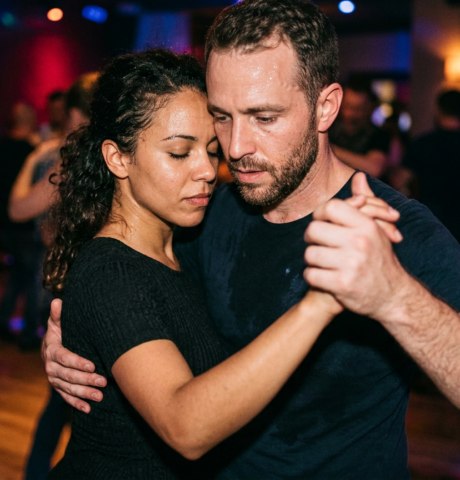 Switching partners in Kizomba: Why socials are so importantSwitching partners at Kizomba socials and festivals is the key to true dancing flexibility. Learn why dancing with strangers improves your technique and how udansa helps you find partners.
 Kizomba Outfits and Shoes: The Style Guide for SocialsThe right style for a Kizomba social: Learn in our guide how to ensure the perfect connection on the dance floor with the right clothing and shoes.
 Finding a Kizomba dance partner for festivals: A guideDo you want to travel to an international Kizomba festival but don't have a companion yet? Learn how to find the perfect dance partner in this guide.
 Hygiene in Kizomba: How to stay fresh in a close danceKizomba is a dance full of closeness and intensity. With our practical hygiene tips, you will stay fresh even at hot parties and be a welcome dance partner.