

Find your rhythm on udansa
On udansa you will find like-minded people who share your passion, as well as suitable dance schools to experience the fascinating cultures of these dances for yourself.

By Mary De LucaUpdated

On udansa you will find like-minded people who share your passion, as well as suitable dance schools to experience the fascinating cultures of these dances for yourself.
Two dances, one common root and yet completely different worlds. Discover how a Caribbean rhythm conquered the streets of Angola and the beaches of Brazil, and gave rise to two of the most fascinating partner dances of our time.
Zouk Béton is a musical style popularized in the 1980s by the Caribbean band Kassav. Its heavy, driving synthesizer rhythm formed the musical foundation for the emergence of Kizomba in Africa and Brazilian Zouk in South America.
The history of Kizomba and Brazilian Zouk is inextricably linked to the global migration of rhythms. While Kizomba matured in the late 1970s and 1980s in the backyards of Luanda, the capital of Angola, Brazilian Zouk was forming at the same time on the other side of the Atlantic. Both dances share a rhythmic DNA that was significantly shaped by the Caribbean band Kassav and their sound, the Zouk Béton from Martinique and Guadeloupe. When this music reached Angola and Brazil in the 1980s, it encountered completely different local traditions and dance cultures.
In Angola, the Caribbean influence merged with traditional Semba, a cheerful, fast-paced circle dance. The result was a new, softer partner dance with close body contact, which eventually became known as Kizomba. If you want to learn more about these African roots, you will find deeper insights in our guide on Kizomba history: From its origins in Angola to a global dance. In Rio de Janeiro, on the other hand, the same Caribbean music met Lambada, which was currently in a crisis. To save the complex turns and fluid movements of Lambada, Brazilian dancers adapted their steps to the slower, heavy beat of Zouk. Thus, the origin of Brazilian Zouk emerged from a creative rescue mission.
Although both styles originate from the same Caribbean rhythm, their movement language developed in completely opposite directions. The fundamental difference between Kizomba and Brazilian Zouk lies in the axis and the dynamics of the movement. Kizomba is a deeply grounded dance. The partners move with a shared center of gravity, the steps are precise, close, and reminiscent of an elegant walk. The connection in the upper body remains constant and intimate throughout the entire dance, while the footwork remains subtle and playful.
Brazilian Zouk, on the other hand, quickly broke away from the close, static embrace. The Brazilian pioneers integrated elements from contemporary dance, jazz, and traditional Lambada. The most striking feature of Brazilian Zouk are the so-called "head movements" (cambrés) and the flowing turns, during which the follower tilts their axis and their hair flies through the room in wide arcs. While Kizomba dancers seek closeness and rhythmic synchronicity on a micro level, Zouk dancers use the entire space for dramatic wave movements, turns, and flowing transitions.
Connecting correctly
Avoid mistakes
The music of Kassav was the spark, but the local cultures in Luanda and Rio de Janeiro ignited completely different fires from it.
Anyone attending a modern social dance event today will notice that both genres have evolved and influenced each other. In Zouk dance history, a split occurred around the turn of the millennium: alongside the traditional Rio style, "Neo Zouk" emerged, which opened up significantly to electronic music, dubstep, and R&B. This development is also reflected in the Kizomba world, where the emergence of Ghetto Zouk and Urban Kiz led to a similar modernization and the use of contemporary pop music. If you are looking to get started in this world, the best place to begin is with the comprehensive Learning to dance Kizomba: The guide for partner dance.
Despite these modern trends, the historical identity of both dances remains preserved. Kizomba proudly maintains its Angolan roots, which are characterized by family community, grounding, and African musicality. Brazilian Zouk, on the other hand, celebrates the freedom of movement, the elastic connection between partners, and constant reinvention through the influence of contemporary dance styles. Both paths impressively show how two completely independent, global dance cultures can emerge from the same musical spark.
The art of the close embrace
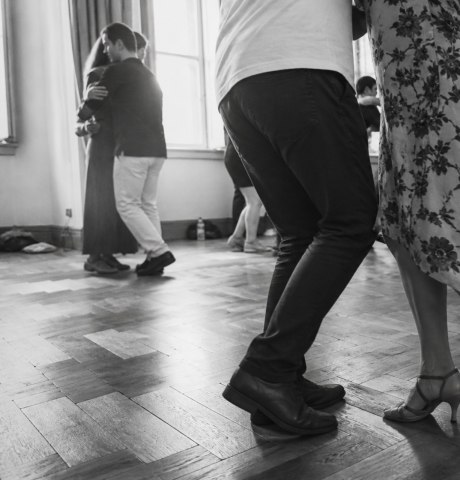
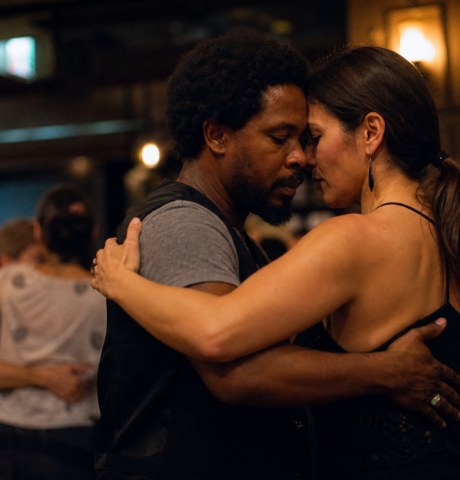
Kizomba focuses on the intimate, calm connection in the upper body. The movements are small, precise, and worked deep into the floor, with partners gliding across the dance floor as one unit.
The freedom of fluid movement
Brazilian Zouk uses the space for dynamic waves, elastic leading over distance, and spectacular head movements. The connection is flexible and stretchy like a rubber band.
The main difference lies in the movement technique and body posture. Kizomba is danced very closely, upright, and grounded, while Brazilian Zouk uses wide turns, body waves, and characteristic head movements.
Brazilian Zouk originates from Rio de Janeiro, Brazil. It emerged there in the late 1980s and early 1990s as a direct evolution of Lambada, after the original Lambada music lost its popularity.
No, although both dances are closely related, they have different step patterns and weight shifts. Kizomba is based on a smooth walk, while Zouk is built on the characteristic three-step rhythm of Lambada.
Find the right course now and learn the fascinating steps of Kizomba and Zouk.
 The history of Kizomba: From its Angolan roots to a global danceDive into the history of Kizomba. Learn how Angolan traditions and Caribbean beats combined to create a global dance phenomenon.
 Learn to dance Kizomba: The guide to the partner danceKizomba combines African rhythms with a deep, emotional connection in partner dance. Learn how to master this fascinating dance style from scratch.The history of Kizomba: From its Angolan roots to a global danceDive into the history of Kizomba. Learn how Angolan traditions and Caribbean beats combined to create a global dance phenomenon.
 Semba and Kizomba: The difference in music and danceDiscover the subtle difference between Semba and Kizomba. We explain how the music defines the dance feeling and movement on the dance floor.
 Understanding Kizomba music: How to hear the rhythmKizomba music has a very special magic. Learn here how to effortlessly pick out the characteristic beat and instruments so you can fully surrender to the music.
 The 5 most important Kizomba music styles comparedDiscover the fascinating variety of Kizomba music: From traditional Semba to the modern Ghetto Zouk beat, we explain the five most important music styles.
 Kizomba Style Quiz: What kind of dancer are you?Find out with our quick self-test whether you are more of a traditional Kizomba dancer or if you feel at home in modern Urban Kiz.
 History of Ghetto Zouk: How the sound changed KizombaGhetto Zouk has taken the Kizomba world by storm. Learn how the fusion of Caribbean rhythms and electronic beats became a global dance trend.
 What is Tarraxinha? Definition and musical rootsTarraxinha shapes the Kizomba world with heavy, electronic beats and a minimalist aesthetic. Learn where this style from Angola comes from and how it changed music.