
Find your dance partner for Kizomba
On udansa you will find like-minded people who share your passion for African rhythms, as well as the right workshops in your city.



By Bernhard De LucaUpdated
On udansa you will find like-minded people who share your passion for African rhythms, as well as the right workshops in your city.
Anyone who understands the difference between Semba and Kizomba grasps the soul of Angolan dance culture. The music dictates every movement: from exuberant joy to deep, intimate connection as a couple.
Semba is a traditional Angolan music and dance style that emerged in the 20th century and is considered the direct rhythmic predecessor of Kizomba. It is characterized by fast, syncopated rhythms and a cheerful, often humorous way of dancing.
To understand the difference between both genres, a look at the Semba dance history helps. Semba originated in Angola and is a lively, extremely cheerful music and dance style. The name is derived from the Kimbundu word Massemba, which means something like belly bump or touching of bellies. Semba music is characterized by a fast tempo, driving rhythms, and the prominent use of traditional percussion instruments, brass, and a rhythmic guitar. The atmosphere is exuberant and festive. If you want to learn how to move to these rhythms, our guide Learning to dance Kizomba: The guide for partner dancing will help you.
Kizomba, on the other hand, only developed in the late 1980s in Luanda. Angolan musicians slowed down the tempo of the fast Semba and mixed it with the then extremely popular Caribbean Zouk. The result was a completely new sound that felt softer, more intimate, and heavier. While Semba radiates a sparkling energy, Kizomba invites you to linger in the moment.

The decisive difference between Semba and Kizomba lies in the musical structure and the energy associated with it. While Kizomba and Semba music share a rhythmic kinship, the emphasis is fundamentally different. Semba music uses a syncopated, driving beat that is often carried by real instruments like congas and acoustic guitars. The rhythm pushes forward and demands a dynamic, bouncy movement on the dance floor.
A traditional Kizomba song, on the other hand, is based on a heavy, electronically produced beat that is borrowed from the Caribbean Zouk rhythm. This beat, often described as boom-chic-chic-boom, is slower and more even. The melodies are often melancholic or romantic and are complemented by soft synthesizer sounds and gentle vocals. This musical deceleration changes the entire dynamic on the dance floor: the movement becomes more fluid, and the focus shifts from the outer show to the inner connection between the couple.
Correct
Wrong
If you don't understand Semba, you will never be able to fully grasp the true depth and roots of Kizomba.
Musical differences are reflected one-to-one in the movement and posture of the dancers. Since Semba music is fast and lighthearted, you dance it with an upright, yet flexible posture. The dance partners keep a slight distance to have room for quick changes of direction, turns, and the typical humorous show elements. Semba is a dance that thrives on spontaneity and often tells a story of courtship and teasing.
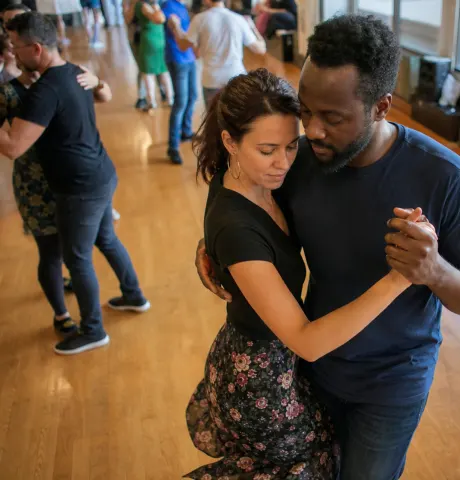
Kizomba demands the exact opposite. Due to the slow, heavy beat, the distance between the dancers shrinks. The connection in the upper body is close and stable, the movements are controlled, fluid, and extremely grounded. There are no hectic turns, but rather a shared, harmonious walking in the rhythm of the music. If you would like to experience these subtle nuances live, you will find the perfect introduction in the community, such as at Kizomba Berlin.
The traditional zest for life of Angola
Semba is pure zest for life. The music is fast, the steps are lively, and the dance thrives on humorous feints and expansive movements across the room.
The modern sensuality of slowness
Kizomba is pure connection. The music is slow and heavy, the embrace is close, and the steps focus on walking together in a meditative way, flowing with the beat.
Semba is significantly faster than Kizomba. While Semba music has a driving, cheerful energy with a high tempo, Kizomba is slower, heavier in the beat, and radiates a calm, sensual atmosphere.
Kizomba emerged in the late 1980s in Angola. Musicians mixed the traditional Semba rhythm with the slower beats of Caribbean Zouk music, which gave birth to the new, softer sound of Kizomba.
Yes, traditional Kizomba is danced in a very close embrace, where chest contact is maintained. Semba, on the other hand, requires a bit more distance between the partners to allow space for the fast steps and playful figures.
Find the right course and learn the difference between Kizomba and Semba directly on the dance floor.
Couple danceLimbach-Oberfrohna · Germany
Silberkurs für PaareSunday · 16:15 · Oct 25 - Nov 15
Limbach-Oberfrohna
Couple danceLimbach-Oberfrohna · Germany
PaartanzkreisSunday · 16:30 · Oct 25
Limbach-Oberfrohna
 Learn to dance Kizomba: The guide to the partner danceKizomba combines African rhythms with a deep, emotional connection in partner dance. Learn how to master this fascinating dance style from scratch.
 Kizomba in Berlin: Guide to dance styles, courses, and socialsKizomba inspires with close connection and musical depth. This guide explains styles, course selection, and how to start dancing for everyone who wants to dance Kizomba in Berlin.
 The history of Kizomba: From its Angolan roots to a global danceDive into the history of Kizomba. Learn how Angolan traditions and Caribbean beats combined to create a global dance phenomenon.
 Understanding Kizomba music: How to hear the rhythmKizomba music has a very special magic. Learn here how to effortlessly pick out the characteristic beat and instruments so you can fully surrender to the music.
 The 5 most important Kizomba music styles comparedDiscover the fascinating variety of Kizomba music: From traditional Semba to the modern Ghetto Zouk beat, we explain the five most important music styles.
 Kizomba Style Quiz: What kind of dancer are you?Find out with our quick self-test whether you are more of a traditional Kizomba dancer or if you feel at home in modern Urban Kiz.
 History of Ghetto Zouk: How the sound changed KizombaGhetto Zouk has taken the Kizomba world by storm. Learn how the fusion of Caribbean rhythms and electronic beats became a global dance trend.
 What is Tarraxinha? Definition and musical rootsTarraxinha shapes the Kizomba world with heavy, electronic beats and a minimalist aesthetic. Learn where this style from Angola comes from and how it changed music.
 Kizomba in Cape Verde: The influence of Passada and ColadeiraKizomba has roots beyond Angola. Learn how the Cape Verdean styles Passada and Coladeira shaped the dance with their elegance and melancholy.