Latin technique5 minutes

Learn Cuban hip movement: The knee technique

In short
  • The Cuban hip movement is not created by muscle power in the pelvis, but is the passive result of precise footwork.
  • By fully extending the knee on the standing leg, the hip on that side is automatically pushed back and up.
  • The knee of the free leg remains slightly bent, which causes that side of the hip to sink forward and down.
  • Only the rhythmic interplay of the extended standing leg and the bent free leg creates the typical Latin American pelvic tilt.

Forget about artificially circling your hips on the dance floor. If you really want to master Cuban hip movement, you have to learn to use your knees as a mechanical engine for your entire lower body.

DefinitionCuban hip motion

Cuban hip motion describes the characteristic, lateral and rotating pelvic movement in Latin American dances. It is created by the rhythmic, staggered straightening and bending of the knee joints during weight transfer.

Why the hip is only the end of the movement

Anyone seeing Latin American dances for the first time is fascinated by the seemingly effortless, wave-like movement in the pelvic area. Many beginners try to create this effect by actively circling, pushing, or isolated wiggling of the buttocks. However, the result usually looks wooden, unnatural, or exaggerated. The secret is that a clean Latin American hip movement technique never starts in the pelvis itself. The hip is merely the end point of a kinetic chain that begins right at the floor and is significantly controlled by the work of your joints.

If you want to learn Cuban hip movement, you must shift your focus away from the hip and toward your knees. The hip reacts passively to what your legs are doing. As soon as you try to move the pelvis in isolation, you block your spine and lose your balance. Only through the coordinated interplay of bending and extending the knee joints at the moment of weight transfer does the typical, fluid dynamic in the pelvis emerge all by itself.

Only the precise interaction between the extended standing leg and the bent working leg creates the characteristic tilt of the pelvis.

The knee mechanics of walking in detail

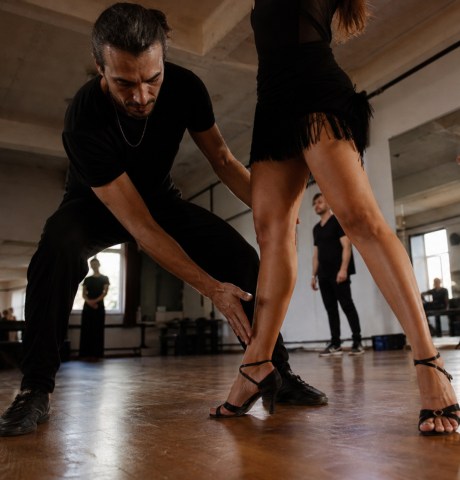
To understand the mechanics, let's look at the sequence of a single step in detail. When you shift your weight onto one leg, you must fully and actively straighten that knee. Through this extension, the thigh bone pushes upward and automatically pushes the hip on the side of the standing leg backward and upward. The knee of the free leg, which carries no weight, remains slightly bent during this process. As a result, the hip side of the free leg sinks forward and downward.

This mechanical principle applies equally to both major dances of the world dance program. If you want to move your Rumba hip, you use this knee extension for slow, melting weight shifts, where the hip describes a continuous figure-eight. For the lively Cha-Cha-Cha hip movement, however, you use the same knee technique at a significantly faster, sharper frequency. The foundation remains identical: without a fully straightened standing leg knee, there is no real Cuban hip movement.

Knee work for clean hip movement

Correct

  • Fully extend the knee of your standing leg with every step
  • Keep the knee of your free leg softly bent forward
  • Shift one hundred percent of your weight onto your standing foot
  • Control the movement slowly in front of the mirror

Incorrect

  • Keep your knees slightly bent when shifting weight while standing
  • Straighten or tense both legs at the same time
  • Leave your weight incompletely distributed between your legs
  • Rotate your hips actively and in isolation using muscle power

In Latin dance, the hip is just the passenger, the engine of the entire movement is located in the feet and the knees.

Dance instructor, Düsseldorf

From conscious stretching to a fluid dance flow

The most common mistake when practicing is the so-called soft knee on the standing leg. If the knee of the weighted leg remains even minimally bent, the pelvis stays horizontal and the typical tilt does not occur. Experienced dancers refer to this as incomplete weighting. Only when the body weight is one hundred percent over the straightened standing leg can the hip shift maximally to the back, while the other knee points softly forward.

To anchor this coordination in your muscle memory, it helps to perform the steps extremely slowly and without music at first. Focus exclusively on the moment when the front knee locks and the hip pushes back with every step. Only when this movement sequence is fluid should you increase the tempo. Over time, you will notice how your balance improves and your movements on the dance floor gain elegance and expressiveness.

Two knees in permanent mechanical contrast

Stretching

The supporting leg

Blocking and lifting the hip on the supporting leg side

The knee is fully extended at the moment of full weight transfer. This mechanically pushes the hip on that side upwards and backwards, providing stability in your stance.

Bending

The free leg

Lowering the hip on the side of the free leg

The knee remains relaxed and slightly bent forward. The hip on this side sinks forward and down, which creates the maximum contrast to the stretched side and adds dynamics.

Frequently Asked Questions

  1. No, the hips do not move by themselves. The movement is a purely passive reaction to the straightening of the standing leg knee and the bending of the free leg knee during weight transfer.

Book Latin dance courses near you

Find the right dance course on udansa now and take your technique to the next level.

View all matching courses

Find your partner for Latin motion

On udansa, you will find like-minded people who want to work on the perfect Latin motion with you, as well as top-class workshops in your area.

Find your partner for Latin motion