Experience Latin technique together
On udansa you will find like-minded people and the right dance courses in your region to refine your partner dance technique step by step. Sign up and discover the joy of harmonious movement on the dance floor.


Latin American dances fascinate with their zest for life and rhythmic elegance. With an understanding of the correct body mechanics, you transform simple steps into expressive movements.
Latin Motion refers to the typical hip and body movement in Latin American dances, which is created by the interplay of footwork, knee extension, and weight transfer.
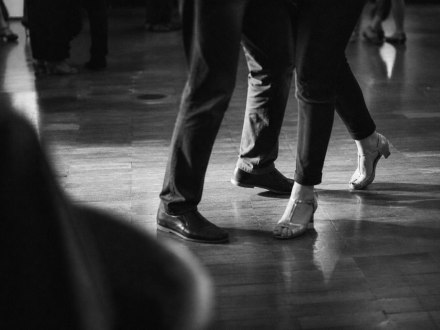
The typical movement in Latin American dances does not come from wild hip circling, but is the direct result of precise footwork. Anyone who wants to learn Latin Motion must understand how body weight is shifted. Every step begins with the ball of the foot before the heel is lowered in a controlled manner. Only when the weight is fully transferred to the new standing leg does the knee straighten, causing the hip on that side to move naturally backward and outward. This coordinated footwork Latin American dances ensures the typical, rhythmic flow without the movement appearing artificial.

A stable yet flexible Latin dance posture differs fundamentally from ballroom dances. In Latin, partners stand at a slightly greater distance from each other to leave room for dynamic turns and solo passages. The connection is maintained primarily through the hands and body tension. Good Latin dance technique for couples is characterized by the fact that both dancers maintain their own balance, instead of supporting each other. The arms act as elastic shock absorbers that transmit signals smoothly without appearing rigid. This allows for sensitive coordination, even during quick changes of direction.
Vertical alignment is particularly important: the spine remains long, the shoulders are relaxed and low, and the body weight is shifted slightly forward towards the partner. This permanent readiness in the body's center forms the foundation for every successful figure in the world dance program.
Practice shifting your weight for Latin motion slowly at a wall or ballet barre first, to get a feel for the interaction between your knees and hips, before you try it with a partner.
Good Latin technique starts in the floor. Anyone who uses the pressure of their feet correctly gets hip movement and balance as a gift.
A successful leading technique in Latin dances is based on the principle of action and reaction through physical connection. Leading in Latin dance does not mean pulling or pushing your partner into a position with muscle power. Instead, the leader initiates the movement from their own body center. This weight shift is transferred via the established body tension directly to the hands and signals the direction and tempo of the next step to the person following.
If you want to harmonize smoothly at socials or in class, use udansa to find partners who place the same focus on a clean connection. When both dancers maintain basic core tension, dancing together becomes an effortless dialogue where even demanding turns in Cha-Cha-Cha or Rumba succeed with ease.
Setting impulses from the body center
The leader gives clear, physical impulses from the center and keeps the connection stable, without restricting or pulling the partner.
Feeling signals and actively implementing them
The follower maintains body tension, picks up signals sensitively, and implements them into their own steps without delay.
Hip movement in Latin dance is created by the controlled lowering of the heel and the subsequent straightening of the knee on the standing leg. Never try to rotate your hips in isolation, as this looks unnatural and throws you off balance.
Find the right course now to improve your Latin dance technique as a couple.
Sunday · 14:30-16:00 · Nov 15, 2026 - Jan 17, 2027
Limbach-Oberfrohna
Sunday · 14:30-16:00 · Sep 6 - Nov 8
Limbach-Oberfrohna
Sunday · 14:30-16:00 · Nov 15 - Nov 29
Limbach-Oberfrohna