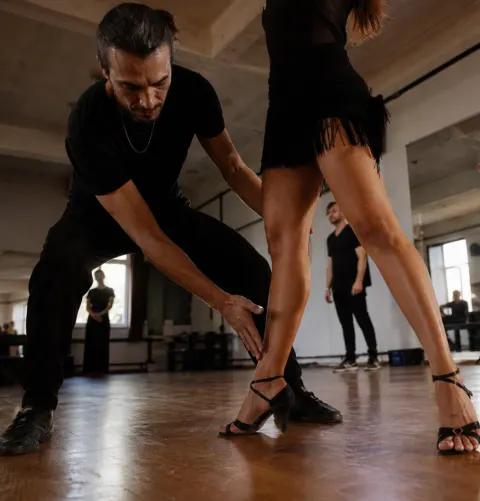
Find your dance partner for Latin dance
Find like-minded people on udansa who want to work on the perfect connection with you and share the fascination of Latin dances.

By Mary De LucaUpdated
Find like-minded people on udansa who want to work on the perfect connection with you and share the fascination of Latin dances.
When you understand the lead blindly while dancing, you feel your partner without looking. It is only through the subtle interplay of push and pull that two individual dancers become a harmonious unit on the dance floor.
The physical connection is the foundation of every successful partner dynamic. If you want to learn to lead and follow Latin dances, simply memorizing step sequences is not enough. Only through the conscious control of pressure and tension does a silent dialogue emerge, in which every weight shift of the leader is transferred to the follower without delay. This connection primarily runs through the torso and is translated by the arms and hands like an elastic band. This prevents movements from appearing mechanical or stiff.
The Latin dance leading technique is based on the principle of action and reaction. The leader initiates the movement from their own core, which minimally increases the pressure in the hand connection. The follower picks up this impulse, maintains body tension, and reacts with a corresponding evasive or following movement. Without this elastic basic tension, the so-called tonus, the signal fizzles out. It is therefore crucial to neither keep the arms completely stiff nor let them hang limply.

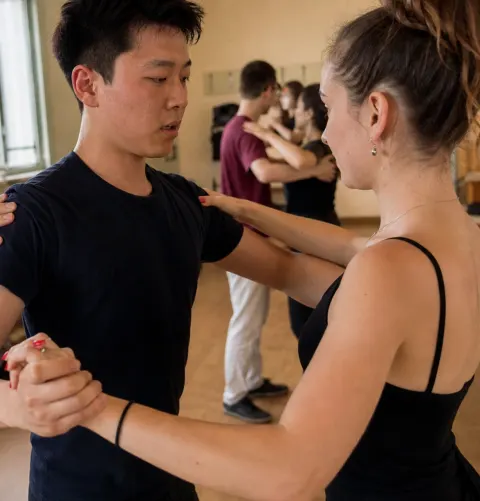
Build a loose hand connection where the fingers interlock slightly like two loose hooks. The palms touch gently, without the fingers gripping tightly.
Pull your shoulder blades slightly back and down and stabilize your core. Keep your elbows slightly in front of your body to form a flexible bridge for energy transfer.
Apply minimal pressure against your partner's palm, as if you were squeezing a soft feather. Your partner resists without changing the position of their arms.
Now switch to a light tension, as if you wanted to gently lean away from each other. Here too, body tension absorbs the pull elastically, without the arms being pulled long.
The leader takes a step back and gently brings the follower along through the tension contact. The movement is started in your own body center before it reaches the hands.
Learn the right leading technique directly from experienced instructors in your area.
Couple danceBurgstädt · Germany
Paarkurs - Boogie & Rock'n'Roll - ClubTuesday · 19:00 · running since Nov 10
Burgstädt
BallroomMeissen · Germany
Tanzkreis | PROFESSIONALThursday · 19:20 · Jan 7 - Mar 25, 2027
"Atelier Federleicht" - Saal Tanzkurse
Couple danceBurgstädt · Germany
Bronzekurs für PaareTuesday · 20:00 · Nov 10 - Nov 24
Burgstädt
Correct
Wrong
Preparation
During
Ideally, the lead feels like an elastic rubber band. There is neither slack nor rigid blocking, but a constant, light resistance in the hands.
The follower builds tension by offering a gentle, controlled resistance to the pressure or pull of the leader. The arms remain elastically bent at the joints.
The power for the lead always comes from the movement of your own body center and hips. The arms merely serve as a stable transmitter of this energy.
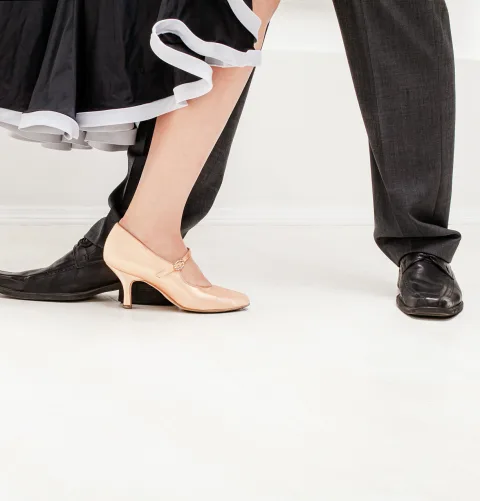 Latin Dance Technique: Mastering Latin Motion
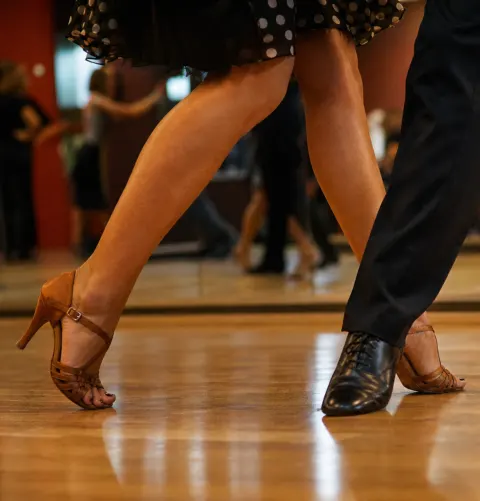 Rumba vs. Cha-Cha-Cha: Body Mechanics Compared
 Latin dance footwork: Mastering the roll
 Mastering Cuban hip motion: The knee technique
 Latin Dance: Mastering Body Tension
 Building a Latin Dance Frame: Stable Partner Connection
 Latin Dance Technique Test: How clean is your dancing?