Dance technique4 minutes

Rumba vs Cha-Cha-Cha: Comparing body mechanics

By Mary De LucaUpdated

In a nutshell
  • Rumba uses a delayed weight shift, where the weight only transfers to the standing foot after the actual step.
  • Cha-Cha-Cha requires an immediate weight transfer at maximum speed, especially during the fast chassés.
  • In Rumba, hip movement remains in a continuous flow, while in Cha-Cha-Cha it is accentuated by abrupt changes in direction.
  • Both dances are based on a 4/4 time signature, but they create completely different dynamics through their contrasting footwork.

Anyone who dances Rumba and Cha-Cha-Cha immediately feels the contrast between sensual delay and lively speed. However, only a look at the bare body mechanics reveals why both dances feel so fundamentally different.

DefinitionLatin Motion

Latin Motion describes the typical hip and body movement in Latin American dances. Anatomically, it is created by the rhythmic bending and stretching of the knees in combination with a controlled weight transfer over the balls of the feet.

Rumba: The art of delayed weight transfer

Anyone who dares to make a direct comparison will quickly notice: Rumba is a dance of delayed weight transfer. While the rhythm flows in a slow four-four time, the footwork consciously lags behind the beat. A step is initiated on the first heartbeat of the bar, but the full weight only shifts on the second beat. This conscious delay creates an enormous internal tension. Every movement thus appears weightless and powerful at the same time. To execute this Rumba dynamic with technical precision, you must learn to extend the free leg with extreme control before the body follows. A common mistake is to push the pelvis over the new standing foot too early. This robs Rumba of its typical, almost floating elegance and makes the dance appear hectic.

Cha-Cha-Cha: Lightning-fast weight transfer in the chassé

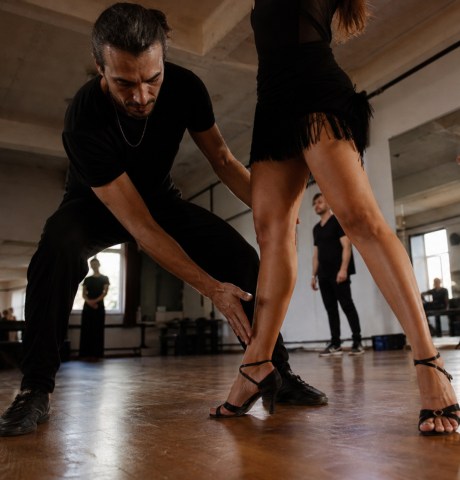
The Cha-Cha-Cha breaks radically with this stretched-out calm. Here, the principle of immediate power transmission reigns. The famous chassé step on the counts four-and-one demands a lightning-fast body movement, where the weight snaps from one foot to the other without any delay. Every time the ball of the foot touches the floor, the corresponding knee must be straightened immediately to bring the hip into the typical Latin American movement. This speed requires a completely different muscle tension in the core than the soft Rumba. When you try out the New Yorker dance figure guide, you will feel this difference immediately: In the Cha-Cha-Cha, the lunge is sharp and crisp, while in the Rumba, it fades away softly.

How to master the perfect Latin technique

Correct

  • Fully extend the knee of the standing leg before shifting your weight
  • In Rumba, consciously delay shifting your weight onto the foot
  • In Cha-Cha-Cha, dance the chassé with precise timing on 4-and-1

Wrong

  • Creeping across the dance floor with bent knees
  • Letting your weight hang backwards uncontrollably in Cha-Cha-Cha
  • Rotating your hips uncontrollably without using footwork

Rumba is the breathing between the steps, while Cha-Cha-Cha is the heartbeat that drives you forward unstoppably.

Latin dance instructor, Duesseldorf

The center of the body as the control center of dynamics

To clearly distinguish between both dances, you need to target your center of the body. In Rumba, the muscles work in a continuous, circular loop. The hip movement never stops, it flows from one corner of the pelvis to the other. In Cha-Cha-Cha, however, this flowing movement is literally chopped up by the fast chassés. Here, soft rotations alternate with abrupt stops. Anyone who masters these fine nuances of footwork can switch between styles without stumbling. To train this effectively, regular solo practice is worthwhile. You can find valuable suggestions for this in the guide Practicing Latin dance solo, which shows you how to strengthen your balance and body control even without a partner.

Two worlds of Latin footwork

Rumba

The soft delay

Continuous flow in four-four time

The principle of gliding dominates here. The feet maintain permanent close contact with the floor, while the weight shift takes place with an extreme delay. This creates the typical, almost floating sensuality.

Cha-Cha-Cha

The lightning-fast action

Sharp precision in the Chassé rhythm

Absolute liveliness prevails here. The weight transfer occurs directly onto the balls of the feet without any delay. The Chassé demands extremely fast, precise knee actions in the exact four-four time.

Frequently Asked Questions

  1. In Rumba, the weight is shifted with a delay only after the foot has been placed, while in Cha-Cha-Cha, it is transferred immediately and without delay to the new standing foot. This fundamentally changes the entire dynamics of the dance.

Latin courses near you

Find the right dance course now to take your technique to the next level.

View all matching courses

Find your dance partner for Latin

On udansa connect you will meet like-minded people who share your passion for Latin American dance moves. Find your perfect dance partner for the next course and polish your footwork together.

Find your dance partner for Latin