Latin technique4 minutes

Latin spinning technique: Learn stable turns as a couple

By Mary De LucaUpdated

In short
  • Stable turns in a couple require an exactly balanced shared center of gravity in the center of the connection.
  • The dance frame must be stable enough to transmit impulses without loss, without the arms locking up.
  • The body weight is kept constantly centered over the ball of the standing foot during the turn.
  • Targeted spotting with your gaze on your partner stabilizes your balance and secures your alignment.

Fast turns in partner dance fascinate with their dynamics and elegance. However, it is only the physical interplay of centrifugal force, a shared axis, and stable body tension that makes Latin American partner turns controllable and effortless.

DefinitionLatin turn technique for couples

Latin turn technique for couples describes the coordinated interaction between two dance partners to stabilize their shared center of gravity during rotations. Centrifugal forces are utilized in a controlled manner through targeted body tension and a precise frame connection.

The shared center of gravity as the foundation of the turn

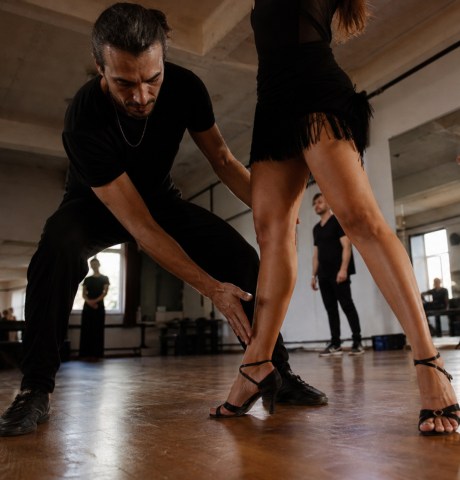
When a dance couple turns in Latin dance, strong physical forces are at play. Without a clear understanding of the shared center of gravity, the movement quickly becomes unstable. The most important foundation of Latin American turning technique as a couple is the realization that your own axis must adapt to your partner at the moment of the turn. Instead of moving independently through the space, a dynamic unit is created, which is stabilized by a precisely balanced counterweight.

To achieve this stability, both partners must activate their own core. In fast turns, the shared center of gravity usually lies exactly in the center of the connection. This means that neither the leader nor the follower should leave their own axis uncontrollably. Anyone who leans too far back or leans into their partner disrupts the delicate balance. Only through constant, sensitive tension in the torso does it become possible to absorb centrifugal forces and finish the turn in a controlled manner.

Connection and frame as impulse transmitters

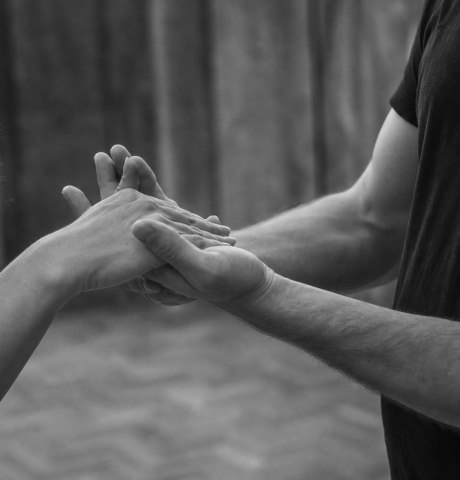
Especially with fast turns, as they are typical for cha cha cha turn technique, the quality of the connection determines success or failure. A common misconception is that the leader has to physically pull the follower around. In truth, a stable turn is based on a precise impulse that is transmitted via a clearly defined frame. Soft, yielding arms absorb the energy instead of transmitting it, which leads to an immediate loss of balance.

However, a stable Latin frame does not mean locking the joints. The elbows remain elastic, while the shoulder blades are pulled stably downwards. This creates a firm, yet adaptable connection. When the impulse for the turn occurs, the entire body moves as a compact unit. This way, the distance between the partners remains constant, and centrifugal force can be used optimally to accelerate the turn without the couple drifting apart.

Master stable turns

Correct

  • Keep your frame elastic but stable
  • Center your weight over the balls of your feet
  • Use your partner as a focal point
  • Generate the rotational momentum from your core

Wrong

  • Fully extending or bending your arms
  • Falling back onto your heels
  • Looking around the room without focus
  • Pulling on your partner with your arms

A stable turn in a couple is not a question of strength, but the result of perfect timing and an elastic connection that secures the shared center of gravity.

Latin dance instructor, Düsseldorf

Control and spotting during rapid changes of direction

While fast dances like the Cha-Cha-Cha require explosive turns, the rumba turning technique balance demands the highest level of control during deceleration. Here, it is about executing the turn with extreme control and maintaining balance over several beats. The secret lies in the placement of the standing leg. The foot must be anchored flat and firmly on the floor, while the body weight is positioned exactly over the ball of the foot.

To prevent swaying or tipping over at the end of the turn, experienced dancers use the principle of spotting. The eyes fixate on a point at eye level for as long as possible before the head is snapped around quickly at the end of the turn. In partner dancing, the partner often serves as this focal point. This not only stabilizes the sense of balance, but also ensures that the partners are perfectly aligned with each other again immediately after the turn and can fluidly initiate the next movement.

Two roles for a perfect rotation

Leading

Stabilizing the axis

The initiator and the steady anchor

The leader stabilizes the couple's axis by providing a reliable frame and initiating the rotational impulse precisely at the right moment, without pulling the partner off balance.

Following

Implementing the impulse

Dynamics and precise execution

The follower maintains her own core tension, uses the transferred impulse for a clean solo turn, and regulates the speed through the placement of her standing leg.

Frequently Asked Questions

  1. For close turns, the shared center of gravity is usually exactly in the middle of the line connecting the partners. Both must stabilize themselves slightly against centrifugal force without pulling or pushing each other.

Latin courses near you

Find the right course on udansa now and polish your turning technique.

View all matching courses

Find your dance partner for stable turns

On udansa you will find like-minded people who want to work on the perfect balance with you, as well as top-class dance courses and workshops nearby to take your Latin turn technique to the next level.

Find your dance partner for stable turns