Dance technique5 minutes

Sway in ballroom dancing: How to master the elegant body inclination

In a nutshell
  • The sway in ballroom dancing is a coordinated body inclination that balances centrifugal force in turns during swing dances, such as the Slow Waltz.
  • The inclination is always initiated from the feet and ankles and extends as a straight line through the entire body up to the head.
  • Bending at the waist should be avoided, as it disrupts the dance couple's shared balance and makes the posture unstable.
  • The sway usually reaches its peak synchronously with the highest point of the rise at the end of a swing step.

The perfect body inclination in ballroom dance gives your steps a breathtaking dynamic. Learn here how to execute the sway technique cleanly, without losing your posture or the balance with your partner.

DefinitionSway

In ballroom dancing, sway refers to the controlled inclination of the entire body from the vertical position towards the inside of a turn. This movement serves to balance centrifugal force and to visually emphasize the momentum.

The physics of elegant leaning in partner dance

Anyone watching couples in the Slow Waltz or Quickstep will quickly notice a fascinating dynamic. In the curves, the dancers' bodies lean elegantly to the side, almost like motorcyclists in a banked turn. In the sway technique of ballroom dancing, we call this phenomenon sway. It is a controlled, aesthetic body lean that is much more than just decoration. It arises quite naturally from the forward movement and the momentum of the couple. Anyone who masters this movement gives their dance a weightless look and simultaneously improves their own balance.

It is often wrongly assumed that you simply have to bend at the waist for the sway. However, that is the surest way to destroy the carefully established distance between partners and the common axis. A correct body lean in ballroom dancing is characterized by the fact that the entire body leans from the feet upwards like an unbroken line. The spine remains long and stable, while the stretch comes from the flanks and the hips. Only in this way does the connection to the partner remain harmonious and stable.
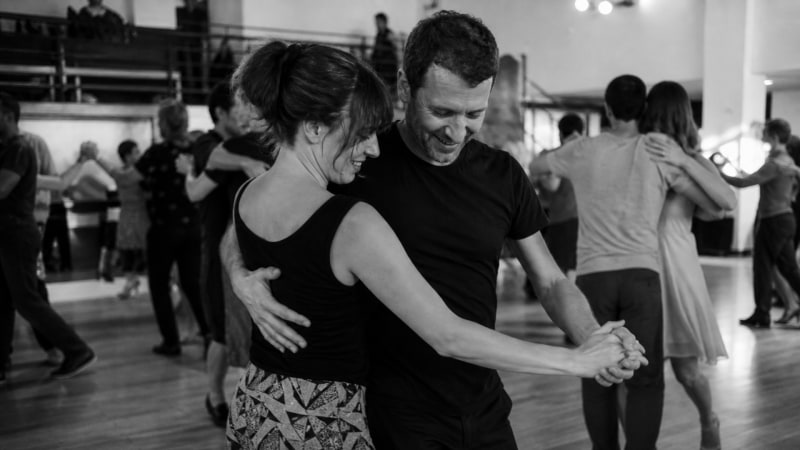
The perfectly coordinated body tilt creates the feeling of floating in swing dances.

How inclination arises in the flow of movement

To correctly execute inclination in space, we must look at how movement originates. A classic example is the Sway in the Waltz, where the inclination usually reaches its peak on the second and third step of a turn. The sway is always executed towards the inside of the curve to compensate for the centrifugal force at work. When you dance a natural turn, your body tilts slightly to the right to elegantly catch the movement and prepare for the next step.

An important key to flawless execution lies in coordination with other techniques. The sway is inextricably linked to rise and fall. As you push upwards onto the ball of your foot, the inclination unfolds in the upper body. A good guide here is the orientation in space in ballroom dancing, as the gaze and the alignment of the head significantly support the inclination. The head always remains on the left side of your own body and follows the line of inclination without bending.

How to master the sway without errors

Correct

  • Build the inclination from the ankles
  • Keep the spine long and stretched
  • Hold the head stable as an extension of the spine
  • Connect the movement fluidly with the lift

Incorrect

  • Bending sideways at the waist
  • Letting your posture collapse in the pelvis
  • Tilting your head unnaturally to the side
  • Forcing the tilt with a jerk

A perfect sway feels like flying in a gentle curve. It must never appear forced, but rather emerge from the pure movement.

Dance instructor, Hamburg

Practical approaches for harmonious gliding

If you want to improve your movements in ballroom dance, you should focus on your feet and legwork. Any tilt in the upper body is only as good as the foundation it stands on. The movement begins in the ankle and knee of the standing leg. By pushing into the floor, you propel your hip diagonally upwards. This energy continues through the entire torso and creates the visible stretch in the flank.

To get a feel for this fluid movement, it helps to practice the sequence in the room without a partner first. Focus on how your ribcage opens on one side while the other side remains compact and stable. For the finishing touches and gliding together, targeted training is recommended, just as it is practiced in conditioning for ballroom dancers. With a little patience, the sway will turn from a conscious muscular effort into an intuitive feeling of pure flow.

Comparing two ways of body leaning

Body line

The extended flank

The unbroken diagonal in space

The body tilts as one continuous, long line from the feet to the crown of the head. The hip actively pushes into the movement and the spine remains stably extended.

Collapse

Collapsing in the pelvis

The most common posture mistake during sway

The upper body collapses at the waist to force a tilt. As a result, body tension is lost and the couple's shared frame collapses.

Frequently asked questions

  1. Sway is used in the classic swing dances. These include Waltz, Viennese Waltz, Quickstep, and Foxtrot. In Tango, it is not used because of the flat, walking character of the dance.

Standard dance courses near you

Learn the perfect technique directly on the dance floor.

View all matching courses

Find your dance partner for elegant sway

Whether you want to deepen the basics of Waltz or try out advanced techniques: on udansa you will find like-minded people and the right courses in your area.

Find your dance partner for elegant sway