Breakdance basics4 minutes

Shoulder freeze in breakdance: A guide for beginners

In a nutshell
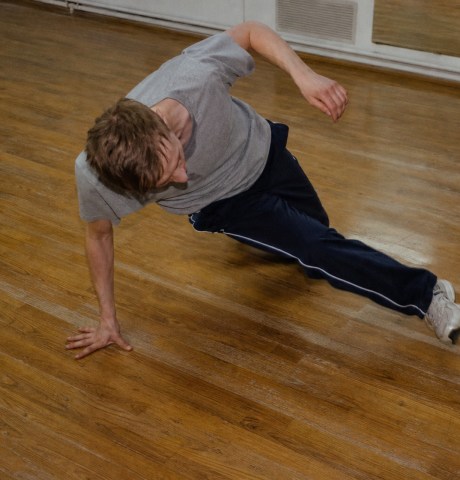
  • The shoulder freeze is a fundamental holding pose in breakdance, where the body weight rests on one shoulder, the side of the head, and both hands.
  • The stability of the position is achieved by forming a clean triangle with the support points on the floor and aligning the pelvis over the center of gravity.
  • Beginners learn the movement sequence most safely from a kneeling position to gradually increase the load on the shoulder.
  • Regular training of the neck and shoulder muscles prevents injuries and ensures the necessary balance for holding the pose.

The shoulder freeze is your entry into the world of breakdance freezes. With the right technique, you use the physics of your body instead of laboriously hoisting yourself up with pure muscle power.

What you need for training

  • Sufficient space on a non-slip floor
  • Warmed-up neck and shoulder muscles
  • Basic core tension in the torso area
  • Comfortable sportswear without annoying hoods or zippers

Why the shoulder freeze is the perfect foundation

The shoulder freeze is one of the absolute foundations when you start breaking. It forms the bridge between floor-level steps, so-called footwork, and your first impressive static poses. Unlike extremely energy-intensive power moves or the kick down in breaking, this freeze primarily requires a good sense of your own axis and the correct weight distribution. You use your own body as a stable triangle, where your head, shoulder, and hands form the foundation on the floor.

Many beginners make the mistake of trying to push themselves into the air with pure muscle power. With the shoulder freeze, however, it is much more about shifting the center of gravity of your pelvis in a controlled manner over your support surface. As soon as you have found this balance point, the position feels surprisingly light. A solid warm-up of the neck and shoulder muscles is mandatory before you venture your first attempts, in order to avoid tension.

5 steps to a stable shoulder freeze

  1. Place your shoulder on the floor

    Get on your knees and place your hands on the floor about shoulder-width apart in front of you. Place your strong shoulder, the one you want to learn the freeze on, in a controlled manner on the floor between your hands.

  2. Rest head on the side

    Gently rest your temple or the side of your head on the floor. Your head serves only as an additional support for balance, it must never carry your entire body weight.

  3. Build a support triangle

    Place your hands so that they form a stable, wide triangle together with your shoulders and your head. Point your fingers slightly outwards to provide optimal support.

  4. Push your pelvis upwards

    Slowly lift your knees off the floor and walk your feet closer to your upper body. This automatically pushes your pelvis upwards over your shoulder axis.

  5. Lift and balance your legs

    Carefully lift one foot and then the other off the floor. Bend your legs and keep them close to your body to stabilize your balance at the center of gravity and breathe calmly.

Safety and stability in comparison

Like this

  • Keep the main weight on your shoulder
  • Place your hands flat to support yourself
  • Push your pelvis over your shoulder in a controlled manner
  • Warm up your neck well before every attempt

Don't do this

  • Press your entire weight onto your head
  • Let your elbows buckle outwards uncontrollably
  • Jump into the position with momentum and haste
  • Continue training despite neck pain

An overview of your freeze training process

Before training

Preparation

While executing

During

After training

Follow-up

Frequently Asked Questions

  1. You should be able to hold the shoulder freeze stably for about 3 to 5 seconds at the beginning. As soon as your balance is secure, you can gradually increase the hold time in your training to 10 seconds or more.

Breaking courses near you

Find the right course and learn the basics directly from experienced instructors.

View all matching courses

Find your crew on udansa

Here you can meet other b-boys and b-girls in your area to work on your freezes together, exchange experiences, and strengthen your basics in training.

Find your crew on udansa